

Irish Red and White Setter
The Irish Red and White Setter is a striking, energetic sporting dog with a rich history, a friendly personality, and a natural enthusiasm for life outdoors. Distinguished by its beautiful white coat with rich red patches, this athletic Irish breed combines the instincts of a dedicated bird dog with the affectionate nature of a devoted family companion. Although less familiar than the solid-red Irish Setter, it has an equally fascinating heritage and a loyal following among hunters and dog enthusiasts. Intelligent, spirited, and remarkably capable in the field, the Irish Red and White Setter is a breed that thrives when its physical abilities and desire for companionship are fully appreciated.

The breed’s roots stretch back several centuries, to a time when Irish sportsmen relied on skilled setting dogs to locate game birds across challenging countryside. Long before the familiar solid-red Irish Setter became fashionable, red-and-white dogs were valued for their stamina, reliable noses, and ability to work closely with hunters. Their contrasting coat colors also helped make them visible among grasses, heather, and rough vegetation. Despite once approaching extinction, dedicated breeders preserved the Irish Red and White Setter, allowing today’s dogs to retain much of the character and working ability that made their ancestors so valuable.
In appearance, this is a handsome, balanced dog with a strong, athletic frame and an unmistakable coat. Compared with the Irish Setter, the Irish Red and White Setter is generally somewhat shorter and sturdier, reflecting its traditional emphasis on practical field performance. Its predominantly white coat features distinct red patches, while feathering around the ears, chest, legs, and tail provides an elegant finish without the excessively flowing appearance sometimes associated with other setters. Beneath that attractive exterior is a powerful, energetic dog built for endurance rather than a sedentary lifestyle.
Personality is another major attraction. Irish Red and White Setters are generally cheerful, affectionate, and enthusiastic about spending time with their families. Many are playful companions who enjoy participating in household activities and forming close relationships with their owners. They can also possess an independent streak, especially when an interesting scent or the movement of wildlife catches their attention. Their intelligence and willingness to cooperate make training rewarding, but successful owners understand the importance of patience, consistency, and engaging activities.
Living with this breed means providing more than occasional neighborhood walks. Irish Red and White Setters need substantial daily exercise, opportunities to explore, and mental stimulation that engages their natural hunting instincts. Hiking, scent games, retrieving activities, and appropriate canine sports can all help satisfy these needs. A securely fenced yard is useful, although it cannot replace meaningful exercise and interaction. When adequately exercised, many settle comfortably into family life and enjoy quieter moments with the people they love.
For active households seeking an affectionate sporting companion, the Irish Red and White Setter offers an appealing combination of beauty, enthusiasm, and loyalty. However, its energy, hunting drive, and need for human involvement make it less suitable for owners wanting a low-maintenance or largely sedentary pet. Understanding the breed’s heritage, exercise requirements, grooming needs, and health considerations is essential before making a long-term commitment.

Table of Contents
Irish Red and White Setter Fast Facts
Breed Group: Sporting
Origin: Ireland
Height: Males 24.5–26 inches; females 22.5–24 inches
Weight: Males 42–60 pounds; females 35–50 pounds
Life Expectancy: 11–15 years
Size: Medium to large
Coat: Medium-length, predominantly white with solid red patches and silky feathering
Coat Care: Moderate; regular brushing and occasional bathing
Shedding: Moderate
Exercise Needs: High; substantial daily physical activity and mental stimulation
Temperament: Friendly, spirited, affectionate, intelligent, and determined
Primary Role: Bird hunting, pointing, and active companionship
Irish Red and White Setter Star Ratings
Apartment Friendly: ★★☆☆☆
Family Friendly: ★★★★★
Good With Children: ★★★★☆
Good With Other Dogs: ★★★★☆
First-Time Owner Friendly: ★★☆☆☆
Easy Grooming: ★★★★☆
Affectionate: ★★★★★
Easy to Train: ★★★★☆
Low Shedding: ★★☆☆☆
Adaptable: ★★★☆☆
High Exercise Needs: ★★★★★
Tolerates Being Alone: ★★☆☆☆
Irish Red and White Setter History and Origins
The Irish Red and White Setter has one of the most remarkable histories of Ireland’s native sporting breeds. Although overshadowed today by the more familiar solid-red Irish Setter, this distinctive bird dog represents an older tradition of Irish setting dogs, developed for their exceptional scenting ability, stamina, and reliability in the hunting field. Its survival is particularly significant because the breed came dangerously close to disappearing before determined enthusiasts began rebuilding its population during the twentieth century.
The origins of the Red and White Setter can be traced back several centuries, with recognizable red-and-white setting dogs established in Ireland by the 1600s. These early dogs belonged to a broader tradition of European hunting dogs developed to locate game birds by scent. Before firearms became widely used for bird hunting, setters were trained to approach concealed birds carefully and crouch or remain motionless, allowing hunters to move forward and capture the game using nets. This characteristic behavior gave the setter its name and became the foundation of the pointing instincts still evident in the breed today.
Ireland’s challenging countryside shaped the development of these dogs. Hunters needed companions capable of negotiating boggy ground, rocky hillsides, heather-covered moorland, and expansive grasslands while remaining attentive to their handlers. Dogs that could work for extended periods, locate birds reliably, and maintain a steady point were particularly valuable. The red-and-white coat also offered a practical advantage, making the dog easier to distinguish against darker vegetation and uneven terrain.
During the eighteenth and early nineteenth centuries, red-and-white setters were maintained by several prominent Irish sporting families. The Rossmore family of County Monaghan became especially associated with preserving a recognizable strain of these dogs. Their setters were admired for their working ability, and the family’s breeding tradition would later prove important to the breed’s survival. At this stage, coat color was not always treated as the defining distinction it would become. Red-and-white and predominantly red dogs could share related ancestry, with breeders frequently placing greater importance on field performance than appearance.
The breed’s fortunes changed dramatically during the nineteenth century. Solid-red Irish Setters became increasingly fashionable, particularly among wealthy enthusiasts and dog-show exhibitors. Their elegant appearance attracted attention both in Ireland and abroad, encouraging breeders to concentrate on producing consistently red coats. The formation of the Red Setter Club in 1882 and the adoption of a solid-red breed standard in 1886 reinforced this preference.
As demand for solid-red dogs increased, the older red-and-white variety steadily declined. By the early twentieth century, relatively few breeding lines remained, and the disruption caused by World War I further threatened their survival. What had once been a respected and widespread working dog was approaching extinction.
The Reverend Noble Huston, a Presbyterian minister from Northern Ireland, played a central role in preserving the breed during the 1920s. After returning from wartime service, he became concerned about the disappearance of the dogs he remembered from earlier years. Working with his cousin, Dr. Elliott, Huston located surviving examples and carefully bred them to maintain the traditional type. Dogs associated with the historic Rossmore bloodlines contributed to these efforts, helping preserve characteristics developed over generations of practical fieldwork.
Another important figure was Maureen Cuddy, whose Knockalla kennel and meticulous breeding records helped establish continuity between the surviving dogs and their descendants. Alongside her husband, William, she became a driving force behind efforts to secure recognition for the breed. William Cuddy founded the Irish Red and White Setter Society in 1944, although gaining broader acceptance would take several more decades.
The breed’s recovery was gradual rather than immediate. Numbers remained small, breeding opportunities were limited, and maintaining sufficient genetic diversity presented ongoing difficulties. Nevertheless, dedicated breeders continued producing dogs that combined the traditional red-and-white appearance with the practical working qualities for which their ancestors were known.
Recognition gathered momentum during the late twentieth century. The Irish Kennel Club formally recognized the breed in the late 1970s, followed by the Kennel Club in the United Kingdom in 1984. A memorable appearance by Harlequin of Knockalla at Crufts in 1980 helped introduce the breed to a wider audience. International recognition followed, and the American Kennel Club officially admitted the Irish Red and White Setter to its Sporting Group on January 1, 2009.
Sometimes described informally as a Red and White Irish Setter, the breed is now recognized as distinct from the solid-red Irish Setter rather than merely another coat-color variety. The occasionally reversed name Irish White and Red Setter also appears in searches, but Irish Red and White Setter remains the correct official designation.
Today, the breed is still relatively uncommon, even in its homeland. It retains a dedicated community of owners, field enthusiasts, and preservation-minded breeders who value its traditional abilities. Its history offers a compelling example of how responsible breeding and long-term commitment can safeguard a distinctive working dog. Despite centuries of changing fashions, the Irish Red and White Setter remains closely connected to the rugged countryside and sporting traditions that originally shaped its character.
The Breed That Nearly Disappeared
The Irish Red and White Setter’s survival depended on a remarkably small number of dedicated breeders. By the early twentieth century, the popularity of solid-red Irish Setters and the disruption of World War I had left the older breed close to extinction. The Reverend Noble Huston helped preserve surviving bloodlines, while Maureen Cuddy later maintained detailed records that supported the breed’s eventual recognition. Unlike breeds recreated primarily through modern reconstruction, today’s Irish Red and White Setters maintain a documented connection to historical working dogs. Their continued rarity makes responsible breeding, genetic diversity, and preservation of traditional field abilities particularly important.

Irish Red and White Setter Appearance and Size
The Irish Red and White Setter is a beautifully proportioned sporting dog whose appearance reflects centuries of purposeful development in the hunting field. Strong, muscular, and unmistakably athletic, this breed combines an elegant outline with the substance and stamina required for demanding outdoor work. Its striking white coat, decorated with clearly defined patches of rich red, creates an immediately recognizable appearance, while its expressive face and natural feathering contribute to an appealing combination of strength and refinement.
An adult male Irish Red and White Setter typically stands between 24.5 and 26 inches at the shoulder, while females generally measure between 22.5 and 24 inches. These measurements place the breed firmly in the medium-to-large category, although individual dogs can vary in overall size and build. The breed standard emphasizes balance, soundness, and working ability rather than excessive height or bulk. A well-developed adult should appear powerful without looking heavy, with enough muscle and bone to support extended periods of vigorous activity.
Compared with the solid-red Irish Setter, the Irish Red and White Setter generally has a somewhat shorter, sturdier appearance. Its body is substantial but not cumbersome, with a deep chest, well-sprung ribs, a strong back, and muscular hindquarters. The body is approximately as long as, or slightly longer than, the dog’s height at the shoulder. This balanced construction allows an efficient, ground-covering stride, particularly important for a breed originally expected to search large areas of countryside while conserving energy.
The head is broad in proportion to the body, with a gently rounded skull, a clearly defined but moderate stop, and a clean, relatively square muzzle. The overall expression should be intelligent, gentle, and attentive. Eyes are dark hazel or dark brown, contributing to the breed’s characteristically warm appearance. The ears are set approximately level with the eyes and carried close to the head, with soft feathering that frames the face without becoming excessively heavy or elaborate.
Perhaps the most distinctive feature is the coat. The correct color pattern consists of a pearly-white background broken by solid patches of rich red. These red markings should appear as clearly defined areas rather than blending gradually into the white. Their positioning and size vary naturally between individuals, giving each dog a distinctive appearance while maintaining the unmistakable characteristics of the breed.
Small red flecks or mottled markings are acceptable in specific locations, including the face, feet, and lower portions of the legs. However, extensive roaning, where red and white hairs intermingle across larger areas, is not part of the preferred breed pattern. The white background should remain clearly visible and provide a strong contrast with the red patches.
Although sometimes informally described as a white Irish Setter, the breed is not simply a pale or unusually marked version of the traditional Irish Setter. It is a separately recognized breed with its own history, structure, and established standard. Similarly, the general description white setter dog does not adequately capture the distinctive red patches and physical proportions that distinguish this particular Irish sporting breed.
The coat itself is fine and silky, with shorter, smoother hair covering the head, front of the legs, and much of the body. Longer feathering develops along the backs of the legs, outer ears, chest, underside, and tail. This feathering should remain reasonably flat and natural, with a slight wave permitted. Excessively thick, woolly, or tightly curled coats are not typical of the breed.
The tail is moderately long, strong at its base, and gradually tapers toward the tip. It carries attractive feathering and is generally held level with or below the back while the dog is moving. When alert or enthusiastically investigating its surroundings, the setter may display lively tail movements, but its overall carriage should remain balanced and functional.
Movement is an important part of the Irish Red and White Setter’s appearance. A healthy, correctly constructed dog should travel with a long, free-flowing stride, using strong hindquarter drive and coordinated forward reach. Its movement should look effortless rather than exaggerated, reflecting an ability to cover uneven terrain efficiently. This combination of strength, agility, and endurance distinguishes the breed from dogs developed primarily for ornamental appearance.
Irish Red and White Setter puppies grow into their adult proportions gradually, with muscle development and coat feathering continuing as they mature. Young dogs may appear comparatively leggy or lightly feathered before developing the fuller, more balanced outline of adulthood. Individual growth rates differ, and maintaining a healthy body condition is more important than encouraging rapid weight gain.
Ultimately, the Irish Red and White Setter’s beauty comes from the close relationship between its appearance and original purpose. Its distinctive markings, muscular frame, expressive face, and practical coat are not merely decorative features. Together, they reflect a capable, hardworking bird dog whose traditional characteristics remain central to the breed today.

Understanding the Red-and-White Coat Pattern
The Irish Red and White Setter’s distinctive coloring follows a specific breed standard. The background should be predominantly pearly white, with clearly defined patches of rich red that stand apart from the surrounding coat. Small red flecks are acceptable around the face, feet, and lower legs, but widespread roaning is undesirable under the American Kennel Club standard. The size and placement of individual patches can differ considerably between dogs, and no two setters need identical markings. Importantly, the breed’s coat is naturally practical rather than excessively elaborate. Moderate feathering, healthy skin, and a well-maintained silky texture are more characteristic than an unusually long or heavily sculpted coat.
Irish Red and White Setter Temperament and Personality
The Irish Red and White Setter is a cheerful, affectionate, and spirited sporting dog whose personality reflects its long history as a cooperative hunting companion. Known for its friendly disposition, intelligence, and determination, this breed combines a genuine enthusiasm for human companionship with the independent instincts of a capable working dog. Although individual personalities vary, a well-bred, properly socialized Irish Red and White Setter is generally outgoing, good-natured, and eager to participate in family activities.
One of the breed’s most appealing characteristics is its affectionate relationship with people. Irish Red and White Setters typically form strong attachments to their owners and enjoy being included in everyday life. They are often happiest when they can follow family members around the house, investigate household activities, or settle nearby after an enjoyable outing. Their sociable nature makes them rewarding companions for people who appreciate an interactive dog rather than one content to spend much of its time independently.
Enthusiasm is another defining personality trait. The typical red and white setter dog approaches familiar activities with energy and curiosity, whether greeting a returning family member, investigating a new environment, or joining a favorite game. Many retain a playful, occasionally mischievous character well into adulthood. Their enthusiasm can be particularly entertaining, although young dogs may need guidance to prevent excited greetings, jumping, or overly exuberant behavior from becoming established habits.
Despite this lively personality, Irish Red and White Setters are often surprisingly sensitive. They tend to respond best to calm, encouraging interactions and may become confused or discouraged by harsh handling, shouting, or unpredictable expectations. This sensitivity should not be mistaken for weakness. The breed is courageous and determined in the field, but its willingness to cooperate is generally strongest when it trusts the person providing direction.
Intelligence plays a major role in the breed’s behavior. Irish Red and White Setters are observant dogs that can quickly recognize routines, anticipate familiar activities, and learn associations between their surroundings and expected rewards. They are capable of developing excellent communication with attentive owners. However, intelligence does not always translate into immediate obedience. Their natural curiosity and strong hunting instincts can sometimes make an interesting scent, distant bird, or unexpected movement more compelling than an instruction.
This independent streak is an important distinction for prospective owners. Irish Red and White Setters were developed to search extensive areas of countryside while maintaining a working relationship with their handlers. They needed enough initiative to locate birds without constant direction, yet sufficient cooperation to respond when required. Modern dogs retain aspects of this balance between independent thinking and human partnership. Owners who appreciate that heritage are often better prepared for the breed’s occasional stubbornness.
Around unfamiliar people, many Irish Red and White Setters are welcoming and sociable once introductions have been made. Some individuals may initially observe new situations before approaching, particularly if they have had limited early socialization. However, pronounced fearfulness or aggression is not characteristic of the desired breed temperament. Their generally friendly disposition also means they are not typically suited to serious guarding duties. While an individual dog may bark when someone arrives, protecting property is not the purpose for which the breed was developed.
Within the family, these setters often display a wonderful combination of affection and humor. Some enjoy carrying toys, inviting games, or seeking attention through playful behavior. Others demonstrate their attachment by quietly following a favorite person from room to room. They can be gentle companions during calmer moments, although their natural size and enthusiasm mean that manners are particularly important around smaller children and vulnerable family members.
The breed’s emotional well-being is closely connected to its daily experiences. Irish Red and White Setters generally enjoy human involvement and may become frustrated when consistently excluded from family activities. Long periods without companionship, physical activity, or opportunities to investigate their surroundings can contribute to restlessness, excessive attention-seeking, or destructive behavior. Not every dog develops separation-related problems, but this is not a breed that should routinely be expected to entertain itself throughout the day without meaningful interaction.
An interesting aspect of the Irish Red and White Setter temperament is the contrast between its working intensity and its affectionate domestic personality. Outdoors, a dog may display remarkable concentration, endurance, and determination while following scent. Back at home, that same animal may happily relax beside its family, enjoying attention and comfortable surroundings. This ability to switch between activity and relaxation develops most reliably when the dog’s exercise, mental stimulation, and social needs are consistently met.
Personality also changes as the dog matures. Puppies and adolescents are often particularly exuberant, distractible, and inclined to investigate everything around them. Adult dogs commonly become more predictable as training and experience develop, although their playful nature and sporting enthusiasm usually remain important characteristics throughout life. Working-line background, inherited temperament, socialization, and individual experiences all influence how these traits are expressed.
Ultimately, the Irish Red and White Setter is best understood as a devoted companion with the heart and instincts of a working bird dog. Its friendliness, intelligence, sensitivity, and determination make it highly rewarding for owners who enjoy building a genuine partnership with their animals. Given appropriate guidance, activity, and companionship, this cheerful Irish breed can bring exceptional warmth, personality, and enthusiasm to everyday family life.
Understanding the Setter’s Independent Streak
An Irish Red and White Setter that suddenly ignores a familiar instruction is not necessarily being deliberately disobedient. Generations of selective breeding encouraged these dogs to investigate scent, assess their surroundings, and make decisions while hunting. In everyday life, those instincts can occasionally compete with their owner’s requests. Rather than relying on repeated commands or increasing pressure, successful owners use engaging rewards, clear expectations, and practice in gradually more distracting environments. Learning to recognize when a setter is becoming absorbed in a scent or visual stimulus can also help prevent frustration. The goal is cooperation without suppressing the natural curiosity that makes this breed distinctive.

Living With an Irish Red and White Setter
Living with an Irish Red and White Setter is a rewarding experience for people who appreciate an energetic, affectionate dog that wants to participate in everyday family life. This distinctive sporting breed brings enthusiasm, curiosity, and a strong sense of companionship into the home, but it also requires considerable commitment. Originally developed to work across demanding Irish countryside, the Irish Red and White Setter retains an active mind, impressive stamina, and natural hunting instincts that influence its behavior long after the working day has ended.
For the right household, an Irish Red and White Setter dog can become a wonderfully affectionate companion. Most enjoy spending time near their owners, following familiar household routines, and joining family activities whenever possible. They generally prefer being involved rather than isolated in a separate area of the property. Whether relaxing beside the sofa, accompanying someone around the garden, or waiting patiently for the next outing, these dogs often develop close relationships with the people who provide their daily care.
The biggest consideration is matching the breed’s energy to the household’s lifestyle. Irish Red and White Setters are not typically satisfied with a brief morning walk followed by an entire day of inactivity. Their working heritage creates a strong desire to move, investigate, and engage with their surroundings. Households that regularly enjoy walking, hiking, countryside outings, or other outdoor pursuits are often particularly well suited to the breed. However, activity must be balanced with opportunities to rest and learn appropriate indoor behavior.
Space is helpful, but the quality of the dog’s daily routine matters more than the size of the property alone. A suburban home with a securely fenced backyard can provide a suitable environment when the owners are committed to regular exercise and companionship. Rural properties may offer greater freedom, although open land introduces additional challenges involving wildlife, livestock, roads, and wandering. A large yard should never be considered a substitute for supervised activities and meaningful interaction.
Secure fencing deserves particular attention. The breed’s natural interest in birds, unfamiliar scents, and moving wildlife can encourage adventurous behavior, especially in younger dogs. Garden boundaries should be appropriately tall, strong, and regularly inspected for gaps or damaged sections. Gates need reliable closures, and owners should avoid assuming that an otherwise obedient setter will always ignore an interesting distraction. Reliable recall is valuable, but physical security remains essential in potentially dangerous environments.
Indoors, a well-exercised Irish Red and White Setter can be a pleasant and affectionate housemate. Many enjoy comfortable resting places where they can remain close to family activities without constantly being disturbed. Providing a quiet bed, predictable household rules, and suitable chew toys helps establish positive routines. Young dogs may need additional supervision around shoes, clothing, children’s toys, and other tempting household objects. Their curiosity and enthusiasm can lead to accidental mischief if they have unrestricted access before developing reliable manners.
Households should also be prepared for the practical realities of an outdoor-loving dog with a feathered coat. Wet grass, muddy paths, and woodland vegetation can leave dirt or small pieces of debris caught around the legs, feet, ears, and tail. Keeping towels near the entrance, checking the coat after outdoor adventures, and maintaining a regular brushing routine make everyday care considerably easier. Although the coat is not exceptionally demanding, it does require more attention than that of a short-coated sporting breed.
Another important consideration is the breed’s need for companionship. Irish Red and White Setters are generally people-oriented dogs and may struggle when left without interaction for excessively long periods. Some individuals learn to manage reasonable periods alone with gradual training, predictable routines, and appropriate enrichment. However, a household where everyone is absent for extended hours every weekday may find meeting the breed’s social and physical needs challenging. Arrangements involving a trusted dog walker, family member, or suitable daytime care can help when schedules become demanding.
Consistency is particularly valuable during adolescence. Young setters often pass through a stage characterized by increased independence, heightened curiosity, and difficulty maintaining attention around distractions. Calm boundaries, positive reinforcement, and supervised freedom help prevent undesirable behaviors from becoming habits. Teaching a dog to settle indoors is just as important as providing opportunities for vigorous outdoor activity. A setter that understands both active and quiet routines is generally easier to live with.
Apartment living is possible for an exceptionally committed owner, but it is not usually the most convenient arrangement for this breed. Limited outdoor access, shared walls, elevators, and restrictions on movement can complicate daily management. A house with convenient access to safe exercise areas is generally a more practical choice, especially for younger dogs with substantial energy.
Ultimately, the Irish Red and White Setter thrives in a home where companionship, outdoor activity, and sensible household routines are part of everyday life. Owners who embrace its working heritage while providing structure and affection are rewarded with a lively, loyal companion that brings considerable character and enjoyment to the household.

Irish Red and White Setter and Children
The Irish Red and White Setter can make a wonderful companion for children, particularly in active families that enjoy spending time outdoors together. Friendly, affectionate, and naturally playful, this distinctive sporting breed often develops strong relationships with younger family members and enjoys participating in their activities. However, its considerable energy, athletic build, and occasionally exuberant behavior mean that successful relationships depend on appropriate supervision, sensible boundaries, and an understanding of the dog’s individual temperament.
One of the breed’s greatest attractions for families is its generally kind and sociable nature. Irish Red and White Setters were developed to work cooperatively with people, and many retain a strong desire for human interaction. They often enjoy the attention of children and respond enthusiastically to opportunities for shared activities. Whether investigating the garden, joining a family outing, or participating in a simple game, a well-socialized setter can become an affectionate and engaging childhood companion.
Their playful personalities can be especially appealing to school-age children. Irish Red and White Setters frequently enjoy retrieving games, exploring unfamiliar surroundings, and investigating interesting scents. Older children who understand appropriate dog handling may find plenty of opportunities to participate in supervised training, scent games, and outdoor adventures. These shared experiences can help strengthen the relationship between the dog and the child while providing valuable physical activity and mental stimulation.
However, enthusiasm must be managed carefully. Although Irish Red and White Setters are not generally known for deliberate roughness toward children, their size and energy can present practical challenges. A young or excited dog may jump up during greetings, rush toward a moving toy, or accidentally knock over a smaller child. Such incidents are usually the result of exuberance rather than aggression, but they demonstrate why consistent training and active adult supervision are essential.
Families with toddlers should be especially mindful of these physical differences. Very young children may move unpredictably, grab at ears or feathering, or approach a resting dog without recognizing signs of discomfort. Even a patient setter should never be expected to tolerate inappropriate handling indefinitely. Adults should remain close enough to intervene immediately and ensure that both the child and dog have opportunities to move away from interactions whenever necessary.
Teaching children to recognize canine body language is an important part of responsible ownership. A relaxed setter may approach willingly, display loose body movements, and seek gentle attention. In contrast, turning away, repeated lip licking, stiffness, avoidance, or attempts to leave can indicate discomfort. Children should learn that a dog choosing to move away is communicating a need for space, not issuing an invitation to follow.
The breed’s sensitive nature also deserves consideration. Irish Red and White Setters generally respond best to calm, positive interactions. Loud shouting, unpredictable teasing, or overly forceful handling can create confusion or anxiety. Encouraging children to use gentle voices, respect the dog’s boundaries, and participate in reward-based activities helps create a more comfortable relationship. Adults should remain responsible for training, even when older children are enthusiastic participants.
Another important consideration is the dog’s natural hunting instinct. Fast movement, running games, and excited shouting can encourage some setters to chase or become overstimulated. While playful chasing is not necessarily aggressive, it can quickly become overwhelming for younger children. Families should establish clear rules around games that involve running, tugging, or retrieving, and teach the dog reliable cues for stopping, releasing toys, and settling calmly.
As children grow older, the Irish Red and White Setter can become an enjoyable companion for increasingly adventurous activities. Family hikes, nature walks, organized dog sports, and supervised outdoor games can provide constructive outlets for the breed’s energy. Children may also enjoy helping prepare enrichment activities, measuring meals under adult guidance, or participating in short training sessions. These responsibilities should remain age-appropriate, with adults retaining overall responsibility for the dog’s safety, exercise, and care.
It is equally important to protect the setter’s need for rest. Active family environments can become noisy and stimulating, particularly when visitors or several children are present. Providing a comfortable resting area where the dog will not be disturbed helps prevent frustration and encourages healthy relaxation. Children should understand that sleeping, eating, and retreating dogs must be left alone.
When choosing an Irish Red and White Setter for a family, individual temperament is just as important as breed reputation. Responsible breeders should be able to discuss the personalities of their dogs, how puppies are raised, and the experiences young dogs have with different people and household environments. Early socialization, continued training, and positive exposure to children all contribute to developing a confident and well-adjusted adult.
Ultimately, the Irish Red and White Setter can be a loving, entertaining, and loyal family companion when its needs are properly understood. Its combination of affection, intelligence, and outdoor enthusiasm makes it particularly appealing to families with older children who enjoy an active lifestyle. With thoughtful supervision, respectful handling, and consistent guidance, children and setters can develop rewarding relationships built around companionship, trust, and shared experiences.

Safe Activities for Children and Setters
Irish Red and White Setters often enjoy activities that combine movement, problem-solving, and interaction with their families. Supervised scent-search games, gentle retrieving exercises, and short reward-based training sessions are particularly suitable for school-age children. An adult should manage the activity, ensure the dog remains comfortable, and intervene if excitement becomes excessive. Children should avoid pulling ears or tails, disturbing a sleeping dog, or approaching its food bowl. Games should finish while everyone is still enjoying themselves, and the dog should always have access to a quiet resting place. These simple routines help children develop confidence while teaching the setter appropriate family manners.
Irish Red and White Setter With Other Dogs and Pets
The Irish Red and White Setter is generally a sociable, good-natured breed that can live successfully with other dogs and, under suitable circumstances, a variety of household pets. Developed to work cooperatively in the hunting field, these athletic setters often enjoy canine companionship and are not typically characterized by excessive territoriality or hostility toward other dogs. Nevertheless, their enthusiasm, physical energy, and strong interest in birds and small moving animals mean that successful relationships depend on early socialization, thoughtful introductions, and appropriate supervision.
Many Irish Red and White Setters enjoy sharing their home with another compatible dog. Their playful personalities and natural sociability can make them particularly engaging companions for dogs that appreciate interactive games, outdoor exploration, and an active daily routine. When personalities and exercise requirements are compatible, two dogs may enjoy walking, playing, and relaxing together. However, companionship should complement rather than replace individual attention, training, and opportunities to interact with their owners.
The breed’s friendly disposition is an advantage, but individual temperament remains important. Some setters are immediately enthusiastic when meeting unfamiliar dogs, while others prefer a more gradual introduction. Younger dogs may display particularly energetic greetings, occasionally overwhelming quieter or more reserved companions. Teaching polite approach behavior, encouraging brief pauses during play, and rewarding calm interactions help prevent excitement from becoming excessive.
Early socialization makes a considerable difference. Puppies benefit from carefully managed exposure to friendly, healthy dogs of different sizes, ages, and personalities. These experiences should be positive rather than overwhelming, allowing the puppy to develop confidence and appropriate communication skills. Well-run puppy classes and supervised meetings with calm adult dogs can be valuable. Simply allowing unrestricted interaction with every unfamiliar dog is not necessarily beneficial and may encourage overexcitement or uncomfortable experiences.
When introducing an adult Irish Red and White Setter to another household dog, a neutral outdoor environment is usually preferable to an immediate meeting inside the home. Parallel walking at a comfortable distance allows the animals to observe one another without unnecessary pressure. As both dogs demonstrate relaxed behavior, the distance can gradually decrease, with brief greetings permitted when appropriate. Owners should watch for stiffness, prolonged staring, repeated avoidance, or escalating excitement and separate the dogs before tension develops.
Living in a multi-dog household also requires sensible management. Feeding areas should be separated when necessary, valuable chew items should be supervised, and every dog should have access to its own comfortable resting space. Although many setters are happy to share toys and attention, resource guarding can occur in any breed. Clear routines and respectful handling help reduce unnecessary competition.
Cats present a different consideration. An Irish Red and White Setter raised alongside confident, dog-experienced cats may learn to regard them as ordinary members of the household. Some setters develop genuinely affectionate relationships with familiar cats, particularly when introduced during puppyhood. However, successful coexistence is not guaranteed, and an adult dog with an established tendency to chase small animals may require significantly more careful management.
Introductions should proceed gradually, beginning with scent familiarity and visual contact through a secure barrier. The cat must have access to elevated resting places and dog-free areas, while the setter should be rewarded for calm observation and disengagement. Initial meetings in a shared space should take place under close supervision, with the dog securely controlled. The aim is peaceful coexistence rather than forcing the animals to interact.
The breed’s hunting heritage becomes particularly important around smaller pets. Irish Red and White Setters were developed to locate game birds, and movement, scent, and fluttering wings can trigger intense interest. A setter that behaves gently with a household cat may still become highly excited around rabbits, guinea pigs, chickens, or pet birds. Familiarity does not eliminate instinct, and owners should never assume that a previously calm dog will remain predictable in every situation.
Small mammals and birds are safest in properly secured enclosures, with physical separation from the dog whenever direct supervision is unavailable. Free interaction with vulnerable pets is not recommended merely because the setter appears friendly. Even playful investigation, pawing, or sudden chasing can cause serious injury to a much smaller animal.
Outdoor encounters deserve similar consideration. A setter may behave beautifully around familiar dogs yet become distracted by wildlife, livestock, or unfamiliar animals encountered during countryside walks. Reliable recall, lead manners, and the ability to disengage from distractions are essential skills. Secure fencing and responsible leash use remain important, particularly in areas containing birds or small wildlife.
Dog parks can provide social opportunities for some individuals, but they are not automatically the best environment for every Irish Red and White Setter. Crowded spaces, unpredictable interactions, and highly aroused dogs may encourage excessive excitement. Smaller supervised playgroups, familiar walking companions, and structured activities often provide more controlled opportunities for positive social experiences.
As setters mature, their social preferences may also change. A young dog that enthusiastically approaches every potential playmate may become more selective in adulthood. This is not necessarily a behavioral problem. Respecting individual preferences and avoiding forced interactions can help maintain confidence and prevent unnecessary conflict.
Ultimately, the Irish Red and White Setter can be an excellent addition to an established multi-pet household when introductions and ongoing management are handled responsibly. Its affectionate nature and sociable temperament provide a promising foundation for canine friendships, while its natural hunting instincts call for additional caution around cats, birds, and smaller animals. The most successful households combine early socialization, consistent training, appropriate boundaries, and respect for every animal’s individual needs.
Introducing a Setter to a Resident Cat
When bringing an Irish Red and White Setter into a home with a cat, begin with separate living areas and allow both animals to become familiar with each other’s scent. A secure baby gate or other suitable barrier permits controlled visual introductions without direct contact. Reward the setter for remaining calm, looking away voluntarily, and responding to familiar instructions. The cat should always have access to elevated resting places, hiding areas, and a safe escape route. Progress to supervised meetings only when both animals appear comfortable. Never allow chasing to become an established game, and maintain physical separation whenever their safety cannot be reliably supervised.

Irish Red and White Setter Exercise and Activity Needs
The Irish Red and White Setter is a highly energetic sporting breed developed for endurance, stamina, and sustained activity across challenging countryside. Originally bred to locate game birds over extensive hunting grounds, these athletic dogs possess remarkable physical capabilities and a strong natural desire to explore their surroundings. Meeting their exercise requirements is one of the most important responsibilities of ownership, influencing not only physical health but also behavior, emotional well-being, and the ability to settle comfortably within the family home.
Unlike breeds content with occasional short walks, the Irish Red and White Setter needs substantial daily physical activity. Healthy adults generally benefit from a combination of extended walks, opportunities for more vigorous movement, and activities that engage their hunting instincts. Many owners should plan for roughly one to two hours of varied daily activity, adjusted to the individual dog’s age, conditioning, health, and enthusiasm. Particularly energetic individuals may need more, while older dogs and those with medical limitations may require considerably less.
Simply covering a certain distance is not always enough. Irish Red and White Setters were developed to work independently while maintaining contact with their handlers, using scent, observation, and judgment to search for concealed birds. Their exercise routine should therefore provide opportunities to investigate their environment rather than focusing exclusively on physical exertion. A varied countryside walk that allows controlled sniffing and exploration can be more satisfying than repetitive exercise that offers little mental engagement.
Walking and hiking are particularly suitable activities. The breed’s strong legs, muscular frame, and efficient movement make it a capable companion on woodland trails, grassy hillsides, and other varied terrain. Exploring different environments introduces interesting scents, sounds, and surfaces while helping maintain physical fitness. Owners should increase the length and difficulty of outings gradually, particularly when introducing a previously sedentary adult dog to demanding activities.
Running can provide another excellent outlet for a physically mature, appropriately conditioned setter. Many enjoy accompanying active owners on trails or participating in structured activities such as canicross, where the dog runs in a suitable harness connected to its handler. However, sustained running alongside bicycles or repeated long-distance jogging should not be introduced while puppies are still developing. Growing joints require protection, and young dogs benefit more from age-appropriate exploration, play, and controlled exercise than forced endurance activities.
One of the most rewarding ways to exercise this breed is through activities that reflect its original purpose. Scent-search games, retrieving exercises, tracking, and appropriate fieldwork allow the setter to use its natural abilities constructively. Hiding a favorite toy in long grass, encouraging the dog to search a designated area, or developing a controlled retrieve can provide meaningful challenges without requiring access to organized hunting activities.
For owners interested in canine sports, Irish Red and White Setters can be enthusiastic participants in agility, rally, tracking, obedience, and field trials. Their intelligence and athleticism make them capable of learning complex tasks, although their independent nature means that training should remain positive and engaging. These activities can strengthen communication between dog and handler while providing a valuable combination of physical exercise and mental stimulation.
Off-leash exercise requires particular care. The breed’s powerful scenting instincts and natural interest in birds can make unfamiliar countryside extremely tempting. Even a setter with excellent recall may become distracted when wildlife suddenly appears. Securely fenced fields, enclosed exercise areas, and carefully managed long-line sessions provide safer opportunities for freedom while recall skills are developing. Owners should never rely solely on previous good behavior when exercising near roads, livestock, or wildlife habitats.
Swimming and water-based activities may appeal to some individuals, particularly those introduced gradually and positively. Although not every Irish Red and White Setter enjoys swimming, supervised water play can provide enjoyable physical activity and variety. Appropriate water conditions, safe entry and exit points, and close supervision remain essential. Owners should never assume that strong running ability automatically translates into confidence or competence in deep water.
Mental activity is equally important. An Irish Red and White Setter that receives plenty of physical exercise but little opportunity to think may remain restless or frustrated. Short training sessions, interactive feeding activities, searching games, and controlled exploration help satisfy the breed’s naturally inquisitive personality. These activities are especially valuable during periods of unsuitable weather, temporary exercise restrictions, or recovery from minor injuries.
Owners should also teach their setters how to relax. Constant stimulation is not necessary or desirable, and repeatedly increasing exercise in response to excitement can create a dog that struggles to settle. A balanced routine includes vigorous activity, quieter enrichment, appropriate rest, and predictable household expectations. Rewarding calm behavior after exercise helps establish a useful distinction between outdoor enthusiasm and indoor relaxation.
Exercise requirements naturally change throughout life. Puppies need frequent opportunities for gentle movement and exploration without excessive repetitive impact. Adolescent setters may possess tremendous enthusiasm before developing reliable self-control, making supervised activity and consistent boundaries especially important. Mature adults often become capable endurance companions, while senior dogs generally benefit from shorter, more comfortable outings that maintain mobility without causing unnecessary fatigue.
Weather conditions deserve consideration, particularly during warm or humid periods. Irish Red and White Setters may continue working enthusiastically even when conditions become demanding, so owners must monitor for signs of overheating, excessive fatigue, or discomfort. Exercise during cooler parts of the day, access to fresh water, and regular opportunities to rest help keep outdoor activities safe and enjoyable.
Ultimately, the Irish Red and White Setter is best suited to owners who genuinely enjoy an active lifestyle and can provide varied opportunities for movement, exploration, and companionship. Its exceptional stamina and enthusiasm are among its most attractive characteristics, but they also demand consistent commitment. When appropriately exercised, mentally engaged, and given time to recover, this spirited sporting dog is far more likely to become a contented, cooperative companion at home.

Recognizing Healthy Exercise Limits
Irish Red and White Setters can be so enthusiastic about outdoor activities that owners may overlook early signs of fatigue. Watch for unusual slowing, excessive panting, reluctance to continue, stumbling, or a change in normal movement. A dog that repeatedly struggles to settle afterward may also need adjustments to its routine rather than simply more exercise. Introduce demanding activities gradually, provide water and recovery breaks, and avoid intense exertion during hot or humid weather. Puppies require particular care because their developing joints are vulnerable to repetitive impact. The most effective exercise routine builds lasting fitness while allowing the dog to remain comfortable, engaged, and enthusiastic.
Training an Irish Red and White Setter
Training an Irish Red and White Setter can be an enjoyable and rewarding experience, particularly for owners who appreciate an intelligent dog with a lively personality and a strong desire to work alongside people. Developed over centuries as a cooperative bird-hunting companion, this breed possesses impressive learning abilities, natural problem-solving skills, and an instinctive understanding of the relationship between handler and dog. However, its enthusiasm, sensitivity, and independent sporting instincts mean that successful training requires patience, consistency, and an approach that makes cooperation genuinely worthwhile.
Irish Red and White Setters are generally intelligent and responsive learners. Many quickly understand new exercises, recognize familiar routines, and anticipate the actions of their owners. Their ability to interpret human signals was essential to their original purpose, allowing them to search independently for game birds while remaining connected to the person directing the hunt. This combination of initiative and cooperation remains an important feature of the modern breed.
Positive reinforcement is particularly effective. Irish Red and White Setters generally respond well to food rewards, enthusiastic praise, toys, and opportunities to participate in enjoyable activities. Harsh corrections, shouting, or intimidating handling can undermine confidence and damage the trusting relationship that supports reliable learning. A calm, encouraging owner who rewards desirable behavior is usually more successful than someone who attempts to force immediate compliance.
Training sessions should be relatively short, varied, and engaging, especially during puppyhood and adolescence. Repeating the same exercise for too long can cause a young setter to lose interest, particularly when interesting scents or movements compete for attention. Several brief sessions throughout the day often produce better results than one lengthy lesson. Alternating between simple obedience exercises, interactive games, and practical household skills helps maintain enthusiasm without overwhelming the dog.
Early puppy training should concentrate on establishing useful everyday behaviors. Responding to a name, approaching when called, sitting calmly, walking without pulling, and accepting gentle handling are valuable foundations. Teaching a puppy to settle on a designated mat also helps prepare it for family life. These early exercises should take place in relatively quiet surroundings before gradually introducing more challenging environments.
Socialization is equally important. Young Irish Red and White Setters benefit from positive exposure to unfamiliar people, suitable dogs, household noises, different surfaces, and a variety of outdoor environments. The aim is to develop confidence and adaptability rather than encourage indiscriminate greetings. Puppies should be allowed to observe unfamiliar situations at a comfortable distance, with owners rewarding relaxed behavior and avoiding unnecessary pressure.
Recall training deserves particular attention because of the breed’s strong hunting heritage. An Irish Red and White Setter may respond beautifully in the garden but become intensely interested in birds or scent trails when exploring the countryside. This does not necessarily indicate a lack of intelligence or willingness to cooperate. Rather, the environment may offer distractions that are considerably more rewarding than returning to its owner.
Developing reliable recall requires a gradual approach. Begin in a quiet, enclosed area, rewarding the dog generously whenever it responds. Introduce a consistent verbal cue or whistle signal, then slowly increase distance and distractions. A properly fitted harness and lightweight long line provide controlled freedom during outdoor practice. Owners should avoid repeatedly calling when the dog is already too distracted to respond, as this can weaken the usefulness of the recall cue.
Another valuable skill is teaching the setter to disengage from interesting stimuli. Rewarding the dog for voluntarily turning away from a scent, looking back toward its handler, or checking in during a walk helps establish a habit of maintaining contact. These behaviors are particularly useful for a breed that naturally searches its surroundings. Rather than attempting to eliminate curiosity, the objective is to develop cooperation alongside it.
Loose-leash walking also requires consistent attention. The Irish Red and White Setter’s energetic stride and enthusiasm for exploration can make pulling a common challenge, especially during adolescence. Rewarding movement beside the handler, changing direction before the leash becomes tight, and allowing appropriate opportunities for sniffing can help develop comfortable walking habits. A dog that understands when it may explore and when it should remain close is often easier to manage.
Adolescence can test an owner’s patience. Previously reliable behaviors may become inconsistent as the young setter gains confidence, independence, and physical strength. This developmental stage is not unusual, and setbacks should be addressed by temporarily reducing distractions and reinforcing previously learned skills. Maintaining predictable expectations is more productive than responding with frustration or increasingly forceful training methods.
The breed’s natural abilities also make it particularly suitable for advanced activities. Field training, retrieving, scent work, tracking, rally, and obedience can all provide satisfying challenges. Owners who do not hunt can still incorporate controlled searching games, retrieving exercises, and other activities that reward concentration and cooperation. Structured fieldwork should emphasize steadiness, responsiveness, and safe behavior around wildlife rather than simply encouraging uncontrolled pursuit.
Training should also prepare the dog for ordinary responsibilities. Remaining calm during veterinary examinations, accepting grooming, greeting visitors politely, and resting quietly when necessary are essential life skills. Cooperative handling exercises, such as voluntarily offering a paw or remaining still during ear inspection, can make routine care easier and less stressful.
Although Irish Red and White Setters are capable of learning sophisticated tasks, progress varies between individuals. Some demonstrate excellent focus from a young age, while others require additional maturity before becoming consistently attentive. Owners should measure success through steady improvement, confidence, and dependable communication rather than expecting immediate perfection.
Ultimately, training an Irish Red and White Setter is about developing a partnership with an intelligent, determined sporting dog. The most successful owners recognize the value of its independent thinking while providing clear guidance, appropriate rewards, and consistent boundaries. With patient instruction and regular opportunities to practice, this affectionate Irish breed can become a responsive, confident, and thoroughly enjoyable companion.
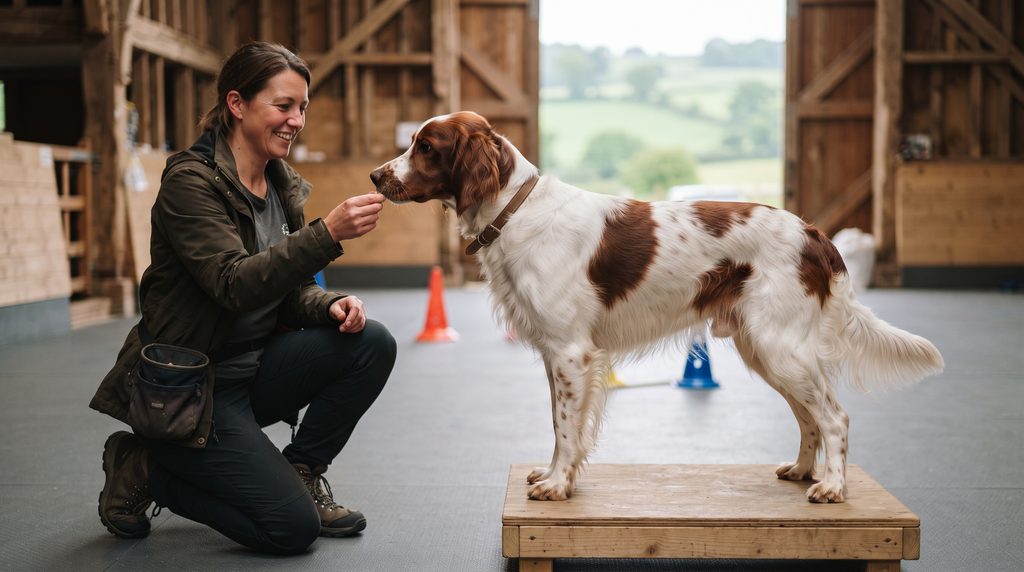
Irish Red and White Setter Grooming and Coat Care
The Irish Red and White Setter has a beautiful, practical coat that combines the elegance of a traditional sporting dog with relatively manageable grooming requirements. Its distinctive pearly-white background, rich red patches, and silky feathering create an attractive appearance without the exceptionally heavy coat maintenance associated with some long-haired breeds. Nevertheless, regular brushing, careful attention to the feathered areas, and sensible hygiene are essential for keeping this active outdoor companion comfortable, healthy, and looking its best.
The coat is naturally fine and silky, with shorter, flatter hair covering much of the body and longer feathering developing around the ears, chest, underside, backs of the legs, and tail. A slight wave is acceptable, but the coat should not be excessively curly, woolly, or artificially sculpted. This relatively moderate coat length reflects the breed’s working origins, providing some protection from vegetation and weather while allowing freedom of movement across challenging terrain.
For most Irish Red and White Setters, brushing two or three times weekly provides a useful starting point, although particularly active dogs may need additional attention. A soft pin brush or quality slicker brush can remove loose hair and surface debris, while a stainless-steel comb helps identify developing tangles beneath the feathering. Owners should work gently through the coat in sections rather than dragging a brush through knots, which can damage hair and cause unnecessary discomfort.
The areas most likely to develop tangles deserve special attention. Hair behind the ears, under the front legs, around the chest, and along the backs of the thighs can become knotted through movement and friction. Feathering around the lower legs and tail may also collect grass seeds, small twigs, and other debris during outdoor adventures. Regularly inspecting these areas allows minor tangles to be removed before they develop into painful mats.
Because Irish Red and White Setters are enthusiastic explorers, grooming should be closely connected to their exercise routine. A dog returning from woodland, long grass, or rough countryside may carry burrs, seeds, or other vegetation in its coat. These materials should be removed promptly, particularly from between the toes, around the ears, and beneath the legs. Grass awns can sometimes penetrate the skin or enter sensitive areas, so persistent licking, swelling, or discomfort following an outing warrants veterinary attention.
Shedding is another normal aspect of ownership. Irish Red and White Setters shed throughout the year, with some individuals experiencing more noticeable seasonal increases. Their coat is not considered hypoallergenic, and loose white and red hairs may accumulate on furniture, clothing, and flooring. Regular brushing helps remove detached hair before it spreads around the home, although it cannot eliminate shedding completely. Individual coat density, seasonal conditions, and general health can all influence the amount of hair released.
Bathing requirements are generally moderate. An Irish Red and White Setter does not need frequent baths simply to maintain its appearance, but washing becomes necessary when the coat is dirty, greasy, or carrying unpleasant odors. A gentle shampoo formulated specifically for dogs is usually sufficient. Owners should rinse thoroughly to prevent residue from irritating the skin, then dry the coat carefully, paying attention to the longer feathering and areas where moisture can remain trapped.
The breed’s predominantly white coat naturally makes mud and environmental staining more visible. However, excessive bathing or aggressive whitening products are unnecessary and may irritate sensitive skin. Allowing ordinary mud to dry before brushing it away can sometimes be more convenient than repeatedly washing the entire dog. A damp cloth or gentle rinse may also be sufficient for cleaning dirty paws and lower legs after everyday walks.
Trimming should remain conservative. The Irish Red and White Setter is intended to retain a natural appearance, and its coat should not be shaved or heavily sculpted for cosmetic reasons. Light tidying around the feet, beneath the ears, and certain other areas may be appropriate, particularly when necessary for hygiene or comfort. Owners interested in showing their dogs should follow the relevant breed standard, which places specific restrictions on permitted trimming.
Ear care is especially important because the breed’s pendant ears can restrict airflow around the ear canal. Regular checks help owners identify redness, unpleasant odors, unusual discharge, or excessive scratching before problems become more serious. Ears should be cleaned only when necessary, using a veterinarian-recommended product and appropriate technique. Cotton swabs should never be inserted deeply into the ear canal, and persistent irritation requires veterinary examination rather than repeated home treatment.
Nail maintenance also deserves attention. Although active setters may naturally wear down their nails on certain surfaces, regular inspection remains necessary. Overgrown nails can affect foot placement, reduce comfort, and interfere with normal movement. Nail trimming or grinding should be introduced gradually, with owners rewarding calm cooperation. The hair between the paw pads should also be checked for trapped debris, irritation, and excessive growth.
Dental care is another important part of the grooming routine. Regular brushing with dog-safe toothpaste helps reduce plaque accumulation and supports long-term oral health. Introducing toothbrushing during puppyhood can make the process easier, although adults can also learn to accept gentle handling through gradual positive reinforcement.
Grooming sessions provide valuable opportunities to examine the dog’s overall condition. Running the hands carefully over the body may reveal unexpected lumps, skin irritation, parasites, or areas of tenderness. Owners can also check for changes in coat quality, unusual hair loss, or persistent scratching that might indicate an underlying health concern.
Ultimately, Irish Red and White Setter grooming is straightforward when approached consistently. The breed does not require elaborate professional styling, but its silky feathering and adventurous lifestyle make regular attention essential. A practical routine of brushing, coat inspection, occasional bathing, ear care, and nail maintenance helps preserve both the dog’s distinctive appearance and its everyday comfort.
Why the Natural Coat Should Be Preserved
The Irish Red and White Setter’s coat should retain the practical, natural appearance associated with its sporting heritage. Heavy clipping, shaving, and elaborate cosmetic shaping are unnecessary for routine maintenance and do not reflect the traditional breed standard. Light trimming around the feet and selected feathered areas may be appropriate for cleanliness, comfort, or presentation, but the overall outline should remain natural. Regular brushing and careful removal of tangles are usually more beneficial than shortening the coat. Owners visiting a professional groomer should explain the breed’s requirements beforehand, particularly if the groomer is more familiar with the longer, heavily styled coats of other sporting breeds.

Irish Red and White Setter Shedding
The Irish Red and White Setter is a moderate-shedding sporting breed with a beautiful, silky coat that is relatively straightforward to maintain. Although its feathered ears, legs, chest, and tail give it an elegant appearance, the coat is not exceptionally heavy or demanding. Nevertheless, anyone considering this affectionate Irish dog should expect some loose hair around the home throughout the year, particularly on furniture, clothing, and frequently used resting areas.
Understanding Irish Red and White Setter shedding begins with recognizing the breed’s distinctive coat structure. Unlike heavily coated northern breeds that possess substantial insulating undercoats, the Irish Red and White Setter has a relatively fine, predominantly single coat. Hair is shorter and flatter across much of the body, while longer feathering develops around the ears, chest, legs, underside, and tail. This combination creates a practical working coat that offers some protection outdoors without producing the enormous quantities of loose undercoat associated with certain other breeds.
Shedding occurs naturally as individual hairs complete their growth cycle and are replaced. The amount varies between dogs depending on genetics, age, general health, environmental conditions, and individual coat characteristics. Some Irish Red and White Setters release relatively little visible hair between brushing sessions, while others leave more noticeable deposits on upholstery and clothing. Neither pattern is necessarily abnormal, provided the coat remains healthy and shedding is not accompanied by unusual skin changes.
Seasonal variations can also occur. Owners may notice more loose hair during spring or fall as changes in daylight and environmental conditions influence the coat’s normal growth cycle. However, the breed should not automatically be expected to undergo the dramatic seasonal coat loss associated with heavily double-coated dogs. Indoor heating, artificial lighting, local climate, and the individual dog’s coat may all influence how noticeable these seasonal changes become.
The predominantly white coat makes shedding particularly visible against dark fabrics. A navy sofa, black trousers, or dark car upholstery may reveal individual white hairs even when the actual quantity is modest. Conversely, red hairs may be more noticeable against pale furnishings. This contrast can sometimes create the impression that a dog sheds more heavily than it really does. Owners who prefer spotless furniture should be realistic about the regular cleaning that accompanies life with a moderately shedding breed.
Fortunately, routine brushing can remove much of the hair that would otherwise accumulate indoors. For many dogs, brushing two or three times weekly is sufficient during ordinary periods, with additional sessions when shedding becomes more noticeable. A soft brush or suitable slicker brush can collect detached hair from the body, while a stainless-steel comb helps reach loose strands caught within the feathering. The objective is to remove hair that is ready to shed rather than aggressively pulling at healthy coat growth.
Care should be taken when selecting grooming equipment. Heavy-duty undercoat rakes and aggressive deshedding tools intended for densely double-coated breeds are generally unnecessary for the Irish Red and White Setter. Inappropriate tools or excessive pressure can damage the fine outer coat and delicate feathering. Gentle, consistent grooming is more appropriate than attempting to strip away large amounts of hair in one session.
Bathing can help release some naturally loosened hair, particularly when followed by careful drying and brushing. However, frequent bathing solely to reduce shedding is not recommended. Excessive washing may remove protective skin oils and contribute to dryness or irritation. A mild dog-specific shampoo and a bathing schedule based on the animal’s actual condition are usually sufficient.
Managing shed hair around the home is generally straightforward with a practical cleaning routine. Vacuuming frequently used areas, washing removable bedding, and keeping washable throws on favorite resting places can significantly reduce visible accumulation. A reusable lint roller or upholstery brush is useful for removing fine hairs from furniture and clothing. Households with multiple dogs or particularly active indoor companions may need to clean more frequently.
Prospective owners should also understand that the Irish Red and White Setter is not hypoallergenic. Although it does not possess the exceptionally dense coat of some heavy-shedding breeds, it still produces allergens associated with skin dander, saliva, and other biological materials. Loose hair can carry these allergens into the surrounding environment. People with known dog allergies should not assume that moderate shedding makes the breed automatically suitable for their household.
Spending time around adult Irish Red and White Setters before making a commitment may help prospective owners understand their personal tolerance, although a brief visit cannot guarantee the absence of future allergic reactions. Individuals with significant allergies should seek appropriate medical guidance rather than relying on breed descriptions alone.
It is also important to distinguish normal shedding from abnormal hair loss. A gradual release of loose hairs across the body is generally expected. In contrast, bald patches, thinning coat, persistent scratching, flaky skin, redness, or an unusual change in hair texture may indicate a problem requiring veterinary attention. Allergies, parasites, infections, hormonal conditions, and other illnesses can affect hair growth and coat quality.
Hypothyroidism is among the health conditions reported in Irish Red and White Setters and can sometimes produce changes in coat density or increased hair loss. However, shedding alone is not evidence of thyroid disease. A veterinarian should assess concerning changes in combination with the dog’s other symptoms and medical history.
A balanced diet, appropriate preventive veterinary care, and consistent grooming all support healthy skin and coat condition. Nutritional deficiencies and underlying illness can influence hair quality, but supplements marketed to eliminate shedding are unlikely to provide meaningful benefits for a healthy dog already receiving complete and balanced nutrition.
Ultimately, the Irish Red and White Setter is a manageable choice for owners comfortable with ordinary dog shedding. Its beautiful red-and-white coat requires regular care, but not elaborate maintenance or constant professional treatment. With gentle brushing, sensible household cleaning, and attention to unusual changes, most families can keep shedding under control while enjoying the companionship of this energetic and affectionate sporting breed.

How Much Hair Should Owners Expect?
Irish Red and White Setters generally shed a moderate amount throughout the year, although individual dogs and seasonal conditions influence how much loose hair becomes noticeable. Their relatively fine, predominantly single coat does not produce the same heavy undercoat blowouts associated with many northern breeds. Nevertheless, white hairs can be particularly visible on dark furniture, clothing, and car seats. Brushing several times weekly, washing bedding regularly, and using a suitable upholstery brush will usually keep household hair manageable. Sudden excessive shedding, bald patches, persistent itching, or unusual skin changes should be investigated by a veterinarian rather than dismissed as normal seasonal coat loss.
Irish Red and White Setter Feeding and Nutrition
Feeding an Irish Red and White Setter correctly is essential for maintaining the strength, stamina, and healthy body condition expected of this energetic sporting breed. Originally developed to work across extensive areas of challenging countryside, these athletic dogs require balanced nutrition that supports muscular development, sustained activity, and long-term health. However, their dietary needs are not determined by energy levels alone. Age, body weight, exercise intensity, reproductive status, and individual metabolism all influence how much food a particular dog requires.
A high-quality, complete and balanced commercial dog food appropriate for the dog’s life stage provides a sensible nutritional foundation. Owners should select a food formulated to meet recognized nutritional standards, such as those established by the Association of American Feed Control Officials (AAFCO). These diets are designed to supply the protein, fat, carbohydrates, vitamins, and minerals necessary for maintaining normal health without requiring routine supplementation.
Protein is particularly important for supporting muscle maintenance and recovery. Irish Red and White Setters possess a strong, athletic build and may participate in demanding activities such as hunting, hiking, running, and organized canine sports. Adequate dietary protein helps maintain lean muscle mass and supports normal tissue repair. However, unnecessarily high protein levels do not automatically produce a fitter or healthier dog. The overall nutritional balance and digestibility of the diet are more important than marketing claims emphasizing a particular ingredient or protein percentage.
Dietary fat supplies concentrated energy and supports healthy skin, coat condition, and normal physiological functions. Particularly active setters may benefit from a more energy-dense formula during periods of sustained fieldwork or intensive exercise. Conversely, a household companion enjoying moderate daily activity may maintain an ideal body condition on a standard adult maintenance diet. Feeding every Irish Red and White Setter as though it were a full-time working dog can lead to unnecessary weight gain.
Determining appropriate portions requires more than following the feeding recommendations printed on a package. These guidelines provide a useful starting point, but individual requirements vary considerably. Owners should assess their dog’s body condition regularly, paying attention to the waistline, abdominal tuck, and the ease with which the ribs can be felt beneath a light covering of tissue. A healthy setter should appear athletic and well-muscled rather than excessively thin or overweight.
Carrying excess body fat places additional stress on joints and can reduce comfort during demanding physical activities. This is particularly relevant for a breed in which hip dysplasia can occur. Maintaining appropriate weight throughout life helps support mobility and general well-being, although good nutrition cannot eliminate inherited orthopedic conditions.
Most healthy adult Irish Red and White Setters can be fed two measured meals daily. Dividing the daily allowance between morning and evening helps establish a predictable routine and avoids presenting the entire day’s food in one large serving. Dogs participating in intensive sporting activities may require carefully adjusted feeding schedules, particularly when exercise involves extended periods of running or fieldwork.
The breed’s relatively deep chest also makes it sensible to understand gastric dilatation-volvulus (GDV), commonly known as bloat. This potentially life-threatening emergency occurs when the stomach becomes distended and may twist, compromising circulation. Although precise risk estimates for Irish Red and White Setters are limited, deep-chested dogs can be susceptible. Feeding smaller meals, discouraging rapid eating, and avoiding vigorous activity immediately around meals are reasonable precautions, but none guarantees prevention.
Owners should recognize the warning signs of GDV, including unsuccessful attempts to vomit, abdominal enlargement, sudden restlessness, excessive drooling, and signs of pain or collapse. These symptoms require immediate emergency veterinary attention. Owners concerned about their dog’s individual risk can also discuss preventive gastropexy with their veterinarian, particularly when there is a relevant family history.
Puppy nutrition requires a different approach. Young Irish Red and White Setters grow rapidly during their early months but continue developing physically well beyond their first birthday. A complete and balanced puppy food appropriate for their expected adult size helps support controlled skeletal growth, muscle development, and healthy body condition. Excessive calorie intake or unnecessary calcium supplementation can interfere with normal development, so owners should avoid attempting to accelerate growth.
Puppies generally require more frequent meals than adults, with feeding frequency gradually reduced as they mature. A veterinarian can help determine when to transition to an adult diet based on the dog’s growth, condition, and nutritional requirements rather than relying exclusively on a fixed birthday.
Treats can be valuable during training, particularly for an intelligent and enthusiastic breed that responds well to positive reinforcement. However, additional calories accumulate quickly when frequent rewards are used throughout the day. As a practical guideline, treats should provide no more than approximately 10 percent of daily calorie intake, with the remaining nutrition supplied by a complete and balanced diet. Small portions of the dog’s regular food can also be reserved for training.
Fresh drinking water should always be available. Active setters may require additional water during warm weather, extended outdoor exercise, and demanding sporting activities. Owners should offer regular drinking opportunities during outings rather than waiting until the dog appears excessively thirsty. Clean, portable water supplies are particularly useful when visiting remote countryside locations.
Some owners consider raw feeding, homemade diets, or grain-free products. These approaches require careful evaluation rather than assumptions that less processed or more expensive food is automatically superior. Homemade diets may be nutritionally incomplete unless formulated by a qualified veterinary nutritionist, while raw animal products introduce potential food-safety risks. Grain-free diets are not inherently necessary for healthy setters, and concerns remain about possible associations between certain diet formulations and canine heart disease. Dietary changes should be based on genuine nutritional or medical requirements.
As Irish Red and White Setters age, their nutritional needs may change. Senior dogs often benefit from closer monitoring of weight, muscle condition, appetite, and digestive comfort. Some require fewer calories as activity decreases, while others need carefully managed nutrition to preserve muscle mass or address specific medical concerns. A suitable senior diet should be selected according to the individual dog’s condition rather than age alone.
Ultimately, successful feeding is about maintaining an athletic, comfortable, and healthy dog throughout every stage of life. A nutritionally complete diet, measured portions, appropriate meal timing, adequate hydration, and regular veterinary assessment provide the strongest foundation. For the Irish Red and White Setter, good nutrition supports not only physical performance but also the vitality and enthusiasm that make this distinctive sporting breed such a rewarding companion.
Adjusting Food for Working and Rest Days
An Irish Red and White Setter participating in regular fieldwork, hunting, or demanding sporting activities may need considerably more energy than a companion enjoying moderate daily exercise. However, those increased requirements do not necessarily continue during quieter periods. Owners should review portions when activity changes rather than feeding the same amount throughout the year. Monitor body condition, muscle development, appetite, and weight trends, making gradual adjustments when necessary. Increased food requirements should be met through an appropriately balanced diet rather than excessive treats or unnecessary supplements. A veterinarian can help establish suitable calorie targets for highly active dogs, particularly those transitioning between intensive working seasons and extended periods of rest.

Irish Red and White Setter Health and Common Health Problems
The Irish Red and White Setter is generally considered a healthy, athletic breed, with many individuals enjoying active lives well into their senior years. However, like all purebred dogs, it has certain inherited and acquired health conditions that prospective owners should understand. Its relatively small breeding population also makes responsible genetic management particularly important. Although dedicated breeders have made considerable progress in controlling several serious hereditary disorders, careful breeding decisions, appropriate veterinary care, and awareness of potential warning signs remain essential.
One of the most important orthopedic concerns is hip dysplasia. This developmental condition occurs when the hip joint does not form or function normally, potentially resulting in joint instability, inflammation, and progressive arthritis. Affected Irish Red and White Setters may develop stiffness, difficulty rising, reluctance to jump, or changes in their normal gait. Some dogs show noticeable symptoms early in life, while others remain comfortable until age-related joint deterioration becomes more apparent.
Hip dysplasia has both genetic and environmental influences. Excess body weight, inappropriate exercise during development, and rapid growth can contribute to joint stress, although they do not independently explain every case. Maintaining a lean body condition, providing age-appropriate activity, and obtaining veterinary advice when mobility changes occur can help protect long-term comfort. Breeding dogs should undergo recognized hip evaluations to help reduce the likelihood of passing significant joint problems to future generations.
Eye conditions are another important consideration. Posterior polar cataracts have historically received particular attention within the breed. These cataracts develop toward the back of the eye’s lens and may be identified during specialist examinations. In Irish Red and White Setters, many documented cases have remained relatively stable without causing substantial visual impairment. Nevertheless, regular ophthalmic assessment is valuable because the severity and significance of individual eye abnormalities can differ.
Progressive retinal atrophy (PRA) is a separate inherited eye disorder that gradually damages the light-sensitive cells within the retina. Depending on the particular form, affected dogs may initially experience difficulty seeing in dim lighting before developing more extensive visual impairment. Genetic testing is available for certain PRA mutations relevant to setters, although no single test identifies every possible cause of inherited retinal disease. Changes in night vision, hesitation in unfamiliar environments, or unexpected collisions warrant veterinary investigation.
A particularly significant hereditary condition is canine leukocyte adhesion deficiency, commonly abbreviated CLAD. This serious immune-system disorder affects the ability of certain white blood cells to reach infected tissues and respond effectively to bacterial infections. Affected puppies may experience persistent infections, poor healing, fever, and failure to thrive. Severe cases can be fatal at a young age.
Fortunately, the availability of reliable DNA testing has enabled responsible breeders to dramatically reduce the occurrence of CLAD. The condition follows an autosomal recessive inheritance pattern, meaning a puppy must inherit the disease-causing variant from both parents to be affected. Because carriers generally appear healthy, visual examination alone cannot establish genetic status. Modern breeding programs rely on documented testing and carefully planned matings to prevent affected puppies.
Hypothyroidism is another condition occasionally reported in the breed. It occurs when the thyroid gland does not produce sufficient thyroid hormone, potentially causing lethargy, unexplained weight gain, coat thinning, or reduced tolerance for cold temperatures. Autoimmune thyroiditis can contribute to thyroid dysfunction in dogs. Diagnosis requires veterinary assessment and appropriate laboratory testing rather than relying on symptoms alone. Many affected dogs respond well to properly monitored lifelong medication.
Von Willebrand disease, an inherited bleeding disorder, also appears in the breed’s historical health records. The condition interferes with normal blood clotting and may cause excessive bleeding following injury or surgery. However, its current significance requires careful interpretation. The Royal Kennel Club withdrew recognition of the previously used breed-specific DNA test in 2023 because that particular test became unavailable. The organization also indicated that historical breeding controls had been successful and that the condition was not considered a current concern within its monitored population. This distinction is important when discussing older health recommendations.
As a relatively deep-chested sporting dog, the Irish Red and White Setter also deserves consideration regarding gastric dilatation-volvulus (GDV), or bloat. Although reliable breed-specific incidence figures are limited, GDV is a potentially fatal emergency affecting susceptible dogs. Symptoms can include unsuccessful attempts to vomit, sudden abdominal enlargement, excessive salivation, restlessness, and collapse. Immediate emergency veterinary treatment is essential whenever GDV is suspected.
Routine health issues should not be overlooked simply because inherited disorders receive greater attention. The breed’s pendant ears may occasionally develop irritation or infection, particularly after swimming or exposure to moisture. Its active outdoor lifestyle also increases opportunities for minor injuries, embedded grass awns, parasites, and paw problems. Regular checks following countryside outings help owners identify changes before they become more serious.
Because the Irish Red and White Setter remains comparatively uncommon, published information about the frequency of certain illnesses is limited. A condition reported in individual dogs should not automatically be interpreted as widespread throughout the breed. Responsible owners should consider documented family history, veterinary findings, and recognized health-screening recommendations rather than relying on generalized lists of possible diseases.
Ultimately, protecting Irish Red and White Setter health involves a combination of responsible breeding, regular veterinary examinations, appropriate nutrition, weight management, and prompt attention to unusual symptoms. Most owners will never encounter every condition discussed here, but understanding the breed’s established health concerns provides a valuable foundation for informed, proactive care.

Irish Red and White Setter Health Screening and Genetics
Responsible health screening plays an especially important role in preserving the Irish Red and White Setter. Although this athletic sporting breed is generally healthy, its relatively small worldwide population creates challenges for breeders attempting to reduce inherited disease while maintaining sufficient genetic diversity. Carefully selected screening examinations, reliable DNA tests, and transparent breeding records help protect individual dogs and support the breed’s long-term future.
The American Kennel Club identifies three principal health assessments recommended by the breed’s national parent club: hip evaluation, examination by a veterinary ophthalmologist, and DNA testing for canine leukocyte adhesion deficiency (CLAD). Additional assessments, including certain genetic tests and thyroid evaluations, may be appropriate depending on family history, regional breeding recommendations, and veterinary advice.
Hip screening is an important starting point. Hip dysplasia can compromise mobility and contribute to painful arthritis, making careful assessment of breeding animals essential. In the United States, breeders commonly use the Orthopedic Foundation for Animals (OFA) or PennHIP to evaluate hip development and joint characteristics. Comparable schemes, including the British Veterinary Association hip-scoring system, are used internationally.
These assessments involve specially positioned radiographs reviewed under established evaluation procedures. An OFA hip evaluation provides a classification of joint conformation, while PennHIP measures passive hip laxity to help assess susceptibility to dysplasia. Breeders should consider the results alongside information about parents, siblings, and previous generations rather than relying on a single apparently healthy dog. Normal hip results reduce uncertainty but cannot guarantee that every offspring will develop healthy joints.
Eye screening is another essential component. Irish Red and White Setters have a documented history of certain inherited ocular conditions, particularly posterior polar cataracts and forms of progressive retinal atrophy. Breeding dogs should receive examinations from appropriately qualified veterinary ophthalmologists, such as specialists certified by the American College of Veterinary Ophthalmologists.
A specialist eye examination can identify structural abnormalities that are not necessarily obvious during a routine veterinary visit. Posterior polar cataracts deserve particular attention because their clinical significance in this breed has historically differed from that of more aggressive cataract conditions. Some affected dogs remain comfortable with little apparent impact on vision. Nevertheless, identifying these changes allows breeders to make informed decisions and avoid unsuitable mating combinations.
DNA testing provides an additional safeguard against specific inherited diseases. CLAD is particularly significant because affected puppies have severely impaired immune defenses and may develop life-threatening bacterial infections. The condition follows an autosomal recessive inheritance pattern, meaning a dog must inherit two copies of the disease-associated variant to become affected.
A genetically clear dog does not carry the tested CLAD variant, while a carrier possesses one copy but is generally unaffected. If two carriers are bred together, each puppy has a 25 percent probability of being affected, a 50 percent probability of being a carrier, and a 25 percent probability of inheriting neither copy. These probabilities apply independently to each puppy, rather than guaranteeing a particular distribution within a litter.
Importantly, a carrier does not automatically need to be excluded from breeding. In a numerically small breed, removing every carrier could unnecessarily restrict genetic diversity. A carefully planned mating between a carrier and a genetically clear dog prevents affected puppies from that specific recessive variant, although some offspring may themselves be carriers. Subsequent testing enables breeders to make responsible decisions across future generations.
Progressive retinal atrophy testing may also be valuable. Specific DNA tests can identify known mutations associated with forms such as rcd1 and rcd4 PRA. However, a clear result for one mutation does not establish that a dog is free from every possible inherited eye disorder. Genetic tests and clinical ophthalmic examinations therefore serve complementary purposes, and neither should automatically replace the other.
Thyroid evaluation may be considered where family history or clinical findings suggest concern about autoimmune thyroiditis or hypothyroidism. Appropriate laboratory testing can provide useful information about thyroid function and, in certain circumstances, evidence of autoimmune disease. Because thyroid status may change over time, periodic reassessment can be appropriate for breeding animals under veterinary guidance.
Von Willebrand disease requires particular care when interpreting older health recommendations. Historically, the breed had a specific inherited bleeding disorder associated with a mutation investigated by the former Animal Health Trust. However, the Royal Kennel Club withdrew recognition of that particular DNA test in 2023 because the original mutation-specific test was no longer available. Tests offered for different von Willebrand mutations should not automatically be considered equivalent for Irish Red and White Setters.
This illustrates why genetic screening must be specific and evidence-based. Commercial testing panels sometimes examine dozens or even hundreds of genetic variants, but not every result is clinically meaningful for every breed. Responsible breeders should prioritize established breed-relevant tests and discuss uncertain findings with qualified veterinary professionals or genetics specialists.
The Canine Health Information Center (CHIC), administered through OFA, provides a useful framework for evaluating breeding records. Dogs that complete the breed’s required screening protocol and have their results made publicly available may receive a CHIC number. However, a CHIC number does not mean every result was normal, nor does it guarantee that the dog or its offspring will remain free from inherited disease. It confirms completion and public disclosure of the required assessments.
Prospective puppy owners should request documented results for both parents, not simply verbal assurances that the dogs have been examined or described as genetically clear. Where available, official database entries, laboratory reports, and specialist certificates allow prospective owners to verify the information independently. Responsible breeders should also be willing to discuss relevant family history, previous litters, and any conditions identified among related dogs.
Genetic diversity remains a particularly important consideration for this breed. Its recovery from near extinction involved a limited foundation population, and excessively restrictive breeding decisions can reduce the availability of unrelated breeding animals. Preserving healthy genetic variation requires thoughtful selection based on overall health, temperament, soundness, ancestry, and working ability rather than concentrating exclusively on individual DNA results.
Ultimately, responsible Irish Red and White Setter breeding depends on balancing disease prevention with the preservation of a sustainable population. Hip evaluations, specialist eye examinations, CLAD testing, and carefully selected additional assessments provide valuable tools. Used alongside transparent records and informed breeding decisions, these measures help protect the health, vitality, and distinctive sporting qualities of future generations.

Health Tests to Request From a Breeder
Before choosing an Irish Red and White Setter puppy, request documented hip evaluations, specialist ophthalmic examination results, and CLAD DNA status for both parents. These are the three principal assessments recommended by the American breed parent club. Additional PRA testing and thyroid evaluations may provide useful information depending on breeding history and veterinary guidance. Ask for official laboratory reports or publicly accessible OFA records rather than relying solely on statements that the parents are healthy. A CHIC number confirms that required screening has been completed and disclosed, but does not guarantee normal results. Responsible breeders should explain their findings openly and discuss how genetic diversity influences their breeding decisions.
Irish Red and White Setter Lifespan and Aging
The Irish Red and White Setter is generally a long-lived sporting breed, with a typical life expectancy of approximately 11 to 15 years. Many individuals remain energetic, affectionate, and enthusiastic about outdoor activities well into their senior years. However, longevity varies according to inherited health, lifestyle, nutrition, veterinary care, and individual circumstances. Understanding how the breed changes with age allows owners to adjust daily routines while preserving the companionship and quality of life that make these distinctive Irish dogs so rewarding.
The commonly quoted Irish Red and White Setter lifespan of 11 to 15 years represents an expected range rather than a guarantee. Some dogs develop significant medical conditions earlier, while others remain healthy beyond their fifteenth birthday. The breed’s relatively limited population also means that extensive longevity studies are less readily available than those for more common breeds. Responsible breeding, documented health screening, and sensible lifelong care provide a valuable foundation, although no combination of preventive measures can eliminate every age-related risk.
Irish Red and White Setters generally mature into strong, athletic adults with considerable stamina. During their prime years, many enjoy demanding activities such as hiking, running, fieldwork, and extended countryside exploration. As they grow older, their physical capabilities may gradually change, although their enthusiasm for familiar activities often remains remarkably strong.
There is no exact birthday at which every Irish Red and White Setter becomes a senior. Owners may begin discussing age-related monitoring with their veterinarian from approximately seven or eight years onward, particularly if changes in mobility or health become apparent. Some dogs remain exceptionally active at ten or eleven, while others require earlier adjustments. Functional ability, comfort, and overall health are more useful indicators than age alone.
One of the most noticeable changes may involve exercise tolerance. An older setter might still eagerly approach the door when its owner reaches for the leash but prefer shorter outings or additional opportunities to rest. These changes should be accommodated thoughtfully rather than interpreted as a reason to stop exercising. Regular, comfortable movement helps maintain muscle strength, joint flexibility, cardiovascular fitness, and mental engagement.
For senior Irish Red and White Setters, several shorter walks may become more appropriate than a single demanding outing. Gentle woodland trails, level countryside paths, and relaxed sniffing opportunities allow older dogs to continue enjoying their natural curiosity. The breed’s interest in scents and outdoor exploration can remain a particularly valuable source of enrichment when more physically demanding activities are no longer suitable.
Joint health becomes increasingly important with age. Hip dysplasia, previous injuries, and ordinary degenerative joint changes may contribute to arthritis or reduced mobility. Owners might notice stiffness after resting, hesitation when climbing stairs, difficulty entering vehicles, or reluctance to jump onto familiar furniture. These changes should not simply be dismissed as unavoidable consequences of aging. Veterinary assessment can identify painful conditions and establish appropriate management plans.
Maintaining a healthy body weight is particularly valuable. Excess weight increases mechanical stress on joints and may worsen mobility problems, while inadequate nutrition can contribute to muscle loss. Older setters benefit from regular body-condition assessments and diets adjusted to their actual energy requirements. Some continue needing substantial nutrition to maintain muscle mass, while others require fewer calories as activity decreases.
Age-related changes in vision and hearing also deserve attention. Irish Red and White Setters have a documented history of certain inherited eye conditions, including posterior polar cataracts and progressive retinal atrophy. These disorders are not simply consequences of aging, but their effects may become increasingly relevant as a dog grows older. Owners should report unusual hesitation in dim lighting, difficulty navigating familiar surroundings, or changes in visual awareness.
Hearing loss can develop gradually, sometimes making an older setter appear less responsive to familiar instructions. Owners may find that hand signals, visual cues, and gentle physical communication become increasingly useful. Maintaining predictable routines and approaching the dog without startling it can help preserve confidence.
Cognitive changes are another consideration. Some senior dogs experience altered sleep patterns, confusion, unusual vocalization, or changes in interaction with family members. These signs may indicate canine cognitive dysfunction, but pain, sensory impairment, and other medical conditions can produce similar behavior. Veterinary assessment is essential before assuming that behavioral changes are caused by aging alone.
Preventive veterinary care becomes particularly important during the senior years. Examinations approximately every six months are often recommended for older dogs, even when they appear healthy. These appointments may include assessment of mobility, dental condition, body weight, heart function, sensory changes, and general comfort. Blood tests, urine testing, and other investigations may be recommended according to the dog’s individual medical history.
The home environment can also be adapted as mobility changes. Nonslip rugs, comfortable supportive bedding, accessible drinking water, and ramps for vehicles or elevated entrances can reduce unnecessary strain. Keeping nails appropriately trimmed helps maintain secure footing, while regular coat and ear care continues to support comfort and hygiene.
Perhaps the most important principle is preserving the older setter’s enjoyment of everyday life. Senior dogs still benefit from affection, gentle play, familiar routines, and opportunities to participate in family activities. Their needs may become less physically demanding, but their desire for companionship often remains strong.
Ultimately, a well-cared-for Irish Red and White Setter can enjoy a fulfilling and active senior life. By recognizing changes early, adjusting exercise and nutrition appropriately, maintaining regular veterinary care, and prioritizing comfort, owners can help their dogs remain engaged, content, and closely connected to the people they love throughout their later years.
Helping an Older Setter Stay Active
Senior Irish Red and White Setters often retain their enthusiasm for outdoor exploration even when their stamina begins to decline. Replace demanding exercise with shorter, comfortable walks that allow plenty of time for sniffing and investigating familiar surroundings. Watch for stiffness after resting, changes in normal movement, or reluctance to climb stairs, and discuss these signs with a veterinarian. Supportive bedding, nonslip flooring, and easier vehicle access can help maintain independence. Regular senior health examinations, appropriate nutrition, and gentle mental enrichment also contribute to quality of life. The goal is not to eliminate activity, but to adapt it so the dog remains comfortable, confident, and engaged.

Cost of Owning an Irish Red and White Setter
Owning an Irish Red and White Setter involves a long-term financial commitment that extends well beyond bringing a puppy or adult dog into the family. This active, affectionate sporting breed requires appropriate nutrition, preventive veterinary care, regular grooming, suitable exercise equipment, and ongoing opportunities for training and enrichment. Although many everyday expenses are comparable to those of other medium-to-large dogs, the breed’s rarity, athletic lifestyle, and specific health-screening considerations can introduce additional costs that prospective owners should understand.
The initial expense of obtaining an Irish Red and White Setter can vary considerably. Because the breed remains uncommon, responsible breeders may have relatively infrequent litters, and prospective owners sometimes need to travel considerable distances to meet breeders or collect a puppy. Transport arrangements, overnight accommodation, and additional veterinary documentation can increase the overall financial commitment. Importantly, choosing a responsible breeder who performs appropriate health assessments is generally more valuable than minimizing the initial expense at the cost of reliable health information.
Adopting an older setter through a breed-specific rescue organization may involve different initial expenses. Adoption contributions often help cover veterinary examinations, vaccinations, microchipping, and other care provided before placement. However, rescued dogs may require additional training, medical treatment, or assistance adjusting to a new household. Prospective adopters should budget for these possibilities rather than assuming that adoption eliminates ongoing financial responsibilities.
Food is one of the most predictable recurring expenses. An adult Irish Red and White Setter typically weighs approximately 35 to 60 pounds, depending on sex and individual build. A complete and balanced diet appropriate for its size, age, and activity level is essential. Dogs participating in intensive fieldwork, running, or other demanding activities may require more calories than relatively quiet household companions, potentially increasing feeding expenses during active periods.
Specialized diets may occasionally be necessary when a veterinarian identifies a medical condition requiring nutritional management. However, expensive boutique foods, supplements, and elaborate feeding arrangements are not automatically necessary for a healthy setter. Selecting a reputable, nutritionally appropriate diet and maintaining an ideal body condition are more important than choosing products based primarily on marketing claims.
Routine veterinary care forms another substantial part of the annual budget. Preventive appointments, vaccinations, parasite control, dental assessments, and occasional diagnostic testing all contribute to maintaining good health. Puppies generally require more frequent veterinary visits during their first year, while older dogs may benefit from examinations approximately every six months. The cost of veterinary services varies significantly between regions and individual practices.
The breed’s inherited health considerations make financial preparation particularly important. Conditions such as hip dysplasia, certain eye disorders, and thyroid disease may require specialist consultations, diagnostic procedures, medication, or long-term management. Although responsible breeding and health screening can reduce some risks, they cannot guarantee that a dog will remain free from illness throughout its life.
Pet insurance can help owners manage certain unexpected veterinary expenses. Accident-and-illness policies may provide reimbursement for eligible treatment, depending on the coverage selected. However, premiums, deductibles, reimbursement percentages, annual limits, waiting periods, and exclusions vary considerably. Owners should review policy conditions carefully, particularly regarding hereditary conditions, orthopedic disorders, and preexisting medical problems. Establishing a dedicated veterinary emergency fund is another approach, either alongside insurance or as an alternative.
Grooming expenses are generally manageable compared with those associated with heavily coated breeds requiring frequent professional clipping. Most Irish Red and White Setters can be maintained at home using a suitable brush, stainless-steel comb, nail-care equipment, and occasional bathing products. Professional grooming may still be convenient for owners who prefer assistance with bathing, coat tidying, or nail maintenance, but elaborate styling is unnecessary.
The breed’s considerable exercise requirements can introduce additional expenses. A secure walking harness, durable leash, long training line, weather-resistant bedding, and suitable outdoor toys are practical investments. Owners who enjoy hiking or structured canine sports may also purchase specialized equipment, attend organized classes, or pay membership fees for training facilities. These activities are optional, but meaningful daily exercise and mental stimulation are not.
Secure fencing is another potential consideration. Irish Red and White Setters have strong hunting instincts and may become highly interested in birds or other wildlife. A properly enclosed yard provides useful freedom and reduces the risk of wandering. Owners moving into a property without suitable fencing should consider whether installation or improvements will be necessary.
Training costs can vary depending on the owner’s experience and the dog’s individual needs. Puppy classes, basic obedience instruction, and occasional specialist guidance can be valuable investments. Although these setters are intelligent and generally responsive to positive reinforcement, professional assistance may be particularly helpful when developing reliable recall, managing adolescent enthusiasm, or addressing persistent behavioral difficulties.
Travel and accommodation also deserve consideration. Owners who work long hours or travel regularly may need trusted dog walkers, pet sitters, or suitable boarding arrangements. Because Irish Red and White Setters are active and strongly people-oriented, appropriate care should include sufficient exercise, companionship, and supervision rather than basic confinement alone.
For broader financial context, a 2026 American pet-care report estimated annual adult-dog ownership expenses at approximately $1,930 to $5,305, depending on circumstances. These figures are general U.S. estimates, not breed-specific projections, and households requiring extensive boarding, specialist veterinary treatment, or other services may spend considerably more.
Ultimately, the Irish Red and White Setter is not an unusually elaborate breed to maintain, but its active lifestyle and long-term health requirements deserve serious financial planning. Owners who budget realistically for routine care, appropriate equipment, preventive medicine, and unexpected emergencies are better positioned to provide a stable, comfortable life for this distinctive Irish sporting companion.

Planning for Unexpected Veterinary Expenses
Emergency veterinary care can create substantial financial pressure, even for owners who comfortably manage routine expenses. Irish Red and White Setters may require urgent treatment for injuries, sudden illness, or conditions unrelated to their inherited health risks. Establishing an emergency savings fund or maintaining suitable pet insurance can help owners make timely medical decisions without unnecessary financial uncertainty. Insurance policies should be reviewed for hereditary-condition exclusions, orthopedic coverage, deductibles, and reimbursement limits. Owners should also identify a nearby emergency veterinary hospital before an urgent situation arises. Planning ahead is particularly valuable for active dogs that regularly explore countryside environments or participate in demanding outdoor activities.
Choosing an Irish Red and White Setter Puppy or Rescue
Choosing an Irish Red and White Setter is an exciting decision, but it requires careful research, patience, and a realistic understanding of the breed’s needs. These affectionate, energetic sporting dogs can become wonderful companions for active households, yet their relatively small population means finding a responsibly bred puppy or suitable rescue may take considerably longer than with more familiar breeds. Prospective owners should prioritize health, temperament, breeding practices, and long-term suitability rather than availability or appearance alone.
The limited availability of Irish Red and White Setter puppies reflects the breed’s uncommon status, particularly outside Ireland and the United Kingdom. In the United States, dedicated breeders maintain relatively small programs, often concentrating on preserving sound structure, reliable temperament, genetic diversity, and traditional working ability. Litters may be planned infrequently, and prospective owners sometimes need to join a waiting list before a suitable puppy becomes available.
The Irish Red and White Setter Association of America is an excellent starting point for researching the breed and making contact with knowledgeable enthusiasts. Breed clubs can help prospective owners understand established breeding practices, recognized health tests, and the characteristics that distinguish this setter from other sporting dogs. Attending dog shows, field trials, or breed-related events may also provide opportunities to meet adult dogs and speak directly with experienced owners.
Responsible breeders should welcome detailed questions about their breeding program. They should be able to explain why a particular mating was selected, describe the temperaments of both parents, and discuss the health history of close relatives. A willingness to provide transparent information is particularly important in a rare breed, where maintaining genetic diversity and avoiding preventable hereditary disease require careful decisions.
Health screening deserves special attention. Before committing to a puppy, prospective owners should request documented hip evaluations, specialist ophthalmic examination results, and CLAD DNA status for both parents. These are the principal assessments recommended by the American breed parent club. Additional testing may be relevant depending on the dogs’ family histories and the breeder’s veterinary guidance.
A responsible breeder should explain what the results mean rather than simply claiming that the parents have been health tested. For example, a dog carrying one copy of the recessive CLAD variant is not necessarily unsuitable for breeding when paired appropriately with a genetically clear partner. Understanding the significance of test results is more valuable than assuming every result must be described as completely clear.
The conditions in which puppies are raised are equally important. Young setters benefit from clean, comfortable surroundings and positive exposure to everyday household experiences. Gentle handling, familiar domestic sounds, suitable visitors, and opportunities to explore different surfaces help develop confidence. Puppies raised with thoughtful socialization are generally better prepared for the transition into a family environment.
When visiting a litter, observe the puppies’ behavior rather than choosing exclusively by coat markings. Healthy, appropriately socialized puppies should demonstrate curiosity and developing confidence, although some may initially approach unfamiliar people more cautiously than others. Watch how they respond to their breeder, interact with their surroundings, and recover from minor surprises. A puppy’s behavior during one brief visit cannot predict its entire adult personality, but it can provide useful information when considered alongside the breeder’s observations.
The phrase red and white setter puppies often attracts people who are drawn to the breed’s beautiful coloring. However, coat markings should never be the deciding factor. Individual puppies may differ in energy, confidence, persistence, and sensitivity. An experienced breeder who knows the litter well can often recommend a puppy whose temperament is compatible with a particular household.
Searches for white setter puppies can also create confusion because several setter breeds have pale or predominantly white coats. The Irish Red and White Setter is a separate recognized breed, distinguished by its defined red patches, characteristic build, and established ancestry. Prospective owners should verify the breed’s identity and registration information rather than relying solely on an advertised photograph.
Puppies should remain with their mother and littermates until they are developmentally ready to leave, generally no earlier than eight weeks. Some breeders may retain them longer to support social development or assess individual temperaments. Before collection, owners should receive appropriate veterinary records, vaccination and parasite-control information, identification details, feeding instructions, registration paperwork where applicable, and a written agreement explaining responsibilities.
A responsible breeder should also remain available after the puppy goes home. Guidance about feeding, early training, exercise, grooming, and socialization can be particularly valuable during the first several months. Many reputable breeders include a contractual commitment to assist with rehoming or accept the dog back if its owner can no longer provide suitable care.
Rescue and adoption offer another worthwhile route. Although Irish Red and White Setters are uncommon in shelters, occasional adults become available through breed-specific rescue organizations, breeder networks, or private rehoming arrangements. Dogs may need new homes because of changes in an owner’s health, housing, work circumstances, or ability to meet the breed’s activity requirements.
An adult rescue can offer certain advantages. Its physical size and general temperament may already be established, and some dogs arrive with useful household manners or previous training. However, prospective adopters should ask about medical history, behavior around children and other animals, separation tolerance, and previous experience living indoors. Setters accustomed to kennel or working environments may require additional time to adapt to ordinary household routines.
Adoption should never be rushed. A successful match depends on understanding the individual dog’s exercise needs, confidence, social preferences, and any existing behavioral challenges. Reputable rescue organizations should provide an assessment of the dog’s needs and offer guidance during the transition. Families should remain prepared for a settling-in period involving patience, consistent routines, and positive reinforcement.
Whether choosing a puppy or adopting an adult, prospective owners should prepare their home before the dog arrives. Secure fencing, suitable bedding, appropriate feeding equipment, safe chew toys, and a plan for veterinary care are essential. Establishing realistic arrangements for daily exercise, companionship, and training is equally important.
Ultimately, choosing an Irish Red and White Setter should be guided by long-term compatibility rather than immediate excitement. Taking time to research responsible breeders, understand documented health testing, and consider rescue opportunities gives prospective owners the strongest foundation for a successful relationship with this distinctive and devoted Irish sporting dog.

Is an Irish Red and White Setter Right for You?
The Irish Red and White Setter can be a deeply rewarding companion, but it is not the right choice for every household. This is an affectionate, intelligent, and athletic sporting breed that thrives when it has close relationships with its people, plenty of physical activity, and a life that includes genuine engagement rather than long stretches of inactivity. For the right owner, the breed offers warmth, loyalty, and tremendous enthusiasm for shared adventures. For the wrong household, its energy, sensitivity, and strong hunting instincts can become difficult to manage.
The first and most important question is whether you genuinely want an active dog. Irish Red and White Setters were developed to work across open countryside for extended periods, using their noses, eyes, and natural initiative to locate game birds. That heritage remains evident today. Even as a family companion, this breed usually needs much more than a quick walk around the block. Owners should be prepared for regular exercise, outdoor exploration, and activities that engage the mind as well as the body. If you enjoy hiking, long walks, training, countryside outings, or canine sports, the breed may fit beautifully into your routine.
This setter is also best suited to people who want a highly involved companion. It is not a detached breed that prefers to live at a distance from family life. Most Irish Red and White Setters enjoy being included in everyday routines and may become unhappy if routinely left alone for very long periods. Households where someone is often home, where the dog can accompany its family on outings, or where reliable arrangements exist for exercise and companionship tend to suit the breed better than homes with long, predictable absences every day.
Temperament is another major consideration. The Irish Red and White Setter is generally friendly, affectionate, and sociable, but it is also energetic and sometimes exuberant. Young dogs in particular can be boisterous, distractible, and full of enthusiasm. Families who appreciate a lively personality and are willing to invest time in training often find this charming. People hoping for a calm, low-maintenance dog from the beginning may find the breed more demanding than expected.
Training ability is usually a strength, but prospective owners should understand the type of dog they are teaching. This is not a mechanical breed that simply obeys every instruction without question. The red white setter is intelligent and cooperative, but it also has an independent streak shaped by generations of fieldwork. Training is most successful when it is patient, positive, and consistent. Owners who enjoy developing a genuine working partnership often do very well with the breed. Those who become frustrated by occasional stubbornness or distraction may struggle.
Living space matters less than lifestyle, although some environments are certainly easier than others. A house with a securely fenced yard is usually more practical than a small apartment, especially for younger dogs. However, a large property does not automatically make the breed easy to own. An Irish Red and White Setter still needs supervision, exercise, and interaction. What matters most is whether the dog’s daily routine includes meaningful activity and companionship.
Families with older children often do well with this breed, especially when they enjoy outdoor life and understand respectful behavior around dogs. The setter’s affectionate and playful nature can make it a wonderful family companion. With toddlers or very young children, supervision is particularly important because the breed’s enthusiasm and size can result in accidental knockdowns or overexcitement. The same lively temperament that makes it fun and engaging also requires sensible management.
Other pets can be compatible, but instinct should never be ignored. Many Irish Red and White Setters live well with other dogs and can adapt to cats under the right circumstances. However, they remain sporting dogs with strong interest in birds and small moving animals. Households with rabbits, guinea pigs, poultry, or pet birds should think carefully about management and supervision.
The breed’s rarity is also worth considering. Because it is less common than many other sporting dogs, prospective owners may wait longer to find a suitable puppy or rescue. Responsible breeders are likely to ask detailed questions and may have waiting lists. For committed owners, this is rarely a disadvantage. In fact, it often improves the chances of finding a well-bred puppy with documented health screening and appropriate early socialization.
In appearance, some people are first drawn to the breed by its beautiful coat and may initially think of it simply as an Irish Setter white and red in color. In reality, the Irish Red and White Setter is a separate breed with its own history, structure, and character. That distinction matters, because choosing the breed should be based on its temperament and lifestyle suitability, not just its striking red-and-white markings.
So who is this breed best for? The ideal owner is active, patient, interested in training, and genuinely happy to share life with an energetic sporting dog. The breed is particularly well suited to households that enjoy the outdoors, value affectionate companionship, and can provide both physical exercise and mental stimulation. It is less suitable for people seeking a highly sedentary pet, a dog that can be left alone most of the day, or a breed with minimal exercise and training requirements.
Ultimately, the Irish Red and White Setter is right for you if you admire its heritage, understand its needs, and are ready to build your life around an active, engaged canine companion. In the right home, it can be a joyful, deeply loyal, and endlessly rewarding member of the family.
Best Match for This Breed
The Irish Red and White Setter is usually happiest with owners who enjoy regular outdoor activity, welcome an affectionate dog into everyday family life, and are prepared for ongoing training and exercise. It tends to suit energetic households better than quiet sedentary ones, and it benefits from people who understand that sporting breeds need both mental and physical outlets. Prospective owners should be realistic about the breed’s enthusiasm, grooming needs, and strong interest in scent and wildlife. When those qualities are embraced rather than resisted, the breed often becomes an exceptionally loyal and enjoyable companion.

Irish Red and White Setter Final Thoughts
The Irish Red and White Setter is an extraordinary sporting breed whose appeal extends far beyond its distinctive appearance. With its beautiful red-and-white coat, athletic build, affectionate personality, and remarkable working heritage, this uncommon Irish dog offers a compelling combination of character, intelligence, and companionship. Its journey from near extinction to international recognition also gives the breed a particularly meaningful place in canine history.
What makes the Irish Red and White Setter so special is the close connection between its traditional working abilities and its modern family temperament. This is a dog developed to spend long hours searching challenging countryside, using exceptional scenting ability, stamina, and independent judgment while remaining attentive to its handler. Those instincts have not disappeared simply because many modern setters now live primarily as household companions. They remain fundamental to understanding what makes the breed happy, responsive, and fulfilled.
For active owners, these qualities can be enormously rewarding. Few experiences capture the breed’s character better than watching a setter confidently investigate open countryside before returning enthusiastically to the person it trusts. Its natural curiosity, energetic movement, and willingness to participate make everyday adventures particularly enjoyable. Whether hiking through woodland, practicing scent work, participating in canine sports, or enjoying a long countryside walk, the Irish Red and White Setter thrives when given opportunities to use its remarkable abilities.
At home, the breed reveals another equally appealing side. Behind its determined working personality is a generally affectionate, friendly, and often playful companion that enjoys being included in family life. Many Irish Red and White Setters form close relationships with their owners, seeking attention, companionship, and involvement in everyday routines. Their sensitivity and enthusiasm can create a particularly rewarding bond with people who understand the importance of positive training, patience, and consistent communication.
However, these attractive qualities come with genuine responsibilities. The Irish Red and White Setter is not a low-energy breed that can comfortably spend most of its life indoors without meaningful activity. Its exercise requirements, hunting instincts, and desire for companionship demand considerable commitment. Prospective owners should also be prepared for regular coat care, secure outdoor boundaries, ongoing training, and the practical responsibilities of living with an athletic medium-to-large dog.
Health and responsible breeding deserve equal consideration. Although many individuals enjoy long, active lives, inherited conditions such as hip dysplasia, certain eye disorders, and canine leukocyte adhesion deficiency demonstrate why appropriate screening remains important. The breed’s relatively small population also makes careful management of genetic diversity essential. Supporting knowledgeable, responsible breeders and established rescue organizations contributes not only to the well-being of individual dogs but also to the preservation of the breed itself.
Its rarity should never be mistaken for a lack of quality. The Irish Red and White Setter remains uncommon largely because its history took a different course from that of more fashionable sporting breeds. Dedicated enthusiasts preserved its traditional characteristics through periods when its future was genuinely uncertain. Today’s owners have the opportunity to appreciate a dog whose physical appearance, temperament, and working instincts remain closely connected to those of its historical ancestors.
Ultimately, choosing an Irish Red and White Setter means welcoming an enthusiastic, affectionate, and capable sporting companion into your life. It is a breed that asks for activity, understanding, patience, and genuine involvement, but gives back extraordinary personality and devotion. For households prepared to embrace its adventurous nature and provide the companionship it deserves, the Irish Red and White Setter can be a deeply rewarding friend throughout every stage of life.

Explore More Sporting Dog Breeds
The Irish Red and White Setter belongs to the Sporting Group, alongside other energetic, intelligent breeds developed to work closely with people. Discover more about retrievers, pointers, spaniels, and setters, including their temperaments, working instincts, exercise requirements, and suitability for family life.
American Kennel Club Breed Information
For additional information about the Irish Red and White Setter, including its official breed characteristics, recognized standard, history, and general care requirements, explore the American Kennel Club’s dedicated breed profile. The AKC provides an authoritative reference for understanding this distinctive Irish sporting dog.