

Australian Terrier
The Australian Terrier may be small in stature, but it possesses the courage, intelligence, and determined personality of a much larger working dog. Developed in Australia during the nineteenth century, this spirited little terrier was bred to tackle vermin, alert families to approaching strangers, and adapt to demanding conditions across farms and rural settlements. Today, the Australian Terrier combines those practical working instincts with an affectionate, engaging personality that makes it an appealing household companion. Its distinctive rough coat, upright ears, lively expression, and confident attitude give it an unmistakable character, while its strong attachment to people makes it much more than simply a miniature working terrier.
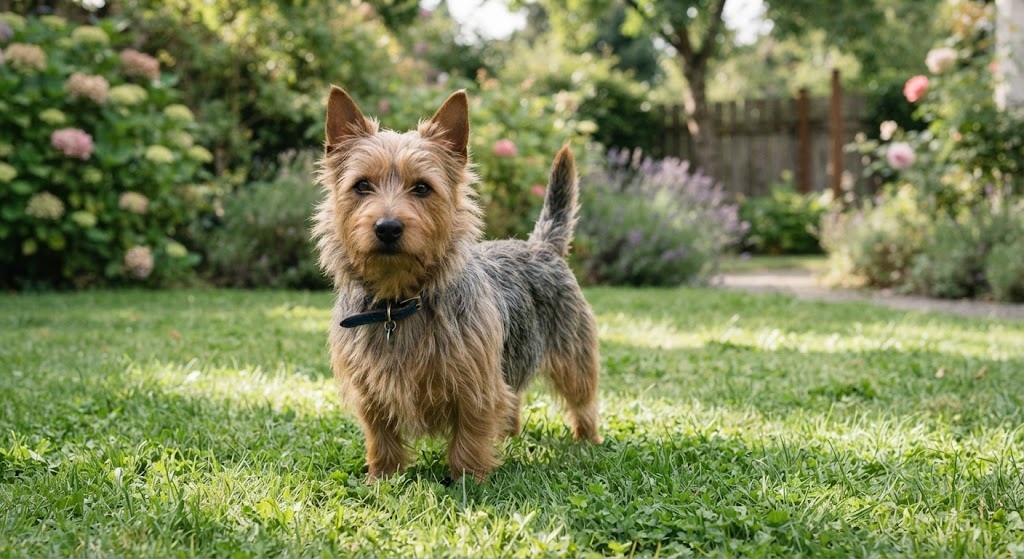
The Australian Terrier’s history is closely connected with the development of rural Australia. Early European settlers brought various British terriers with them, including dogs related to the Skye, Dandie Dinmont, and other rough-coated working terriers. Through generations of selective breeding, these hardy little dogs developed into a distinctly Australian breed capable of coping with unfamiliar terrain, challenging weather, and the practical demands of colonial life. Their duties included controlling rats and mice around buildings and food supplies, confronting other troublesome animals, and providing an early warning when someone approached an isolated property. That background explains much of the breed’s alertness, independence, and willingness to investigate its surroundings.
Unlike some small companion breeds developed primarily for appearance, the Australian Terrier has always possessed a genuine working heritage. Its relatively low, sturdy body, strong legs, and harsh protective coat were practical advantages rather than decorative features. These dogs needed to move confidently through rough vegetation, investigate burrows, and remain alert while working around farms and homesteads. Although most modern Australian Terriers no longer perform these duties, their instincts remain readily apparent. Many still love digging, following scents, chasing movement, and exploring every interesting corner of a garden.
Physically, the Australian Terrier is compact but substantial for its size. Adults generally stand around 10 to 11 inches at the shoulder and commonly weigh approximately 15 to 20 pounds. The body is slightly longer than it is tall, giving the dog a low, sturdy outline without making it appear heavy or awkward. Small, erect ears, keen dark eyes, and an alert expression contribute to its unmistakable terrier appearance. Its weather-resistant double coat features a harsh outer layer, a softer undercoat, a distinctive neck ruff, and a silky topknot. Accepted colors include blue and tan, solid sandy, and solid red, giving the breed several attractive but traditional appearances.
Personality is where the Australian Terrier often makes its strongest impression. Despite its modest size, it is typically self-assured, curious, lively, and surprisingly bold. Many Australian Terriers are affectionate with their families and enjoy being included in everyday activities, whether accompanying an owner around the garden, investigating a new walking route, or settling nearby after a busy morning. For anyone discovering the Australian Terrier Dog for the first time, its confident behavior can be a surprise. This is not usually a timid lapdog content to watch the world from a cushion. It is an active-minded terrier that wants opportunities to participate, explore, and make its presence known.
That confidence can also bring challenges. Australian Terriers are intelligent and capable learners, but their independence means they may not respond with the unquestioning obedience some owners expect. Their traditional role required initiative, quick reactions, and persistence, qualities that can translate into determination when something captures their attention. Training works best when it is positive, varied, and engaging, with rewards that make cooperation worthwhile. Early socialization is equally important, helping puppies develop confidence around unfamiliar people, everyday environments, and appropriately selected dogs without encouraging uncontrolled excitement.
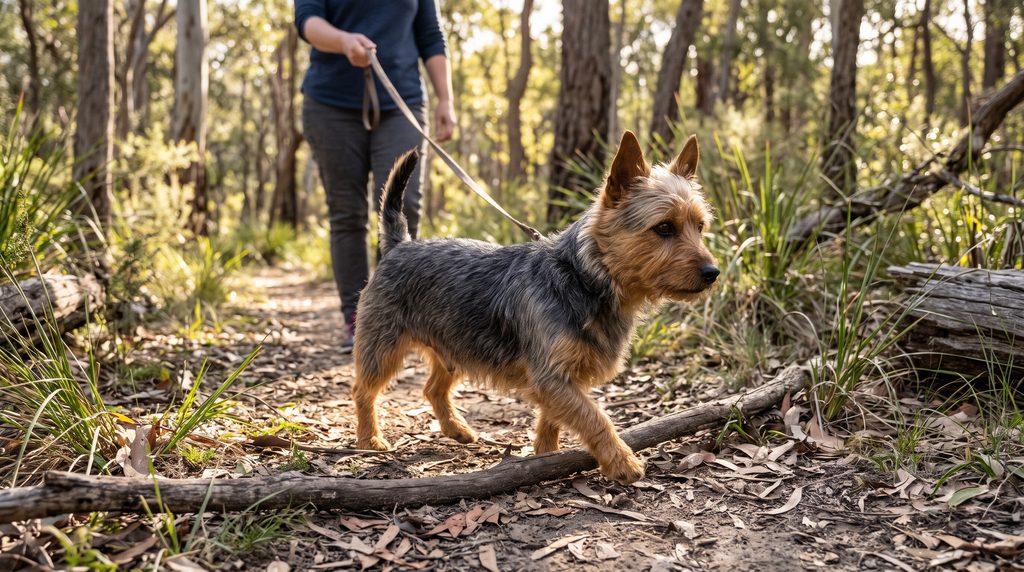
Daily activity is essential, although the Australian Terrier does not need the same exercise schedule as a large sporting or herding breed. Regular walks, interactive play, scent-based games, and short training sessions can provide a satisfying balance of physical and mental stimulation. Many enjoy exploring gardens, visiting interesting outdoor locations, and investigating natural scents along walking trails. However, their hunting instincts should never be underestimated. A squirrel, rabbit, or other small moving animal may trigger an immediate pursuit, making secure fencing and sensible leash management important even for an otherwise well-trained dog.
The breed can adapt to a variety of living arrangements, including suburban houses and apartments, provided its needs are properly met. Its small size makes indoor accommodation practical, but potential owners should remember that Australian Terriers are naturally alert and may bark when they notice unfamiliar sounds or activity. They also enjoy human companionship and generally do better when included in household routines rather than left alone outdoors for extended periods. A secure garden is useful, although owners should expect occasional digging and investigate any weaknesses in fencing. With thoughtful management, many Australian Terriers become entertaining, affectionate, and highly adaptable members of the family.
Relationships with children and other pets deserve consideration. Many Australian Terriers enjoy the company of respectful children, particularly when interactions involve appropriate play and clear boundaries. Their sturdy build can make them more robust than some delicate toy-sized dogs, but supervision remains essential. Their relationships with other dogs vary according to individual temperament and social experiences, while their strong prey drive can make homes with rabbits, rodents, or other small animals more challenging. Owners should not assume that a dog’s compact size makes its hunting instincts insignificant.
Grooming is relatively manageable, although the Australian Terrier’s distinctive coat requires more attention than a smooth, short-haired breed. Regular brushing helps prevent tangles and maintain its natural texture, while some dogs benefit from appropriate hand-stripping or coat maintenance to preserve the harsh outer coat. Owners should also provide routine nail care, dental hygiene, and skin checks. The breed sheds, but its coat is generally less demanding to manage than the long, flowing coats of many small companion dogs. Proper coat care allows the Australian Terrier to retain its characteristic rugged appearance without excessive styling.
Health and longevity are also important considerations. Australian Terriers are generally hardy little dogs, with a typical life expectancy of approximately 11 to 15 years. Nevertheless, responsible breeding and preventive veterinary care remain essential. Conditions such as patellar luxation, Legg-Calvé-Perthes disease, and certain eye disorders deserve attention, while sensible nutrition and weight management help protect long-term mobility. Prospective owners should seek breeders who understand inherited health concerns and provide appropriate screening information rather than relying solely on the breed’s reputation for toughness.
Ultimately, the Australian Terrier offers a particularly appealing combination of working-dog spirit and affectionate companionship. Its intelligence, courage, humor, and enthusiasm can make it a delightful partner for people who appreciate a dog with genuine character. However, its small size should never lead owners to overlook its need for training, activity, secure surroundings, and appropriate boundaries. For households prepared to embrace its independent terrier nature, the Australian Terrier can be a loyal, entertaining, and deeply rewarding companion with a personality that is unmistakably its own.

Table of Contents
Australian Terrier Fast Facts
Breed Group: Terrier
Origin: Australia
Height: 10–11 inches
Weight: 15–20 pounds
Life Expectancy: 11–15 years
Size: Small
Coat: Harsh double coat with soft topknot; blue and tan, sandy, or red
Coat Care: Regular brushing and occasional coat maintenance
Shedding: Low
Exercise Needs: Moderate; daily walks, play, and mental stimulation
Temperament: Spirited, affectionate, alert, courageous, independent
Primary Role: Vermin hunter, watchdog, and companion
Australian Terrier Star Ratings
Apartment Friendly: ★★★★☆
Family Friendly: ★★★★☆
Good With Children: ★★★☆☆
Good With Other Dogs: ★★★☆☆
First-Time Owner Friendly: ★★★☆☆
Easy Grooming: ★★★★☆
Affectionate: ★★★★☆
Easy to Train: ★★★☆☆
Low Shedding: ★★★★☆
Adaptable: ★★★★☆
High Exercise Needs: ★★★☆☆
Tolerates Being Alone: ★★☆☆☆
Australian Terrier History and Origins
The Australian Terrier holds a particularly important place in canine history as one of the first dog breeds developed in Australia and the first Australian breed to gain recognition and appear in organized dog shows in its homeland. Unlike many terriers whose histories are rooted almost entirely in Britain, the Australian Terrier emerged from the practical demands of nineteenth-century colonial life. Early settlers needed small, courageous dogs capable of controlling vermin, protecting food supplies, alerting households to strangers, and coping with challenging rural environments. From those requirements developed a distinctive working terrier whose intelligence, determination, and adaptability remain evident today.
The breed’s ancestry can be traced to rough-coated working terriers brought from Britain during the nineteenth century. These dogs accompanied settlers traveling to Tasmania and mainland Australian colonies, particularly Victoria and New South Wales. Early breeding records were inconsistent, so the exact combination of breeds cannot be established with certainty. However, the Skye Terrier, Dandie Dinmont Terrier, old Scottish Terrier types, and Yorkshire Terrier are generally considered important contributors. Some historical accounts also identify influences from other British terriers. Rather than following a carefully documented breeding program from the beginning, the Australian Terrier developed gradually through practical selection for useful working characteristics.
Tasmania features prominently in accounts of the breed’s early development. Historical descriptions refer to small, broken-coated terriers with blue-toned bodies and tan markings being bred around settlements such as Campbelltown and Ross during the early nineteenth century. Similar dogs subsequently became established across southeastern Australia. Known initially as Broken Coated Terriers or Rough-Coated Terriers, they varied in appearance and size but shared several useful characteristics: sturdy construction, alertness, determination, and the ability to work independently. Their eventual development into a recognizable breed reflected generations of selection under Australian conditions rather than the preservation of any single imported British terrier type.
Life in rural Australia required considerable versatility from a small working dog. Farms, homesteads, stables, and grain stores attracted rats and mice, making efficient vermin control essential. Australian Terriers were also historically used to confront snakes, although such encounters were inherently dangerous and are not something modern owners should encourage. Their ability to investigate confined spaces, move quickly through rough vegetation, and persist when pursuing small animals made them valuable around isolated properties. Because they required relatively little food and space compared with larger working dogs, these compact terriers offered practical advantages to families with limited resources.
Their responsibilities were not confined to hunting vermin. Australian Terriers also served as alert watchdogs, announcing the arrival of visitors or unusual activity around homes and outbuildings. In isolated settlements, an attentive dog could provide an early warning when someone approached. Historical accounts also describe Australian Terriers accompanying workers around livestock and rural properties, although they were never developed primarily as specialist herding dogs. Their combination of alertness, confidence, and close attachment to people made them useful companions during a period when households often depended heavily on the abilities of working animals.
The Australian gold rushes and expansion of rural settlements provided further opportunities for these adaptable dogs. Goldfields, temporary camps, stores, and expanding towns created environments where rodents and other pests were troublesome. Small terriers could accompany their owners between locations, investigate buildings and stores, and act as companions during demanding working days. Their willingness to tackle unfamiliar surroundings helped reinforce the qualities for which the breed became known. The modern Australian Terrier’s curiosity, vocal alertness, and determination are understandable when viewed against this history of practical work in changing environments.
By the middle of the nineteenth century, Australian-bred rough-coated terriers were becoming sufficiently recognizable to appear in organized exhibitions. Historical accounts record their appearance at a Melbourne dog show in 1868, an important milestone in the emergence of a distinct Australian breed. During the following decades, breeders and enthusiasts began working toward greater consistency in coat texture, body proportions, coloring, and general appearance. Early classifications varied, reflecting the fact that the breed was still developing and that standardized pedigree registration was less established than it is today.
Breed organization gathered momentum during the 1880s and 1890s. An early Australian Rough-Coated Terrier club was established in Melbourne in 1887, and attempts were made to develop a formal standard. The name Australian Rough Coated Terrier became increasingly associated with the developing breed, while Australian Terrier gradually emerged as its established identity. By 1899, dogs were being exhibited under Australian Terrier classifications at major shows. These developments marked an important transition from a collection of practical colonial working dogs toward a recognized pedigree breed with identifiable characteristics and increasingly consistent breeding objectives.
The breed’s appearance continued to reflect its working origins. A sturdy, slightly elongated body provided stability and flexibility when moving through difficult ground, while strong legs supported surprisingly agile movement. Its harsh outer coat offered practical protection against vegetation and unfavorable weather, and the characteristic neck ruff and softer topknot contributed to its distinctive appearance. Blue-and-tan, sandy, and red coloring became established within the breed. Although modern Australian Terriers are usually kept as companions, the original emphasis on functional construction remains central to their recognized standard.
The Australian Terrier’s development also overlaps with that of the Australian Silky Terrier. Both breeds share ancestry among the rough-coated terriers established in Australia, but selective breeding eventually produced two distinct types. The Australian Terrier retained a harsher coat and strongly practical working appearance, while the Australian Silky Terrier developed a finer, longer, silkier coat and a more refined outline. Their shared ancestry helps explain certain similarities, but they are separate breeds with different coat characteristics, standards, and historical breeding objectives.
As Australian Terrier breeding became more organized, the breed gradually attracted attention beyond Australia. Dogs were exported to Britain, where enthusiasts appreciated their spirited character and unusual origins. Their arrival in the United States came considerably later, with important imports occurring during the late 1940s. The Australian Terrier Club of America was established in 1957, providing a foundation for promoting responsible breeding and recognition. In 1960, the American Kennel Club officially admitted the Australian Terrier to its registry, making it the 114th breed recognized by the organization. This marked a significant achievement for a small working terrier developed far from the traditional British centers of pedigree dog breeding.
Today, the Australian Terrier is valued primarily as an affectionate, intelligent, and lively companion, but its working heritage remains central to its identity. The determination that once helped it pursue vermin is still apparent when it investigates a scent, digs enthusiastically, or notices movement in the garden. Its watchdog instincts often emerge through alert barking, while its independence reflects generations of dogs expected to make decisions without constant direction. Understanding these origins helps explain why this small breed benefits from purposeful activities, consistent training, and opportunities to use its natural curiosity.
Ultimately, the Australian Terrier represents an important chapter in Australia’s canine heritage. Developed from imported British terriers but shaped by the distinctive conditions of Australian colonial life, it became a recognizable working breed before expanding into the wider world of pedigree dogs and family companionship. Its modest size conceals considerable courage, resourcefulness, and personality. Although modern Australian Terriers enjoy far more comfortable lives than their early ancestors, they retain the alertness, resilience, and independent spirit that made them such valued companions to Australia’s early settlers.
Australian Terrier or Australian Silky Terrier?
The Australian Terrier and Australian Silky Terrier share elements of their early ancestry, but they developed into distinct breeds with different appearances and purposes. The Australian Terrier retained a harsh, weather-resistant coat, sturdy construction, and practical working-terrier character. The Australian Silky Terrier developed a longer, finer coat with a more refined overall appearance. Both breeds are Australian developments, and their historical relationship occasionally causes confusion. An Australian Terrier should not have the long, flowing coat associated with the Silky. Understanding this distinction is particularly useful when examining early breed photographs or identifying dogs with similar blue-and-tan coloring.

Australian Terrier Appearance and Size
The Australian Terrier is a small but surprisingly substantial dog whose appearance reflects its origins as a practical working terrier. Although compact enough to fit comfortably into many households, it possesses a sturdy frame, strong legs, and a confident bearing that distinguish it from more delicate companion breeds. Its slightly elongated body, distinctive harsh coat, upright ears, and expressive dark eyes create an immediately recognizable appearance. A correctly proportioned Australian Terrier should look capable of moving freely across rough ground, investigating narrow spaces, and carrying out the demanding tasks for which its ancestors were originally developed.
An adult Australian Terrier generally stands approximately 10 to 11 inches at the shoulder and weighs around 15 to 20 pounds, according to American Kennel Club breed information. Males and females are broadly similar in appearance, although individual differences in size and substance are normal. The official breed standard emphasizes balanced proportions and good working condition rather than a particular weight. Despite its relatively modest measurements, the Australian Terrier often feels more solid than newcomers expect. It should have enough bone and muscle to appear robust without becoming heavy, coarse, or awkward.
One of the breed’s defining physical characteristics is its body shape. The Australian Terrier is longer than it is tall, with a firm, level back and a strong, relatively short loin. This produces a slightly rectangular outline rather than the compact, square silhouette seen in some other terriers. The chest is moderately deep, reaching approximately to the elbows, with well-sprung ribs that provide adequate space without creating an excessively rounded body. Its proportions should suggest strength and flexibility, allowing the dog to move confidently while retaining the compact dimensions necessary for working around buildings and rough terrain.
The legs are relatively short but should never appear weak or disproportionately tiny. Straight forelegs, firm pasterns, and compact, well-padded feet support an agile, purposeful gait. The hindquarters are muscular and appropriately angled, providing the drive needed for energetic movement. Australian Terriers should be capable of covering ground freely rather than shuffling along with excessively short steps. Their sturdy construction is particularly noticeable during brisk walking, when the body remains balanced and the legs work together efficiently.
The head is another recognizable feature. It is relatively long and strong, with a fairly flat skull, a modest but clearly defined stop, and a muzzle approximately equal in length to the skull. The nose is black, and the jaws are surprisingly powerful for a dog of this size. Small, dark brown to black eyes create a keen, intelligent expression, while the high-set, pointed ears are carried erect. The ears should remain relatively small and neatly proportioned, rather than dominating the head. Together, these features give the Australian Terrier its characteristic alert and inquisitive appearance.
A distinctive feature sometimes overlooked is the breed’s neck and forechest furnishings. The neck is moderately long, strong, and slightly arched, blending into well-placed shoulders. Longer hair around the neck forms a protective ruff, extending into an apron across the forechest. This arrangement gives the Australian Terrier a somewhat rugged, almost miniature working-dog appearance. Unlike decorative coat furnishings developed primarily for exhibition, these features reflect the practical protective qualities valued in the breed’s ancestors.
The coat itself is one of the Australian Terrier’s most important identifying characteristics. It consists of a harsh, straight, dense outer layer approximately 2½ inches long over the body, supported by a shorter, softer undercoat. The outer coat should feel distinctly coarse rather than fluffy, woolly, or silky. On top of the skull sits a small, soft topknot, noticeably finer in texture than the surrounding hair. This contrast between the rough body coat and softer head furnishings is particularly characteristic of the breed and helps distinguish it from other small terriers.
Questions about Australian Terrier Short Hair often arise because the dog is sometimes photographed with a neatly maintained or unusually close-trimmed coat. However, the breed is not naturally smooth-coated in the manner of a Jack Russell Terrier or Miniature Pinscher. Its characteristic appearance depends on retaining sufficient harsh outer hair, along with the recognizable ruff and topknot. Excessive clipping can soften the coat’s appearance and make the dog less immediately recognizable. Proper grooming should maintain the breed’s natural, practical outline rather than create an artificially sculpted hairstyle.
The recognized coat colors are blue and tan, solid sandy, and solid red. Blue-and-tan Australian Terriers may have body coloring ranging from dark blue and steel-blue to lighter silver-blue, accompanied by rich tan markings on the face, ears, underside, legs, and feet. The contrast can be particularly striking when the tan is clear and well defined. The topknot is commonly silver or a lighter shade than the surrounding head color, creating an attractive highlight above the eyes. Although blue-and-tan dogs are especially recognizable, sandy and red individuals are equally authentic representatives of the breed.
Sandy coloring ranges from pale golden tones to deeper warm shades, while solid red Australian Terriers may display richer reddish or copper-colored coats. In both varieties, the color should be reasonably clear and even, without extensive dark shading through the body. The softer topknot may be lighter than the surrounding coat. Puppies can look different from mature adults as their coat color and texture develop, so early photographs do not always demonstrate the appearance the dog will eventually have.
A White Australian Terrier is not a recognized color variety under the official breed standard. Very pale sandy dogs may occasionally appear almost cream-colored in photographs, particularly under bright sunlight, but genuine solid white is not among the accepted colors. Small white markings can occur, although white on the chest or feet is penalized under the standard. Color variation should never be confused with separate breed varieties, nor should unusual pigmentation be treated as evidence of superior health, temperament, or pedigree.
The tail is set high and carried confidently. Australian Terriers may have natural or historically docked tails, depending on breeding practices and applicable legislation. An undocked tail may be straight or curve forward, but the overall carriage should remain consistent with the breed’s alert expression and balanced outline. The Australian Terrier’s movement is similarly distinctive, combining lively, purposeful strides with sufficient reach and drive. Despite its small size, this is a dog built to move efficiently rather than simply look attractive while standing still.
The Australian Terrier is sometimes confused with the Australian Silky Terrier, Cairn Terrier, or Yorkshire Terrier. However, its relatively long body, harsh protective coat, distinct ruff, upright ears, and working-terrier construction provide useful identifying differences. The Australian Silky Terrier has a finer, longer, silkier coat, while Cairn Terriers have different head proportions and an overall appearance associated with their Scottish ancestry. Breed identification is most reliable when several characteristics are considered together rather than relying solely on coat color or ear shape.
Ultimately, the Australian Terrier’s appearance represents an effective balance between compact size and genuine working ability. Its sturdy proportions, distinctive coat, keen expression, and energetic movement are all closely connected with its historical purpose. Whether blue and tan, sandy, or red, a well-proportioned Australian Terrier should appear alert, healthy, agile, and unmistakably terrier-like. The breed’s appeal lies not in exaggerated features or decorative styling, but in the practical, confident character expressed through its natural appearance.
Why Australian Terrier Puppies Can Look Different From Adults
Young Australian Terriers do not always display the same coat color, texture, and furnishings seen in mature dogs. Blue-and-tan puppies may initially appear darker, while the contrast between their markings can become clearer as the coat develops. The characteristic neck ruff and soft topknot also become more noticeable with maturity. Early puppy photographs can therefore be misleading when comparing appearance with the official breed standard. Prospective owners should examine the parents’ structure and coat characteristics rather than expecting a young puppy to look like a miniature adult show dog. Healthy development and balanced proportions matter more than early cosmetic perfection.
Australian Terrier Temperament and Personality
The Australian Terrier is a spirited, intelligent, and remarkably self-assured little dog with a personality considerably larger than its physical size. Developed to work independently while remaining closely connected to its human companions, the breed combines traditional terrier determination with genuine affection and loyalty. Australian Terriers are often curious, enthusiastic, and quick to investigate anything that attracts their attention. They enjoy being involved in household activities and rarely behave like passive observers. For owners who appreciate a lively companion with intelligence, humor, and a confident outlook on life, the Australian Terrier can be an exceptionally rewarding breed.
One of the defining characteristics of the Australian Terrier Temperament is its combination of independence and devotion. These dogs were originally expected to make decisions while pursuing vermin, so they developed considerable confidence in their own judgment. Nevertheless, they also lived and worked closely alongside people, creating a breed that generally values human companionship. Many Australian Terriers follow their owners around the house, settle nearby during quiet activities, and enthusiastically participate whenever something interesting happens. They may be independent thinkers, but they are not typically emotionally distant dogs.
Their confidence is particularly noticeable when encountering unfamiliar surroundings. An Australian Terrier may approach a new environment with curiosity, carefully investigate unusual objects, or become immediately interested in unfamiliar sounds and scents. This natural boldness is part of the breed’s appeal, although individuals vary in confidence and social experience. A well-adjusted Australian Terrier should be alert without being excessively fearful or unnecessarily confrontational. The official breed standard emphasizes courage and self-assurance while identifying shyness and aggression toward people as undesirable characteristics.
Affection is another important part of the breed’s personality. Australian Terriers often develop strong bonds with their families and enjoy physical closeness with trusted people. Many appreciate relaxing beside an owner after a busy day, receiving gentle attention, or simply being included in familiar routines. Their affectionate nature can be particularly appealing to people who want a small dog with a genuine companionable personality. However, they may also seek attention persistently, especially if they have learned that barking, pawing, or interrupting an activity reliably earns a response.
The Australian Terrier’s intelligence makes it an entertaining and sometimes mischievous household companion. These dogs are quick to recognize patterns, remember rewarding experiences, and discover how to get what they want. An Australian Terrier may learn household routines remarkably quickly, anticipating walks, mealtimes, or the arrival of a familiar visitor. The same intelligence can encourage creative misbehavior if the dog becomes bored. Some investigate cupboards, rearrange toys, dig in flowerbeds, or develop elaborate strategies for attracting attention. Owners generally achieve the best results by providing appropriate activities and encouraging desirable behavior rather than expecting unquestioning compliance.
Playfulness remains a distinctive quality throughout much of the breed’s life. Australian Terriers often enjoy carrying toys, playing short retrieving games, investigating hidden treats, and participating in activities that involve their owners. Their enthusiasm can make ordinary interactions surprisingly entertaining. Many have a humorous, cheeky side and appear delighted when they discover a new game or successfully solve a puzzle. This playful character makes the breed appealing to active households, although excitement should be balanced with opportunities to relax. A constantly stimulated terrier may become increasingly demanding rather than genuinely content.
Alertness is another characteristic inherited from the breed’s working past. Australian Terriers were valued as watchdogs around rural homesteads, and many remain highly attentive to unfamiliar noises, approaching visitors, and activity beyond their property. They may announce these discoveries with a surprisingly substantial bark for such a small dog. Their behavior generally reflects awareness and curiosity rather than a desire to intimidate people. Nevertheless, excessive barking can become troublesome when an Australian Terrier reacts to every passerby, delivery vehicle, or neighborhood sound. Teaching calm responses and avoiding repeated reinforcement of unnecessary barking helps maintain a more comfortable household.
Their hunting instincts are equally significant. Australian Terriers were developed to pursue rodents and other troublesome small animals, and this determination remains evident in many modern dogs. A rustling hedge, moving lizard, or squirrel crossing the garden can attract immediate attention. Some become intensely focused on investigating holes, following scent trails, or digging around vegetation. These behaviors are not signs of poor character; they reflect deeply established terrier instincts. However, owners should recognize that affectionate companionship and strong prey drive can exist in the same dog. A reliable relationship with people does not automatically eliminate the desire to chase.
Relationships with other dogs vary considerably. Some Australian Terriers are sociable and enjoy familiar canine companions, while others can be assertive, possessive, or selective about interactions. Their small size does not necessarily reduce their willingness to challenge a larger dog, particularly when they feel threatened or become excited. Early positive experiences can help develop appropriate social behavior, but owners should respect individual preferences rather than assuming every Australian Terrier will enjoy unrestricted group play. Confidence is a desirable quality, but unnecessary confrontation is not.
The breed also possesses an emotional sensitivity that can be overlooked beneath its confident exterior. Australian Terriers often respond closely to their owners’ moods and may become unsettled by harsh handling or inconsistent expectations. They generally thrive when treated with patience, affection, and predictable guidance. Their independent streak should not be mistaken for an inability to cooperate. When owners make learning enjoyable and communicate clearly, many Australian Terriers demonstrate impressive willingness and enthusiasm. Their best qualities emerge when natural confidence is supported by a secure, trusting relationship.
Ultimately, the Australian Terrier offers a distinctive personality shaped by courage, curiosity, affection, and independence. It is not simply a quiet little companion or a miniature version of a larger working dog. It is a genuine terrier with strong instincts, a lively mind, and a considerable desire to participate in family life. For people who enjoy a companion with character and are prepared to understand its natural behavior, the Australian Terrier can provide years of warmth, entertainment, and loyal companionship.
Confidence Should Not Be Mistaken for Aggression
The Australian Terrier’s bold personality sometimes leads people to describe it as fearless, but confidence and aggression are not interchangeable. A well-adjusted Australian Terrier should be alert, self-assured, and comfortable interacting with people without displaying unnecessary hostility. Its historical determination when hunting vermin does not mean aggression toward humans is desirable. Some individuals may be assertive around unfamiliar dogs or strongly motivated to chase small animals, making thoughtful handling important. Responsible breeding, positive early experiences, and consistent management help support the breed’s natural confidence while encouraging appropriate social behavior. Owners should value emotional stability rather than deliberately encouraging confrontational behavior.

Living With an Australian Terrier
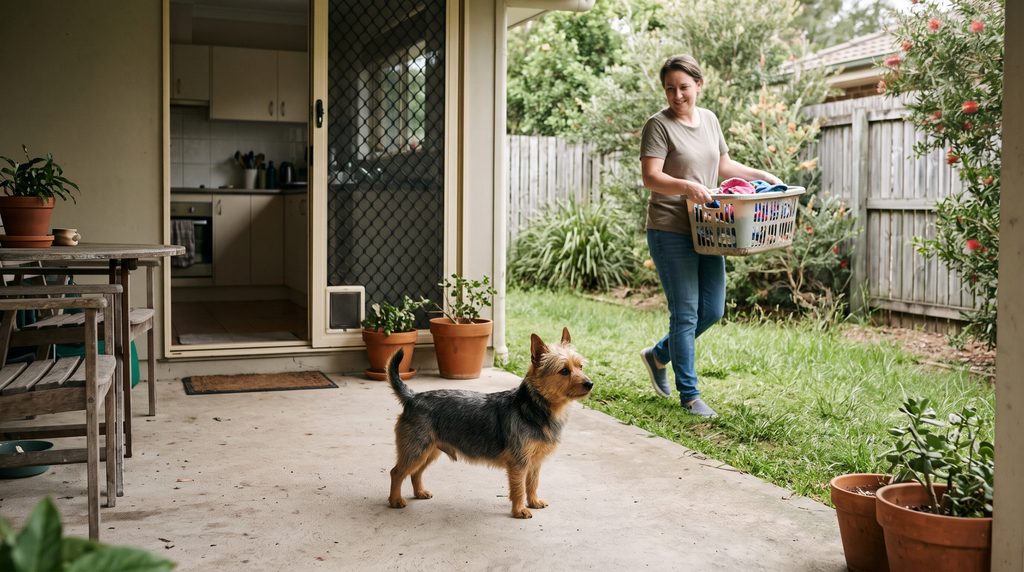
Living with an Australian Terrier is usually lively, entertaining, and deeply companionable. This is a breed that tends to involve itself in whatever is happening around the home, whether that means following an owner from room to room, supervising garden work, announcing a visitor at the gate, or curling up nearby once the day’s excitement has passed. Although small enough to fit comfortably into many households, the Australian Terrier is not a decorative lapdog with minimal needs. It is an active-minded little working terrier that thrives when treated as a genuine household companion with routines, responsibilities, and regular opportunities to engage with the world.
One of the most appealing aspects of the breed is how easily it becomes part of daily life. Australian Terriers generally like being close to their people and often keep an eye on family activity throughout the day. Many develop strong habits of checking where everyone is, following a favorite person outdoors, and settling in whatever room seems most interesting. This makes them rewarding companions for owners who enjoy a dog with presence and personality. It also means they are usually happiest when included in family routines rather than left alone in the yard for long stretches with little interaction.
Their size makes them flexible in terms of housing. An Australian Terrier can live happily in a suburban home, townhouse, or apartment, provided its mental and physical needs are met. A large property is not essential, but regular walks, play, and supervised outdoor time are. Apartment living can work well for owners who are committed to daily activity and sensible management, though barking needs to be addressed early. Because the breed is naturally alert, it may quickly develop a habit of reacting to hallway sounds, passersby, or neighboring activity if quiet behavior is never encouraged.
A secure yard is useful, but it is not a substitute for involvement. Australian Terriers enjoy investigating, patrolling, and sunning themselves outdoors, yet most still want human company and shared activity. Secure fencing matters because this breed is curious, confident, and capable of squeezing into surprisingly small spaces if something interesting lies beyond the boundary. Owners should also expect some digging, especially if the dog notices movement under a fence, catches an exciting scent, or discovers a favored patch of soft soil. Digging is part of the terrier package, and management is usually more effective than outrage.
Inside the home, Australian Terriers are often adaptable and comfortable once their basic needs have been met. Many settle well after a satisfying walk or play session and enjoy a comfortable bed, a sunny patch of floor, or a place beside their owner on the sofa. However, they can also be quite inventive when bored. A dog left with nothing to do may bark at noises, scratch at doors, raid baskets, or reorganize cushions and toys. Simple enrichment helps greatly. Food puzzles, short training sessions, safe chew items, and scent-based games can make everyday life much easier and more satisfying for both dog and owner.
Because the breed is intelligent and observant, routines tend to matter. Australian Terriers usually do well when meals, walks, rest periods, and bedtime follow a fairly predictable rhythm. Predictability helps them feel secure and often reduces nuisance behavior. At the same time, they should not become so dependent on one rigid schedule that any small change causes distress. A well-adjusted Australian Terrier should be able to cope when an owner goes out, visitors arrive, or the usual walk happens a little later than expected. Building that flexibility early is worthwhile.
Time alone deserves thought. Australian Terriers are companionable dogs and do not generally thrive when isolated for long periods every day. That does not mean they cannot be left alone at all, but they should gradually learn how to rest calmly without constant company. Puppies especially benefit from short, manageable separations so independence becomes normal rather than alarming. Owners who work long hours away from home need to consider whether the dog will receive enough company, stimulation, and toilet opportunities. A small breed may be physically easier to house than a large dog, but emotionally it can still struggle if its social needs are ignored.
Visitors are another everyday consideration. Australian Terriers often take their watchdog role seriously and may announce arrivals with great enthusiasm. Many warm up quickly once they see that everything is normal, but good manners still need to be taught. Calm greetings, a reliable place to settle, and a routine for answering the door can prevent the dog from believing every knock or footstep is a major emergency. Because the breed is small and confident, some owners underestimate how quickly pushy or noisy habits can become well established if they are repeatedly rehearsed.
Living with children can work very well when everyone understands the dog. Australian Terriers are often sturdier than many small breeds, which can make them a little more robust in family life. Even so, they are not toys and should not be expected to tolerate grabbing, chasing, or constant interruption. Clear boundaries, supervision, and respectful handling matter just as much with a small terrier as they do with a larger breed. The dog should always have a quiet place to rest undisturbed.
Other pets require realistic expectations. Some Australian Terriers coexist happily with familiar dogs, and some can learn to live sensibly with cats. However, their prey drive is real, and households with rabbits, guinea pigs, rats, or similar animals need to be especially cautious. Small pets should never be treated casually around a terrier developed to hunt vermin. Even where relationships appear peaceful, secure separation remains the responsible approach.
Ultimately, living with an Australian Terrier means sharing your home with a bright, busy little character that notices everything and wants to be part of ordinary life. The breed fits best with owners who appreciate companionship, accept a certain amount of terrier attitude, and are willing to provide structure along with affection. When those needs are met, the Australian Terrier is usually not just easy to love, but genuinely enjoyable to live with every day.
Australian Terrier and Children
The Australian Terrier can be a delightful companion for children when the household is well managed and the dog is treated with respect. This breed is often affectionate, lively, and eager to take part in family life, which can make it especially appealing in homes where children enjoy an interactive dog rather than a passive pet. Australian Terriers are generally sturdy for their size and often more robust than many delicate toy breeds, but they are still small dogs with their own limits, preferences, and need for security. As with any breed, successful relationships depend on supervision, appropriate expectations, and teaching both the dog and the children how to behave around one another.
One of the Australian Terrier’s strengths in family life is its confident, engaging personality. Many enjoy games, daily routines, and simply being around people. They often like to know what everyone is doing and may happily follow children into the garden, join a family walk, or settle nearby during quieter parts of the day. That natural involvement can help the breed form strong bonds with children who are calm, respectful, and old enough to understand how to interact appropriately. A good relationship usually develops through repeated positive experiences rather than through constant excitement or rough play.
The breed’s small size can be both an advantage and a point requiring care. Australian Terriers are easier to manage physically than larger, more powerful dogs, and they do not usually overwhelm children simply through size alone. At the same time, their compact build should not lead adults to assume that children can handle them however they like. Even a sturdy small terrier can feel uncomfortable if pulled, cornered, lifted awkwardly, or repeatedly disturbed while resting. Children need to understand that the dog is a living companion, not a toy or plaything.
Families with school-age children often find the Australian Terrier easier to integrate than households with very young toddlers. Older children can usually understand simple rules, take part in supervised games, and learn to recognize when the dog wants space. They may enjoy helping with basic training, tossing a toy, or accompanying an adult on walks. Toddlers, by contrast, are much less predictable from the dog’s perspective. Sudden running, shrieking, grabbing, or falling against the dog can make any breed uncomfortable. With babies and toddlers, direct supervision is essential whenever the dog and child share the same space.
Children should be taught clear rules from the beginning. They should not pull ears or tails, hug tightly around the neck, disturb the dog while it is eating or sleeping, or try to take toys and chews away. They should also avoid leaning over the dog’s face, climbing on it, or following it when it walks away. These rules are important not because the Australian Terrier is unusually difficult, but because terriers are often spirited, alert, and quick to respond when they feel pressured. Respecting boundaries helps prevent misunderstandings and protects the dog’s trust.
Just as children need guidance, the dog also needs training and structure. An Australian Terrier that is allowed to jump up wildly, chase running children, bark constantly during play, or guard toys from family members is not being set up for success. Good household manners make life easier for everyone. The dog should learn calm greetings, a reliable recall within the home and garden, and the ability to settle when asked. Short, positive training sessions can help children take part in the dog’s routine under adult supervision, which often strengthens the relationship in a useful way.
Parents should also learn to recognize canine communication. An Australian Terrier that is enjoying interaction may look bright, relaxed, and engaged, willingly returning for more contact or joining a game. A dog that turns away, stiffens, avoids eye contact, licks its lips repeatedly, or seeks distance may be showing discomfort. Growling should never be punished in isolation, because it is an important warning signal. Instead, adults should step in early, separate dog and child calmly, and consider what made the dog uneasy. The aim is always to prevent pressure from building in the first place.
A quiet resting place is especially valuable in family homes. The Australian Terrier should have a bed, crate, or quiet corner where it can relax undisturbed. Children must be taught that when the dog is in that space, it is not to be bothered. This becomes particularly important during busy times such as visits from friends, birthday parties, or family gatherings. Even a friendly dog can become overtired or irritable if it has no way to withdraw from excitement and noise.
With visiting children, extra caution is sensible. A dog that behaves beautifully with the children it knows may not react in exactly the same way to unfamiliar guests who move differently or ignore household rules. Adults should supervise closely, keep greetings calm, and separate the dog if the environment becomes too chaotic. There is no need to make the Australian Terrier part of every game or social event. Sometimes the kindest choice is to let it rest elsewhere.
Ultimately, the Australian Terrier can do very well with children in the right home. It is affectionate, sturdy, and lively enough to enjoy family life, but it still needs supervision, boundaries, and respectful treatment. The best relationships develop when adults actively guide both sides, helping children understand dogs and helping the dog feel safe and included. In that setting, the Australian Terrier can become a cheerful, entertaining, and genuinely rewarding companion for the whole family.
Teach Children to Let the Dog Walk Away
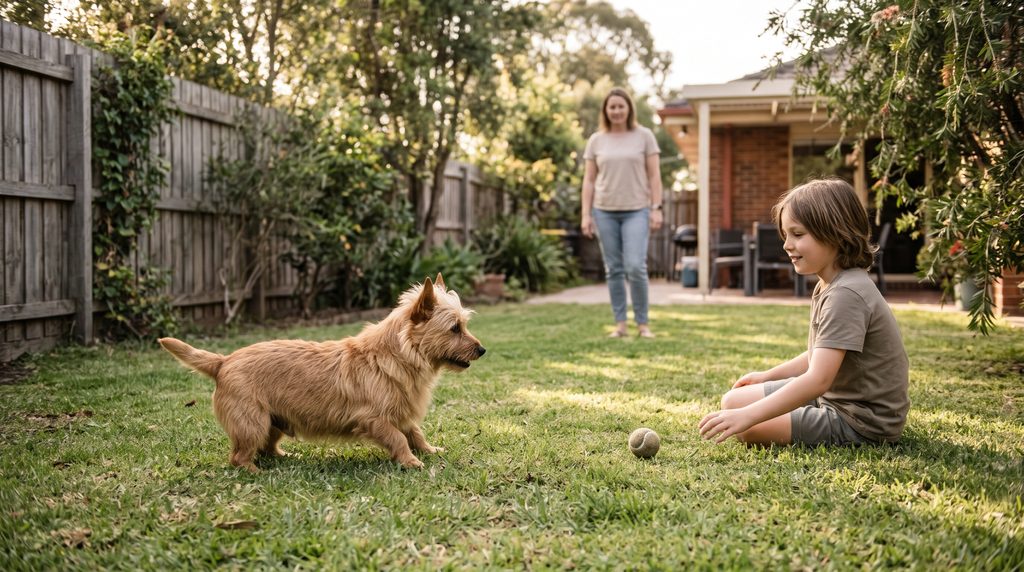
One of the most useful family rules is allowing the Australian Terrier to walk away whenever it wants to. Children often mean well, but they may keep following a dog that has already had enough attention. Teaching them to pause and let the dog choose whether to return helps build trust and reduces pressure. This simple habit is especially important around resting places, food bowls, and exciting games. A dog that feels secure and respected is far more likely to stay relaxed in family life. Good supervision is not just about watching closely, but about stepping in early and guiding interactions calmly.
Australian Terrier With Other Dogs and Pets
The Australian Terrier can live successfully with other animals, but its relationships with dogs, cats, and smaller pets require an understanding of its working heritage. Originally developed to pursue vermin around Australian farms and settlements, this small terrier retains strong hunting instincts, considerable confidence, and a willingness to investigate anything that moves. These characteristics do not prevent it from forming positive relationships with familiar animals, but they do mean that compatibility should never be assumed. Individual temperament, early experiences, careful introductions, and sensible household management all influence whether an Australian Terrier will be comfortable sharing its home with other pets.
Many Australian Terriers enjoy the company of familiar dogs, particularly when relationships develop gradually and both animals have compatible personalities. Some are playful, sociable companions that happily share walks, resting areas, and ordinary household routines. Others are more independent or selective about canine company. The breed’s self-assurance can occasionally create difficulties because an Australian Terrier may behave confidently toward dogs considerably larger than itself. This boldness is typical of working terriers, but owners should never assume that a small dog is automatically safe during disagreements simply because it is physically less powerful.
Early socialization can make a meaningful difference to how Australian Terriers respond to unfamiliar dogs. Puppies benefit from carefully selected interactions with calm, appropriately vaccinated dogs that demonstrate good social skills. These experiences help develop confidence, communication, and the ability to remain relaxed around other animals. However, socialization should not involve allowing every dog to approach or encouraging uncontrolled group play. Learning to pass another dog calmly on a walk is just as valuable as enjoying a friendly game. The goal is a confident, well-adjusted adult rather than a dog that expects every encounter to involve direct interaction.
When introducing an Australian Terrier to a new canine companion, a gradual approach is usually best. Begin in a quiet, neutral location with both dogs on comfortable leashes and accompanied by separate handlers. A parallel walk allows them to become familiar with one another’s presence without the pressure of an immediate face-to-face greeting. If both remain relaxed, the distance can be reduced gradually. Owners should watch for loose body movements, comfortable expressions, and the ability to disengage naturally. Stiff posture, prolonged staring, repeated growling, or increasingly forceful approaches indicate that more space may be needed.
Size differences deserve particular consideration. An Australian Terrier may be perfectly willing to challenge a much larger dog, but its courage offers little physical protection if a disagreement escalates. Even friendly play between dogs of substantially different sizes can result in accidental injury when the larger animal becomes overexcited. Owners should choose playmates carefully and interrupt rough or one-sided interactions before either dog becomes uncomfortable. A gentle, socially experienced larger dog may be a suitable companion, but temperament and play style matter considerably more than breed or body size alone.
Multi-dog households can work well when individual relationships are compatible and owners maintain sensible boundaries. Some Australian Terriers live happily with another terrier or a different breed, while others prefer having more personal space. Competition over food, toys, resting areas, or human attention may occasionally cause tension, particularly in confident or possessive individuals. Separate feeding arrangements, individual beds, and supervision around valued items can prevent unnecessary disagreements. Some same-sex pairings may present additional challenges, although sex alone cannot predict whether two dogs will get along. The behavior of the individuals involved should guide decisions.
Living with cats introduces a different consideration because the Australian Terrier’s natural prey drive can be strong. Some individuals coexist successfully with familiar household cats, especially when introduced carefully and given time to develop a predictable relationship. However, a terrier that calmly observes a resting cat may respond very differently when that same animal suddenly runs across the garden. Movement can trigger pursuit, even in dogs that appear affectionate and relaxed in other circumstances. Owners should therefore avoid assuming that growing up alongside a cat guarantees permanent safety.
Introductions between an Australian Terrier and a cat should proceed slowly, with the cat retaining access to secure escape routes and dog-free areas. Initially, controlled visual contact through a sturdy barrier may be more appropriate than direct interaction. Calm behavior can be rewarded, while chasing, persistent fixation, or repeated attempts to rush toward the cat should prompt greater separation. Progress should depend on the comfort and behavior of both animals. Some households may eventually allow carefully supervised shared access, while others will need permanent management arrangements. Neither outcome should be forced.
Smaller pets require considerably greater caution. Rabbits, guinea pigs, hamsters, pet rats, and similar animals resemble the kinds of prey Australian Terriers were historically bred to pursue. Their rapid movements, small size, and characteristic scents can activate hunting behavior even in an otherwise affectionate family companion. These animals should be kept in secure enclosures within areas the dog cannot access. A cage alone may not provide sufficient protection from a determined terrier. Owners should not attempt direct introductions simply to discover whether the dog will behave gently.
Birds and backyard poultry also deserve careful management. An Australian Terrier may show little interest in a stationary chicken or bird but become highly excited when it flutters, runs, or escapes unexpectedly. Households keeping chickens, ducks, or other birds should use secure fencing and separate areas to prevent uncontrolled encounters. The same precautions apply to wildlife visiting the garden. Lizards, rodents, and small birds may attract intense attention, particularly when the dog is allowed to investigate outdoors without close supervision.
Training helps Australian Terriers develop useful control around other animals, but it cannot reliably eliminate their hunting instincts. Recall, loose-leash walking, attention to the owner, and a practiced leave-it cue are valuable everyday skills. Rewarding calm behavior around distractions can help the dog learn to disengage rather than automatically pursue movement. Nevertheless, reliable commands in familiar surroundings do not guarantee obedience when a fast-moving animal appears unexpectedly. Secure fencing, appropriate leashes, and supervised access remain essential safeguards.
Ultimately, an Australian Terrier does not need unrestricted access to other animals to enjoy a fulfilling life. Some become affectionate companions to familiar dogs and cats, while others are happiest as the only household pet. What matters is recognizing the individual dog’s behavior and creating arrangements that protect every animal involved. With thoughtful introductions, realistic expectations, and suitable management, many Australian Terriers can enjoy positive relationships with other pets without compromising their natural confidence or characteristic terrier spirit.
Small Pets Need More Than a Secure Cage
Australian Terriers were developed to pursue small animals, and their hunting instincts may remain strong even when they are affectionate with familiar household pets. Rabbits, guinea pigs, hamsters, and pet birds should have secure living areas that the dog cannot enter. A cage positioned within reach of a determined terrier may not provide adequate protection, particularly if the animal moves suddenly or attracts the dog’s attention. Separate rooms with reliably closed doors are generally safer than relying on obedience or supervision alone. Successful coexistence means ensuring every animal feels secure, not expecting a working terrier to ignore its natural instincts.

Australian Terrier Exercise and Activity Needs
The Australian Terrier is a lively, energetic little dog whose exercise requirements reflect its history as a determined working terrier. Although considerably smaller than many athletic breeds, it possesses stamina, curiosity, and an enthusiasm for exploring its surroundings. Its ancestors spent their days investigating farms, pursuing vermin, and accompanying their owners around rural properties, developing both physical endurance and an active, independent mind. Modern Australian Terriers may live primarily as household companions, but they still benefit from regular opportunities to walk, investigate, play, and participate in stimulating activities. Their small size should never be mistaken for an absence of exercise needs.
Most healthy adult Australian Terriers benefit from approximately 45 to 60 minutes of combined daily activity, although this is a practical starting point rather than a rigid requirement. Some individuals are content with a moderate walk and several short play sessions, while particularly energetic dogs may enjoy longer outings. Age, fitness, health, weather conditions, and individual temperament should all influence the routine. The objective is not to exhaust the dog, but to provide enough meaningful activity to maintain healthy body condition, satisfy natural curiosity, and encourage comfortable relaxation afterward.
Daily walking is one of the simplest and most effective ways to meet these needs. Australian Terriers generally enjoy accompanying their owners through parks, quiet neighborhoods, gardens, and appropriate countryside trails. Their relatively short legs do not prevent them from maintaining an enthusiastic walking pace, and many are capable of covering surprisingly substantial distances when properly conditioned. However, owners should avoid judging exercise quality entirely by speed or distance. A varied walk that includes opportunities to investigate the environment can be more satisfying than a repetitive march along the same pavement.
Sniffing deserves particular attention because the Australian Terrier was developed to investigate and locate small animals. Its natural curiosity can make ordinary scent exploration an important part of a rewarding outing. Allowing the dog time to investigate grassy verges, fallen leaves, or interesting patches of ground provides mental engagement alongside physical movement. Owners can incorporate short sniffing breaks into walks rather than insisting that every minute involves walking directly beside them. A comfortable harness and appropriately managed leash can make these opportunities easier while maintaining safe control.
The breed’s hunting instincts also create an important exercise-related responsibility. Australian Terriers may respond instantly when they notice a rabbit, squirrel, lizard, or other small moving animal. Even a dog that normally responds well to its owner can become intensely focused during a chase. For this reason, off-leash exercise should take place only in appropriately secured areas. The Australian Terrier Club of America specifically emphasizes secure fencing and leash use because the breed’s prey drive can override ordinary responses to commands. Owners should not rely on size, familiarity with a location, or previous good behavior as guarantees against sudden pursuit.
Interactive games provide an excellent complement to walking. Many Australian Terriers enjoy retrieving small toys, playing controlled tug games, searching for hidden objects, or participating in brief games that involve cooperation with their owners. Their natural enthusiasm makes them entertaining partners, although individual preferences differ. Some love chasing a softly tossed toy, while others prefer carrying an object or investigating where it has been hidden. Games should remain enjoyable and appropriately paced, with breaks before excitement becomes excessive. Repeated high jumps or abrupt turns are unnecessary when ordinary play can provide ample activity.
Digging is another characteristic worth incorporating into exercise planning. Many Australian Terriers naturally enjoy investigating soil, burrows, and interesting scents beneath the ground. Where space allows, providing a designated digging area can give the dog an appropriate outlet for this behavior. A shallow sandpit or carefully prepared patch of soil can be used for supervised games involving buried toys or hidden rewards. This approach does not guarantee that the terrier will ignore every flowerbed, but it offers a constructive alternative. Owners should also check fencing regularly because determined digging near boundaries can create escape opportunities.
Mental exercise is particularly valuable for a breed that learns quickly and enjoys solving problems. Food puzzles, snuffle mats, simple scent searches, and short training games can keep an Australian Terrier engaged without requiring prolonged physical exertion. Owners might scatter a small portion of the dog’s regular food across suitable grass, hide a familiar toy around the house, or introduce a sequence of simple tasks that the dog can complete for rewards. These activities are useful during rainy weather, unusually hot days, or periods when outdoor exercise must be reduced. They also encourage concentration rather than constant physical excitement.
For owners interested in organized activities, Australian Terriers can participate in obedience, rally, agility, scent work, and other suitable canine sports. Their alertness and willingness to investigate make scent-based activities particularly appealing, while their agility and sturdy construction can support enjoyable obstacle work when appropriately introduced. Training should remain varied and rewarding because repetitive exercises may quickly lose the interest of an independent terrier. Competitive success is not essential. Learning to navigate a simple obstacle course, search for an object, or complete a short sequence of cues can provide substantial satisfaction without demanding excessive physical effort.
Puppies require a different exercise approach from mature adults. Young Australian Terriers are often enthusiastic explorers, but their developing bones, joints, and supporting tissues should not be subjected to repetitive high-impact activities or forced endurance exercise. Short walks, free movement in safe areas, gentle games, and age-appropriate exploration are usually more suitable than lengthy hikes or repeated jumping. Puppies should be allowed frequent opportunities to rest, and exercise should increase gradually as their physical capabilities develop. A veterinarian can provide guidance where growth, joint health, or unusual movement raises concerns.
Weather conditions should also influence activity. Although the Australian Terrier possesses a protective double coat, prolonged exertion in hot conditions can still cause overheating, particularly on exposed paths with little shade. During Australian summers and similarly warm climates, early-morning or evening walks are often more comfortable. Owners should carry fresh water, provide rest breaks, and check pavement temperatures before heading out. Cooler weather is generally easier to manage, although elderly dogs and those with medical conditions may appreciate shorter outings or additional protection during particularly cold or wet conditions.
Older Australian Terriers often remain enthusiastic about everyday activity, but their exercise should become more adaptable as they age. Arthritis, reduced stamina, or other medical concerns may make demanding walks less comfortable. Several shorter outings can provide valuable stimulation without unnecessary fatigue. Gentle scent games and familiar activities can help preserve mental engagement even when mobility changes. Owners should watch for limping, stiffness, reluctance to climb steps, or unusual tiredness rather than assuming that a naturally determined terrier will stop when uncomfortable.
Equally important is teaching the Australian Terrier to relax between activities. Some individuals become increasingly demanding when every sign of restlessness leads to another exciting game. A balanced routine should include exercise, enrichment, companionship, and predictable quiet periods. Rewarding calm behavior and allowing sufficient rest helps the dog develop a more manageable daily rhythm. A happy Australian Terrier should enjoy participating in an adventure while also being comfortable settling beside its family afterward.
Ultimately, Australian Terrier exercise is best approached through variety rather than intensity. Regular walks, opportunities to sniff, suitable games, mental challenges, and safe exploration all contribute to a satisfying lifestyle. The breed’s compact size makes its physical needs manageable for many households, but its lively intelligence and hunting instincts still require attention. Owners who combine enjoyable activity with secure surroundings and sensible routines can help their Australian Terrier remain fit, confident, and content throughout its life.

Why Australian Terriers Need Secure Exercise Areas
Australian Terriers were developed to pursue vermin, and their instinct to chase small animals can remain exceptionally strong. A dog that normally walks politely may suddenly become absorbed in pursuing a rabbit, squirrel, or other moving animal. For this reason, outdoor exercise should involve a secure leash or a reliably enclosed area. Fencing must be checked for gaps and opportunities to dig underneath, particularly around gates and garden boundaries. A private, securely fenced space provides opportunities for energetic play without exposing the dog to unnecessary risks. Safe exercise preserves the breed’s natural enthusiasm while protecting wildlife and preventing accidents.
Training an Australian Terrier
Training an Australian Terrier can be an enjoyable and rewarding experience, but success depends on understanding the breed’s independent working background. These intelligent little dogs are capable of learning quickly, remembering routines, and developing impressive practical skills. However, they were originally bred to make decisions while pursuing vermin rather than waiting for constant instructions from a handler. That independence remains an important part of their character. An Australian Terrier may understand exactly what is being requested yet become distracted by a more interesting smell or movement. Effective training therefore relies on motivation, consistency, and making cooperation genuinely worthwhile.
Positive reinforcement is particularly well suited to the Australian Terrier’s lively personality. Rewarding desirable behavior with small food treats, enthusiastic praise, toys, or access to enjoyable activities helps the dog understand what produces good results. Many Australian Terriers respond especially well to brief, engaging exercises that allow them to think and participate. Harsh corrections, intimidation, and repeated physical punishment can damage trust without addressing the underlying cause of unwanted behavior. Owners generally achieve better progress by explaining expectations clearly, rewarding success promptly, and arranging training situations in which the dog can make appropriate choices.
Training should begin as soon as an Australian Terrier puppy arrives home. Early priorities include learning its name, responding to gentle handling, coming when called in safe surroundings, settling comfortably, and becoming familiar with everyday household routines. Very young puppies have limited attention spans, so sessions lasting just a few minutes are often more productive than prolonged practice. A puppy that enjoys several successful exercises will usually be more enthusiastic about the next lesson than one that has become tired or frustrated. Training can be incorporated naturally into mealtimes, play, walks, and ordinary interactions.
Socialization is equally important, particularly because Australian Terriers tend to be confident and alert. Puppies should gradually experience a suitable variety of people, household sounds, surfaces, outdoor environments, and calm, socially appropriate dogs. The objective is not to overwhelm them with constant activity or insist that they greet everyone. Instead, they should learn that unfamiliar experiences can be approached calmly and safely. Rewarding relaxed observation is especially useful for a breed that naturally notices movement and changes in its surroundings. Well-managed early experiences can reduce the likelihood of unnecessary barking, fearfulness, and confrontational responses as the dog matures.
Recall training deserves special attention because of the Australian Terrier’s strong prey drive. A dog may respond beautifully in the kitchen or enclosed garden, then become intensely focused when a lizard or rabbit suddenly appears. Owners should practice recall in gradually more distracting but secure environments, offering generous rewards for returning promptly. A long training line can provide additional control during suitable outdoor exercises. However, even a well-trained Australian Terrier should not be trusted off-leash near roads, wildlife, or other hazards unless the area is reliably enclosed. Training improves responsiveness, but it cannot guarantee that inherited hunting instincts will disappear.
Loose-leash walking is another essential skill. Australian Terriers are enthusiastic explorers, and many naturally want to investigate every interesting scent along their route. Rather than expecting the dog to remain in a strict heel position throughout every outing, owners can teach the difference between walking comfortably beside them and enjoying controlled sniffing opportunities. Rewarding a loose leash, changing direction gently, and allowing appropriate exploration helps make walks pleasant without suppressing the dog’s curiosity. A well-fitted harness can be useful, particularly for individuals that initially pull when excited.
Barking often requires consistent attention. Australian Terriers were valued as alert watchdogs, so announcing unfamiliar visitors, passing animals, or unexpected noises comes naturally to many individuals. Attempting to eliminate every bark is neither realistic nor necessary. The more useful goal is teaching the dog to settle after an appropriate alert. Owners can acknowledge the sound, encourage the dog to move away from the window or gate, and reward quiet behavior. Preventing repeated rehearsal also matters. A terrier that spends hours watching a busy footpath through an uncovered window may develop a deeply ingrained barking habit.
Impulse control can improve many aspects of daily life. Teaching an Australian Terrier to wait briefly before going through a doorway, leave an interesting object, release a toy, or settle on a mat helps channel its enthusiasm into manageable behavior. These exercises should progress gradually, with rewards appropriate to the difficulty involved. A dog that can ignore a stationary treat indoors may not immediately resist chasing a fast-moving animal outdoors. Realistic training involves practicing skills across different environments while recognizing the limits imposed by excitement and instinct.
Owners should also be prepared for occasional stubbornness. Australian Terriers are intelligent enough to notice inconsistent rules and may repeat behaviors that have worked previously. If jumping earns attention sometimes but is discouraged at other times, the dog can become confused or persistent. Consistency between household members is therefore valuable. Short, varied sessions are usually more effective than endlessly repeating the same command. Introducing a new trick, changing the training location, or using a favorite toy as a reward can help maintain enthusiasm without turning learning into a struggle.
House training generally benefits from a predictable routine and careful supervision. Puppies should be taken outdoors after sleeping, eating, drinking, and active play, with immediate rewards for toileting in the correct place. Accidents should be cleaned thoroughly without punishment. Australian Terriers can also benefit from gradual training to remain comfortable alone. Short separations, a safe resting area, and suitable enrichment help build independence without creating unnecessary distress. Because the breed forms strong attachments to its people, this is an important part of developing a confident household companion.
More advanced activities can provide useful opportunities for training once the fundamentals are established. Australian Terriers may enjoy rally, obedience, agility foundations, scent work, and trick training. Scent-based activities can be particularly satisfying because they allow the dog to use its natural investigative abilities within a structured game. Owners do not need to pursue competition to benefit from these activities. Teaching a dog to locate a hidden toy, touch a target, or complete a simple sequence of cues can provide mental stimulation and strengthen communication.
If significant behavioral difficulties develop, early professional guidance is preferable to allowing habits to become entrenched. Persistent reactivity, resource guarding, separation-related distress, or escalating aggression should be assessed individually rather than dismissed as typical terrier behavior. A qualified reward-based trainer or veterinary behavior professional can help identify contributing factors and develop an appropriate plan. Sudden changes in behavior also warrant veterinary attention because discomfort or illness may influence a dog’s responses.
Ultimately, training an Australian Terrier is about building cooperation without trying to remove the qualities that make the breed distinctive. Its curiosity, determination, alertness, and independent judgment are part of its heritage. Owners who provide clear guidance, worthwhile rewards, realistic boundaries, and enjoyable learning opportunities can develop a remarkably capable companion. The most successful Australian Terrier is not necessarily one that obeys mechanically, but one that understands household expectations, trusts its owner, and can confidently navigate everyday life.
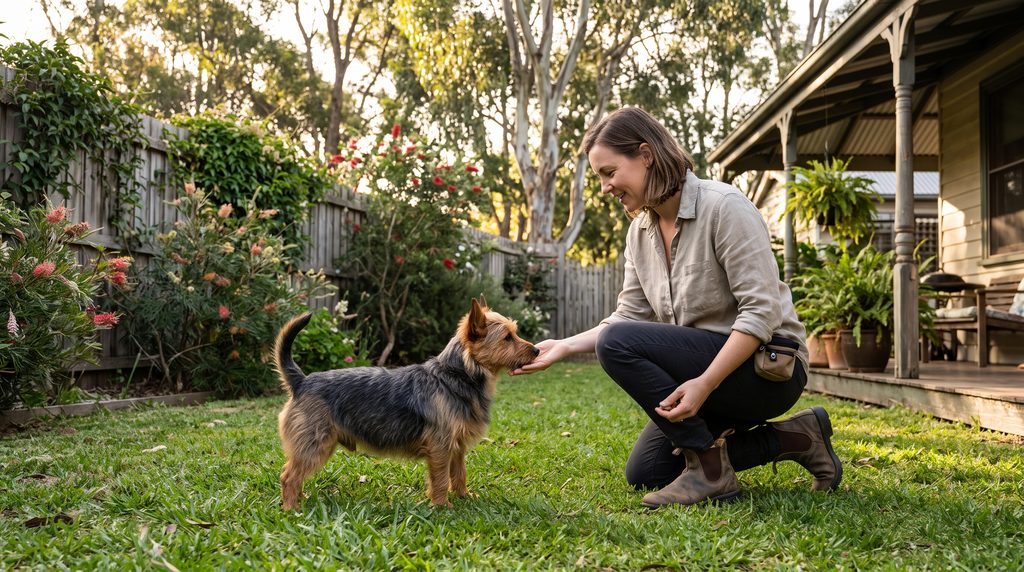
Australian Terrier Grooming and Coat Care
The Australian Terrier has a distinctive, weather-resistant double coat that is considerably easier to maintain than its rugged appearance might suggest. Developed for practical work around Australian farms and settlements, the breed’s harsh outer coat helps protect the skin from dirt, vegetation, and changing weather conditions. Unlike long-haired companion breeds that require extensive styling, the Australian Terrier generally needs straightforward, consistent maintenance rather than elaborate grooming. However, preserving its characteristic coat texture requires some understanding of how harsh-coated terriers differ from dogs with soft or continuously growing hair.
The coat consists of a straight, coarse outer layer approximately 2½ inches long over the body, supported by a short, soft undercoat. This combination provides a protective covering while helping repel ordinary dirt and moisture. The breed also has a distinctive neck ruff, longer furnishings around the forechest, and a soft topknot that contrasts with the harsher body coat. These features should remain recognizable after grooming. An Australian Terrier should look naturally tidy and functional rather than heavily sculpted or trimmed into the rounded appearance sometimes associated with decorative companion breeds.
For most family companions, brushing once or twice a week is sufficient to maintain a comfortable coat. A soft slicker brush, suitable pin brush, or metal comb can help remove loose hair, dust, and small pieces of vegetation collected during outdoor adventures. Brushing should follow the natural direction of hair growth, with particular attention to the neck ruff, chest furnishings, legs, and areas where the coat may become tangled. Although the breed rarely develops the extensive matting associated with long, silky coats, neglected areas can still become uncomfortable. Regular brushing also provides an opportunity to examine the skin beneath the coat.
One important distinction involves hand-stripping, a traditional grooming technique used with many harsh-coated terriers. Rather than cutting the hair, hand-stripping involves carefully removing mature, loose outer hairs so that fresh coat growth can maintain the appropriate texture. This technique is particularly relevant to Australian Terriers prepared for conformation shows, where the coat’s natural harshness and correct appearance are important. Proper hand-stripping should be performed gently and only on hairs that are ready to release. It requires skill and should never involve forcefully pulling healthy, firmly attached hair.
Family Australian Terriers do not necessarily require the extensive coat preparation associated with showing. The Australian Terrier Club of America notes that companion dogs generally need relatively little grooming beyond regular brushing and basic maintenance. Nevertheless, owners who want to preserve the traditional harsh texture may benefit from occasional professional hand-stripping or guidance from an experienced breed specialist. The appropriate approach depends on the dog’s coat, age, skin condition, and lifestyle. An owner should not feel obligated to maintain a show-quality coat when a simpler routine provides adequate comfort and cleanliness.
Clipping deserves consideration because it can change the appearance and texture of a harsh coat. Repeated close clipping may encourage a softer, less weather-resistant finish and reduce the distinction between the protective outer coat and undercoat. For this reason, experienced breed groomers generally prefer techniques that preserve the natural texture. However, the dog’s comfort must remain the priority. An elderly Australian Terrier, a dog with sensitive skin, or one unable to tolerate prolonged grooming may need an adapted routine. Owners should discuss practical alternatives with a knowledgeable groomer rather than treating any single technique as suitable for every individual.
Bathing is another area where less is often better. The Australian Terrier’s coat naturally helps repel dirt, so frequent shampooing is usually unnecessary. Many dogs need a full bath only when they become noticeably dirty, develop an unpleasant odor, or require washing for a particular reason. Excessive bathing can strip natural oils, soften the harsh outer coat, and contribute to dry or flaky skin. When a bath is needed, use a gentle shampoo formulated for dogs, rinse thoroughly, and allow the coat to dry comfortably. Heavy conditioners designed to produce an especially soft, silky finish are generally unnecessary for this breed.
Facial grooming requires some attention because longer hairs can grow between or in front of the eyes. These should be kept from irritating the eye surface or obstructing vision. Careful trimming or appropriate removal by someone experienced with the breed can maintain comfort without eliminating the distinctive topknot. Owners should avoid working close to the eyes with sharp tools unless they are confident and competent. A professional groomer can demonstrate how to maintain this area safely while preserving the Australian Terrier’s natural expression.
Routine grooming should also include the feet, ears, and tail. Excess hair between the paw pads can trap debris or reduce traction on smooth flooring, so occasional careful tidying may be helpful. The ears should be checked for redness, unusual odor, discharge, or irritation, particularly after outdoor adventures. Cleaning should be gentle and performed only when appropriate, using a veterinarian-recommended product. The naturally upright ears generally allow good visibility during inspection, but persistent scratching or discomfort warrants veterinary attention. Hair around the sanitary areas may also need modest trimming to maintain cleanliness.
Nail care is especially important in a small, active breed. Although regular walking on firm surfaces may naturally wear some nail growth, many Australian Terriers still require periodic trimming. Nails that become excessively long can affect paw placement and walking comfort, particularly in dogs that spend much of their time on grass or indoor flooring. Owners can gradually introduce nail clippers or a suitable grinder using rewards and calm handling. If the dog is uncomfortable or the owner is uncertain how much nail to remove, a veterinarian or experienced groomer can provide assistance.
Dental hygiene should form part of the grooming routine from an early age. Australian Terriers, like other small breeds, can develop dental problems if plaque and tartar are allowed to accumulate. Regular brushing with a dog-specific toothbrush and toothpaste is the most useful home-care measure. Owners should also arrange appropriate veterinary dental examinations and address persistent bad breath, inflamed gums, or difficulty chewing. Grooming sessions offer a convenient opportunity to examine the mouth and notice changes before they become more troublesome.
Skin care deserves particular attention because some Australian Terriers are sensitive to flea bites and may develop significant itching or allergic reactions. Maintaining effective veterinary-recommended parasite prevention is therefore important, even for dogs that spend most of their time indoors. Owners should also watch for persistent scratching, redness, hair loss, flaky skin, or repeated licking of particular areas. These symptoms should not automatically be attributed to poor grooming or dry skin. Allergies, parasites, infections, and other medical conditions may require veterinary assessment rather than changes to shampoo or brushing frequency.
Introducing grooming during puppyhood helps establish comfortable habits that can last a lifetime. Short sessions involving gentle brushing, touching the feet, inspecting the ears, and rewarding cooperation are usually more effective than attempting lengthy grooming sessions immediately. Australian Terriers are intelligent and can learn to participate willingly when handling is predictable and pleasant. Owners should avoid forcing the dog to remain still through discomfort. Gradually building tolerance makes grooming safer, reduces stress, and helps maintain a positive relationship between dog and owner.
Ultimately, Australian Terrier grooming is about maintaining a naturally protective coat and ensuring the dog’s everyday comfort. Weekly brushing, occasional bathing, appropriate coat maintenance, regular nail trimming, dental care, and skin checks will meet the needs of many family companions. Owners who appreciate the breed’s rugged appearance should resist the temptation to overstyle it. With a sensible routine and occasional professional guidance where needed, the Australian Terrier can retain its distinctive weather-resistant coat while remaining clean, healthy, and comfortable throughout life.
Hand-Stripping Versus Clipping an Australian Terrier
Hand-stripping removes mature, loose outer hairs to help preserve the Australian Terrier’s naturally harsh coat. Clipping cuts the hair instead and, particularly when repeated, can leave the coat looking softer and less characteristic of the breed. Show dogs generally require more specialized coat preparation than ordinary family companions, which often remain comfortable with regular brushing and occasional tidying. Hand-stripping should only be carried out by someone who understands the technique, and it should never cause unnecessary pain or skin irritation. For older dogs or those with medical concerns, a simpler grooming routine may be more appropriate. Comfort and coat health should always come first.

Australian Terrier Shedding
The Australian Terrier is often considered a relatively tidy breed to live with, particularly when compared with heavily coated dogs that leave obvious hair across floors, furniture, and clothing. Its harsh outer coat and short undercoat do shed, but usually in a more modest and manageable way than the coats of many double-coated breeds. Owners should still expect some loose hair around the home, particularly on dark fabrics or in favored sleeping spots, but the breed is not generally associated with dramatic seasonal coat drop. For people who want a small terrier that is easier to keep tidy than many other breeds, the Australian Terrier often fits that expectation reasonably well.
Part of this impression comes from the coat’s texture. The outer coat is harsh, straight, and weather-resistant rather than soft and fluffy, which means it tends not to release clouds of loose undercoat in the way a heavily shedding breed might. Loose hair is often caught in the coat until removed during brushing rather than falling everywhere immediately. This can make the breed seem almost non-shedding to inexperienced owners, but that is not entirely accurate. Australian Terriers do shed, just usually at a lower and less obvious level than many smooth-coated or plush-coated dogs.
Regular brushing helps keep shedding manageable. A once- or twice-weekly grooming session removes loose hairs, dirt, and small bits of plant material before they spread around the house. It also helps owners keep the coat tidy and monitor the skin underneath. In many homes, this simple routine makes a noticeable difference to how much hair ends up on upholstery and bedding. A neglected coat may still not look dramatically messy, but regular maintenance usually keeps the breed at its best and reduces gradual buildup of loose hair in the furnishings around the neck, chest, and legs.
Seasonal changes may affect shedding slightly, although the pattern is usually less dramatic than in breeds with thick, dense undercoats. Some Australian Terriers shed a little more during warmer parts of the year or when the coat is naturally renewing. Dogs living mainly indoors may show less obvious seasonal change because indoor heating, artificial light, and a fairly stable home environment can soften the contrast between seasons. Individual coat differences matter too. Some dogs simply carry and release hair differently from others, even when equally healthy and well cared for.
The grooming method also affects how much shedding owners notice. Hand-stripped or regularly maintained harsh coats often release less obvious loose hair into the home because dead outer hairs are removed during grooming. Dogs that are clipped repeatedly may develop a softer coat texture over time, and this can sometimes make loose hair more noticeable. Even so, clipping does not transform the breed into a heavy shedder. It simply changes how the coat behaves and may alter the crisp, protective texture that makes the Australian Terrier so distinctive.
A common question is whether the Australian Terrier is hypoallergenic. The honest answer is no. Like every dog breed, the Australian Terrier produces proteins in its skin cells, saliva, and urine that can trigger allergic reactions in sensitive people. Shedding level alone does not determine whether a breed is suitable for allergy sufferers. Even a relatively low-shedding dog can still spread allergens through dander, grooming, skin flakes, and everyday contact with furniture and clothing. For this reason, no Australian Terrier should be advertised as truly allergy-free.
That said, some people with mild dog allergies may find low-shedding, harsh-coated breeds easier to live with than dogs that shed much more heavily. The Australian Terrier may release fewer loose hairs into the environment than a Labrador Retriever or German Shepherd, and regular brushing can help reduce the amount of coat debris in the home. However, this should be treated as a matter of degree rather than a guarantee. Someone with significant allergies or asthma should spend meaningful time around the breed and seek medical guidance before assuming that an Australian Terrier will be a safe choice.
Good household management can reduce the impact of shedding and allergens. Regular vacuuming, washing the dog’s bedding, brushing outdoors when possible, and cleaning favored resting areas all help. Some owners also find that keeping dogs off beds and certain upholstered furniture makes the home easier to manage. None of these steps removes allergens completely, but they can make everyday life more comfortable. The same simple measures also keep the home cleaner and reduce the gradual buildup of coarse terrier hairs on soft furnishings.
It is also important to distinguish normal shedding from hair loss caused by a health problem. A healthy Australian Terrier should not develop bald patches, inflamed skin, a strong odor, or persistent itching simply because it is shedding. Excessive scratching, chewing at the feet, recurrent ear trouble, flaky skin, or obvious thinning of the coat may point to allergies, parasites, infection, hormonal disease, or another medical issue. Because the breed can be sensitive to flea bites and may develop skin irritation, unexplained coat change should not be ignored or blamed automatically on routine shedding.
Nutrition and general health also influence coat condition. A complete, balanced diet helps support healthy skin and normal hair growth, while parasite control and routine veterinary care reduce the likelihood of preventable skin problems. Owners should be cautious about assuming that supplements are automatically necessary whenever they notice loose hair. In many cases, a modest amount of shedding is completely normal. When coat quality changes noticeably, it is usually more useful to consider the dog’s overall health, skin comfort, and grooming routine than to reach immediately for a new product.
Overall, the Australian Terrier is a relatively low-shedding breed with a practical, easy-to-manage coat, but it is not non-shedding and not hypoallergenic. Most owners find the amount of hair in the home quite manageable with regular brushing and ordinary cleaning. For people who appreciate the breed’s rugged appearance and terrier personality, the coat is usually one of its more convenient features. Realistic expectations matter most: this is a tidy little dog, not a magically hair-free one.
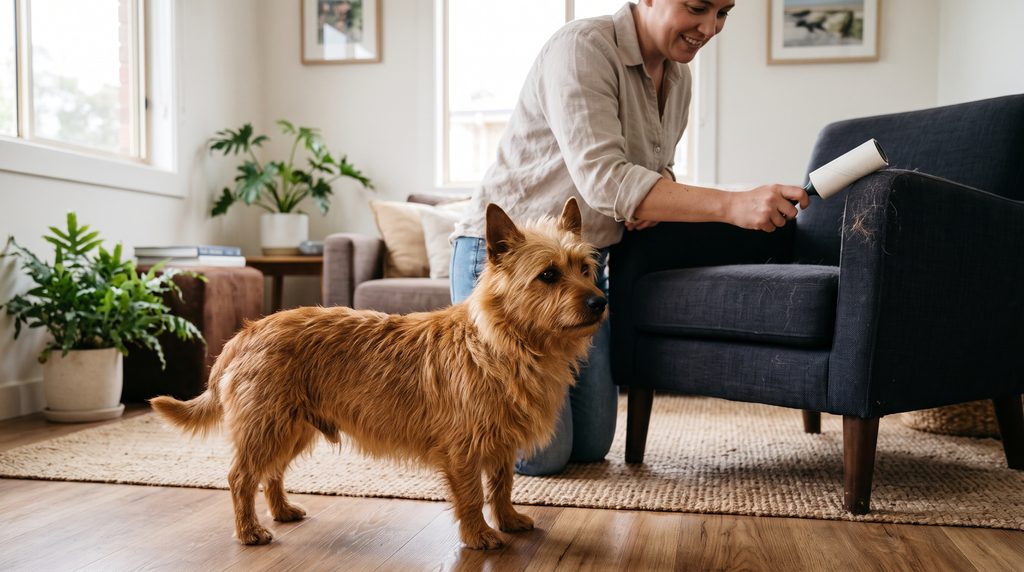
Low Shedding Does Not Mean Allergy-Free
Australian Terriers are often easier to keep tidy than many heavier-shedding breeds, but that does not make them hypoallergenic. People react mainly to proteins found in dander, saliva, and urine rather than to hair alone. A relatively low-shedding coat may reduce the amount of hair visible around the home, yet allergens can still collect on furniture, bedding, and clothing. Regular brushing, good household cleaning, and washing dog bedding can help keep things manageable, but they do not eliminate allergic triggers. Individual reactions also vary considerably, so one person’s positive experience with an Australian Terrier does not guarantee another person will respond in the same way. Anyone with significant allergies should spend time around the breed before making a long-term decision.
Australian Terrier Feeding and Nutrition
The Australian Terrier is a small, energetic breed whose nutritional needs are best met through a balanced diet, appropriate portions, and consistent feeding habits. Although these dogs possess the enthusiasm and stamina of traditional working terriers, their relatively modest body size means they do not require large quantities of food. Maintaining an appropriate weight is particularly important because even a few additional pounds can place unnecessary strain on a small dog’s joints and affect its overall comfort. The goal is to provide enough energy for an active lifestyle while avoiding the gradual overfeeding that can occur when meals, treats, and household scraps accumulate throughout the day.
A high-quality commercial dog food formulated to meet the nutritional requirements of the dog’s life stage provides a suitable foundation for most Australian Terriers. Owners should look for a nutritional adequacy statement indicating that the food is complete and balanced according to recognized AAFCO standards. This helps establish that the diet provides essential proteins, fats, vitamins, and minerals in appropriate proportions. Australian Terriers do not ordinarily require an unusual or specialized breed-specific diet simply because of their heritage. The best choice depends on the individual dog’s age, activity level, health, body condition, and response to its food.
Protein supports normal muscle maintenance, growth, and tissue repair, while dietary fat provides concentrated energy and helps maintain healthy skin and coat condition. The Australian Terrier’s distinctive harsh double coat benefits from adequate nutrition, although no particular ingredient can replace proper grooming or correct an inherited coat characteristic. A balanced diet should also provide essential fatty acids, carbohydrates where included in the formulation, and sufficient micronutrients. Owners should be cautious about selecting food based solely on attractive ingredient descriptions or marketing claims. Nutritional adequacy and the manufacturer’s expertise are more meaningful than fashionable terminology.
Portion control is especially important for this compact breed. Adult Australian Terriers typically weigh approximately 15 to 20 pounds, but their individual calorie requirements can vary considerably. A highly active dog that enjoys long walks and structured activities may require more food than a similar-sized companion with a quieter lifestyle. Feeding instructions on the package provide a useful starting point, but they should be adjusted according to the dog’s body condition and weight trend. Measuring meals with a kitchen scale or consistent measuring device is generally more reliable than estimating portions by eye.
Owners should assess body condition rather than relying exclusively on the number displayed by the scales. A healthy Australian Terrier should have a noticeable waist when viewed from above and a gently tucked abdomen when seen from the side. The ribs should be easy to feel beneath a light covering of tissue without appearing excessively prominent. Because the breed has a coarse coat and longer furnishings around the chest, weight gain may not always be immediately obvious. Regular hands-on checks and occasional weigh-ins can help identify gradual changes before they become more difficult to manage.
Most healthy adult Australian Terriers do well with two measured meals each day. Dividing the daily allowance between morning and evening can provide a predictable routine and reduce the temptation to leave food available continuously. Puppies require more frequent feeding because of their smaller stomachs, rapid development, and changing energy requirements. Young Australian Terriers should receive a complete and balanced puppy diet appropriate for growth, with meal frequency gradually reduced as they mature. A veterinarian can help determine the appropriate transition to adult food based on the individual puppy’s development.
Treats are useful for training because Australian Terriers are intelligent, food-motivated individuals that often respond enthusiastically to rewards. However, their small size means that frequent treats can contribute a surprisingly large proportion of daily calorie intake. As a general guideline, treats and other supplementary foods should provide no more than approximately 10% of the dog’s total daily calories. Using small rewards or reserving part of the regular food allowance for training can help prevent overfeeding. The nutritional contribution of dental chews, edible enrichment toys, and occasional table scraps should also be included in the overall calculation.
The breed’s natural curiosity makes food-based enrichment particularly appealing. Rather than serving every meal in a conventional bowl, owners can occasionally use a snuffle mat, suitable puzzle feeder, or supervised scent-search game. These activities encourage the Australian Terrier to investigate, problem-solve, and use its natural hunting-related behaviors in a constructive way. Feeding enrichment should remain safe and appropriate to the dog’s temperament. Dogs that become frustrated, guard food, or attempt to damage puzzle equipment may need simpler activities or additional guidance.
Fresh drinking water should always be available, especially after exercise or during warm weather. Australian Terriers may be enthusiastic outdoor companions, and even moderate activity can increase their hydration needs in hot conditions. Owners should provide water during longer outings and avoid leaving food or water bowls in direct sunlight for extended periods. A sudden change in thirst, appetite, or urination should not be dismissed as an ordinary response to the weather. Such changes can indicate a medical problem and deserve veterinary attention.
Health conditions may sometimes require adjustments to an Australian Terrier’s diet. Diabetes mellitus has been reported in the breed and is particularly relevant when considering unexplained weight loss, increased thirst, or changes in appetite. A dog diagnosed with diabetes requires an individualized veterinary feeding and treatment plan rather than a general change to a commercially marketed specialty food. Other conditions, including dental disease, digestive disorders, and food-responsive skin problems, may also influence dietary choices. Restrictive elimination diets should be undertaken with veterinary guidance to avoid nutritional deficiencies and misleading conclusions.
As Australian Terriers age, nutritional requirements may change alongside activity levels and muscle condition. An older dog that exercises less may need fewer calories, but adequate protein and essential nutrients remain important. Simply reducing food substantially without considering nutritional balance is not ideal. Senior dogs with arthritis, dental discomfort, chronic disease, or unintentional weight loss may benefit from a more individualized feeding plan. Regular veterinary reviews help ensure that dietary adjustments support healthy aging rather than merely maintaining a particular number on the scales.
Ultimately, feeding an Australian Terrier is about consistency, balance, and attention to individual needs. A complete and balanced diet, measured portions, sensible treat allowances, fresh water, and regular body-condition checks provide a reliable foundation for lifelong health. Owners who combine appropriate nutrition with the breed’s active lifestyle can help maintain the sturdy, agile physique that has characterized Australian Terriers since their working origins.
A Simple Feeding Check for Small Australian Terriers
Because Australian Terriers are relatively small, minor portioning errors can have a noticeable effect over time. Check the calorie content of the chosen food rather than assuming that the same number of cups will be appropriate across different brands or formulas. Weighing the daily allowance and dividing it between meals can make feeding more consistent. Remember to account for training rewards, edible chews, and food placed inside enrichment toys. Review your dog’s weight and body condition regularly, particularly after changes in exercise, neutering, or age-related activity levels. A veterinarian can help establish an appropriate calorie target when adjustments are needed.

Australian Terrier Health and Common Health Problems
The Australian Terrier is generally regarded as a sturdy, healthy breed with a relatively long life expectancy and fewer exaggerated physical characteristics than many modern companion dogs. Its development as a practical working terrier encouraged sound movement, resilience, and a functional body structure. Nevertheless, Australian Terriers can develop inherited and acquired health conditions, some of which deserve particular attention from breeders and owners. Understanding these concerns helps families recognize early warning signs, make informed decisions about veterinary care, and support their dogs throughout a life that commonly extends into the early or middle teenage years.
Patellar luxation is one of the better-recognized orthopedic concerns in Australian Terriers. This condition occurs when the kneecap moves out of its normal position within the groove of the thighbone. Some affected dogs occasionally skip, hop, or briefly carry a hind leg before returning to normal movement. Others experience persistent lameness, discomfort, or progressive joint changes. Severity varies considerably, and not every case requires surgery. However, recurrent symptoms should be assessed by a veterinarian because untreated instability may contribute to arthritis and reduced mobility. Maintaining healthy body condition is particularly important for dogs with vulnerable joints.
Legg-Calvé-Perthes disease is another condition associated with the breed, although responsible breeding has helped reduce its occurrence in some populations. It develops when the blood supply to the head of the femur becomes disrupted, causing deterioration of the bone within the hip joint. The condition typically becomes apparent in young dogs, often through increasing hind-leg lameness, pain, or reluctance to bear weight. Diagnosis generally involves veterinary examination and radiographs. Treatment depends on severity, but surgery can offer a good outcome for many affected dogs. Persistent limping in a young Australian Terrier should never be dismissed as ordinary puppy awkwardness.
Diabetes mellitus is an important metabolic condition reported in Australian Terriers and recognized within breed health research. Dogs with diabetes cannot regulate blood glucose normally, usually because they do not produce sufficient insulin. Warning signs commonly include increased thirst, more frequent urination, changes in appetite, and unexplained weight loss despite normal or increased food consumption. Some affected dogs develop weakness or cataracts. Diabetes requires veterinary diagnosis and ongoing management, generally involving insulin treatment, consistent feeding routines, and regular monitoring. Early attention to changes in drinking and urination can make a substantial difference to the dog’s welfare.
Hypothyroidism occurs when the thyroid gland fails to produce adequate amounts of thyroid hormones. Affected Australian Terriers may develop unexplained weight gain, reduced energy, thinning hair, skin changes, or an increased tendency to seek warmth. These symptoms can resemble other medical problems, so diagnosis requires appropriate veterinary testing rather than assumptions based on appearance. Dogs diagnosed with hypothyroidism can often enjoy a good quality of life with prescribed thyroid hormone replacement and periodic monitoring. Thyroid evaluation is also among the health tests recommended by the Australian Terrier Club of America for breeding dogs.
Eye disorders are another consideration, particularly because maintaining good vision is important for an active, inquisitive terrier. Cataracts can cause cloudiness within the lens and may interfere with vision as they progress. Progressive retinal atrophy has also been reported in the breed and involves deterioration of the light-sensitive cells within the retina. Some affected dogs initially struggle in dim lighting before experiencing more substantial visual impairment. Not every change in an older dog’s eyes indicates an inherited disorder, but squinting, unusual cloudiness, bumping into objects, or difficulty navigating familiar surroundings warrants veterinary assessment.
Skin health can occasionally present challenges, particularly through allergic skin disease and flea-bite hypersensitivity. The Australian Terrier’s harsh outer coat provides useful physical protection, but it does not prevent irritation beneath the hair. Affected dogs may scratch persistently, lick their feet, develop reddened skin, or experience recurrent ear problems. Flea allergy can cause significant discomfort even when only a small number of fleas are present. Effective parasite prevention and early investigation of persistent itching are therefore important. Owners should avoid repeatedly changing shampoos or diets without establishing the underlying cause, as infections, environmental allergies, and other conditions can produce similar symptoms.
Dental disease also deserves attention. Australian Terriers have relatively strong jaws and teeth for their size, but small dogs can still accumulate plaque and tartar, develop inflamed gums, and experience painful periodontal disease. Bad breath, reluctance to chew, excessive drooling, or visible gum inflammation should prompt an examination. Regular toothbrushing with dog-specific toothpaste, suitable veterinary dental care, and routine oral assessments can help preserve dental health. Dental problems are particularly easy to overlook in cheerful terriers that continue eating despite discomfort.
Less frequently reported concerns include epilepsy and seizure disorders, certain heart abnormalities, and other inherited or acquired conditions. Their presence in breed health records does not establish that they are common or that every Australian Terrier faces an unusually high risk. Seizures, episodes of collapse, unusual weakness, or sudden changes in coordination always require veterinary attention. The breed’s health organizations continue collecting information about a broad range of conditions to better understand which problems may have an inherited component and how frequently they occur.
Cancer can also affect Australian Terriers, particularly as they become older. No single cancer should be assumed to be inevitable or uniquely characteristic of the breed. Nevertheless, owners should investigate unexplained lumps, persistent wounds, changes in appetite, unusual bleeding, or progressive weight loss. Many lumps are benign, but appearance alone cannot reliably distinguish harmless growths from more serious problems. Early veterinary assessment allows appropriate diagnostic testing and, where necessary, treatment before a condition becomes more advanced.
Preventive veterinary care provides an important foundation for lifelong health. Australian Terriers benefit from regular physical examinations, appropriate vaccinations, parasite prevention, dental assessment, and monitoring of body condition. Their natural enthusiasm may occasionally make illness less obvious, particularly when discomfort develops gradually. Owners should pay attention to changes in mobility, appetite, thirst, energy, skin condition, or behavior rather than waiting until the dog appears seriously unwell. A previously active terrier that becomes reluctant to walk or jump may be experiencing discomfort rather than simply becoming stubborn.
As an Australian Terrier reaches its senior years, arthritis, dental deterioration, changes in vision or hearing, and age-related medical conditions may become more relevant. Older dogs may need more frequent veterinary reviews or adjustments to their exercise and nutrition routines. Some remain remarkably active well into their teens, but maintaining quality of life involves recognizing when their needs have changed. Gentle activity, comfortable resting areas, appropriate pain management, and prompt investigation of new symptoms can help preserve independence and enjoyment.
Inherited health concerns also highlight the importance of responsible breeding. The Australian Terrier Club of America recommends examinations of the knees, eyes, and thyroid gland in breeding stock. These evaluations do not eliminate every possibility of disease, but they provide useful information for identifying potential problems and making more informed breeding decisions. Prospective owners should be encouraged to ask about documented family health histories rather than relying solely on assurances that the parents appear healthy. The specific tests, recommended intervals, and interpretation of results are covered in the following Health Screening and Genetics section.
Overall, the Australian Terrier remains a comparatively robust small breed, and many individuals enjoy long, active lives without developing serious inherited disease. Awareness of patellar luxation, Legg-Calvé-Perthes disease, diabetes, thyroid disorders, eye conditions, and skin problems allows owners to respond sensibly rather than worry unnecessarily. With responsible breeding, appropriate preventive care, and attention to early symptoms, an Australian Terrier has an excellent opportunity to remain a lively and affectionate companion for many years.
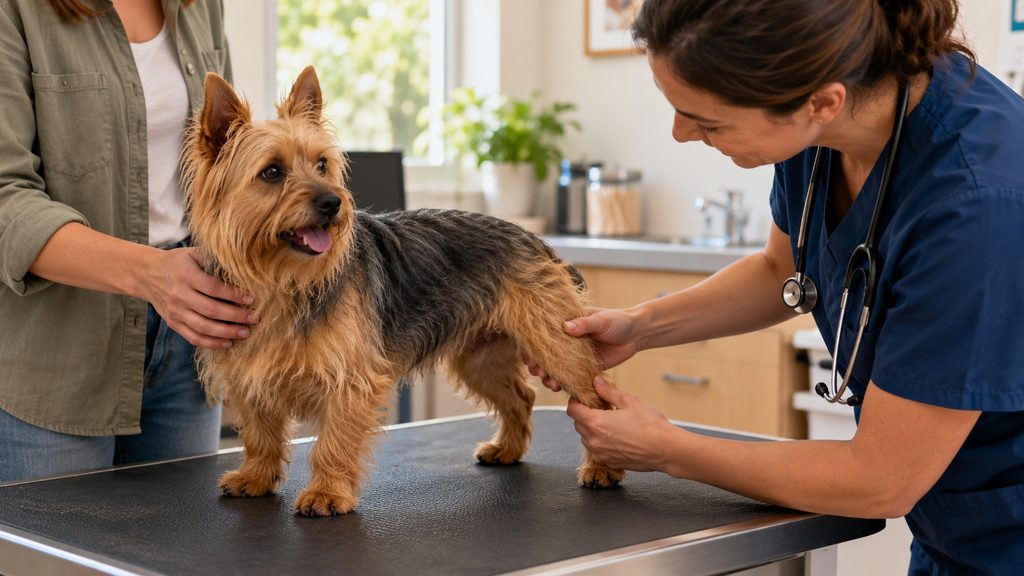
Australian Terrier Health Screening and Genetics
Responsible health screening plays an important role in protecting the long-term health of the Australian Terrier. Although this sturdy little breed is generally associated with good longevity and relatively few exaggerated physical characteristics, certain inherited conditions can occur within its population. Screening breeding dogs before producing puppies helps identify potential health concerns, informs breeding decisions, and reduces the likelihood of passing some problems to future generations. For prospective owners, understanding which examinations are recommended provides a practical way to distinguish responsible breeding practices from reassuring statements that are not supported by veterinary evidence.
The Australian Terrier Club of America recommends three principal health evaluations for breeding dogs: patellar examination, ophthalmologist evaluation, and thyroid testing. These recommendations form the foundation of the breed’s participation in the Orthopedic Foundation for Animals (OFA) Canine Health Information Center, commonly known as CHIC. Each examination addresses a different aspect of health, and none should be regarded as interchangeable with the others. Together, they provide useful information about orthopedic soundness, eye health, and thyroid function.
Patellar evaluation assesses whether the kneecaps remain correctly positioned within their normal grooves. Patellar luxation is a recognized concern in the Australian Terrier and can range from mild instability to more significant displacement associated with discomfort and lameness. An OFA patellar evaluation involves a veterinary examination of both knees, with certification available for dogs aged at least 12 months. Results may identify normal patellae or document the presence and severity of luxation. Responsible breeders should consider these findings alongside the dog’s family history rather than relying on appearance or movement alone.
A normal patellar result is valuable, but it does not guarantee that every puppy produced by that dog will have completely healthy knees. Patellar luxation can have a complex inherited component, and factors influencing its development may not be captured by a single examination. Breeders should therefore consider the health of parents, siblings, and previous offspring where records are available. Buyers can ask to see the results for both parents and discuss whether joint problems have occurred elsewhere in the family.
Ophthalmologist evaluation is another essential part of Australian Terrier screening. This examination should be performed by an appropriately qualified veterinary ophthalmologist who can assess the eyes for abnormalities that might affect breeding decisions. Conditions of interest include cataracts and other inherited or potentially hereditary eye disorders. Some eye diseases become apparent only as a dog matures, which makes periodic examinations important. A clear result obtained when a dog is young does not establish that its eyes will remain free from problems throughout life.
The Australian Terrier Club of America’s recommendations emphasize keeping eye examination results current. Breeders should be prepared to discuss when the examinations were performed and whether any changes have been identified over time. A specialist eye evaluation is also different from a routine visual check during an ordinary veterinary appointment. While general examinations are valuable, they do not replace a properly documented ophthalmologist assessment for breeding purposes.
Thyroid evaluation is the third principal recommended screening test. Australian Terriers can develop hypothyroidism, including thyroid dysfunction associated with autoimmune disease. Screening involves blood testing through an appropriate laboratory to assess thyroid function and relevant markers of autoimmune thyroiditis. The OFA thyroid program evaluates results using measures such as free thyroxine, thyroid-stimulating hormone, and thyroglobulin autoantibodies. These findings help breeders identify dogs with evidence of thyroid disease or related abnormalities that may influence breeding decisions.
Thyroid testing also requires appropriate interpretation. Results can be affected by illness, medications, and other factors, while some thyroid disorders develop later in life. For this reason, a single normal test should not be treated as permanent proof that a dog will never experience thyroid disease. The Australian Terrier Club of America recommends periodic updates to screening results, reinforcing the importance of continued health monitoring rather than relying exclusively on tests completed early in adulthood.
The OFA CHIC program provides a useful framework for documenting these evaluations. Dogs that complete the required breed-specific testing and meet the program’s identification and disclosure requirements may receive a CHIC number. However, a CHIC number does not mean that every result was normal or that the dog is certified free from inherited disease. It indicates that the required screening information has been recorded under the program’s rules. Prospective owners should examine the actual results rather than assuming that the presence of a CHIC number alone establishes excellent health.
Additional inherited concerns also deserve attention, even when they are not included in the breed’s three principal recommended tests. Legg-Calvé-Perthes disease, for example, can affect the development of the hip joint in young Australian Terriers. Because there is no widely established, breed-specific DNA test that reliably identifies every dog at risk, knowledge of family history remains important. Breeders should be transparent about affected relatives, orthopedic problems appearing in previous litters, and any relevant veterinary findings.
Diabetes mellitus is another condition of particular interest within Australian Terrier health research. The Australian Terrier Club of America and breed health organizations have supported the collection of information about diabetes and other medical problems affecting the breed. Unlike a straightforward disorder associated with a single known mutation, diabetes risk may involve more complicated interactions between inherited susceptibility and other factors. A routine commercial DNA panel cannot establish that an Australian Terrier will never develop diabetes. Accurate health records, ongoing research, and communication between breeders remain valuable.
Genetic testing technology continues to develop, and some breeders may use commercially available DNA panels alongside their recommended health examinations. These tests can provide useful information when they assess validated mutations relevant to the breed. However, a broad panel containing hundreds of tests is not automatically more informative than appropriate breed-specific screening. Many inherited conditions are influenced by multiple genes, and some do not have a clinically validated DNA test. Genetic results should therefore be interpreted with veterinary guidance and should complement, not replace, examinations of the dog’s eyes, knees, and thyroid function.
Genetic diversity is another consideration for a comparatively uncommon breed. Responsible breeding involves maintaining a healthy population while reducing the risk of serious inherited disease. Selecting breeding animals solely because they have desirable coloring, excellent show results, or completely normal findings on one particular test can overlook other important factors. Sound temperament, physical structure, overall health, genetic relationships, and family longevity should all contribute to breeding decisions. Excluding large numbers of dogs unnecessarily can also reduce genetic diversity, which may create problems of its own over time.
For prospective puppy owners, the most useful approach is to ask clear, specific questions. Responsible Australian Terrier breeders should be willing to explain which examinations have been completed, provide identifiable results for both parents, and discuss any relevant conditions within their breeding lines. Buyers can consult the public OFA database where appropriate and should understand that test records may be held through equivalent recognized schemes in other countries. Breeders who acknowledge the limitations of screening and discuss health concerns openly often provide more meaningful reassurance than those who simply describe every dog as perfectly healthy.
Health screening does not end when breeding decisions have been made. Owners also contribute to the breed’s long-term welfare by sharing veterinary diagnoses with breeders and participating in legitimate health surveys where appropriate. Information about conditions that develop later in life can help identify patterns that were not apparent when a dog was young. Australian Terrier health organizations encourage the collection of such information because accurate records support future research and more informed decisions.
Ultimately, Australian Terrier health screening combines established veterinary examinations, knowledge of family history, responsible breeding judgment, and continuing research. Patellar, ophthalmologist, and thyroid evaluations provide the principal foundation, while attention to conditions such as Legg-Calvé-Perthes disease and diabetes contributes to a broader understanding of inherited health. No screening program can guarantee a completely disease-free puppy, but transparent testing and informed breeding significantly strengthen the foundation for a healthy Australian Terrier population.
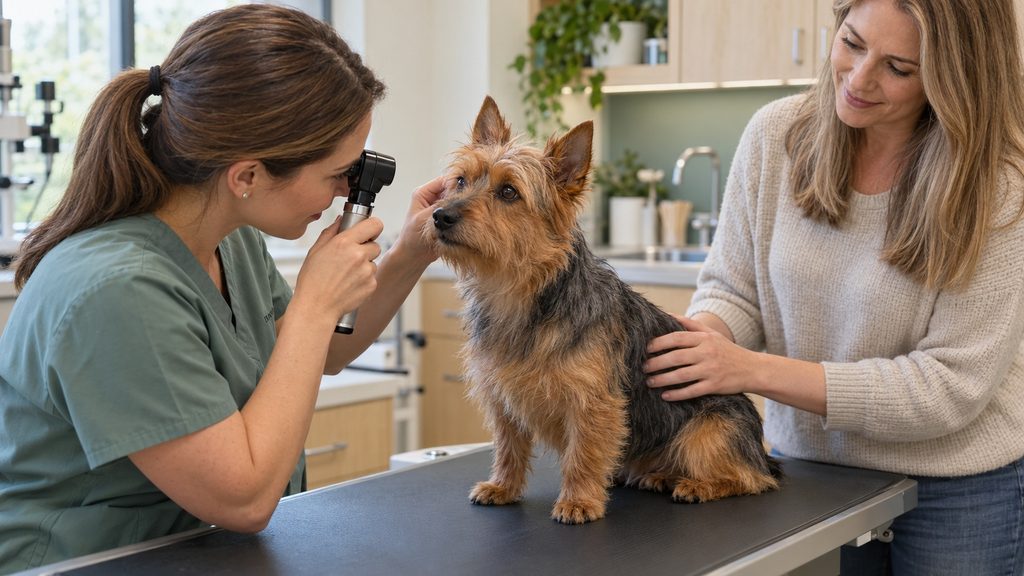
What an Australian Terrier CHIC Number Actually Means
A CHIC number shows that an Australian Terrier has completed the required breed-specific health screenings under the OFA program’s identification and disclosure rules. It does not necessarily mean that every test result was normal. The Australian Terrier Club of America recommends patellar, ophthalmologist, and thyroid evaluations for breeding dogs, and prospective owners should examine the individual results for both parents. Dates also matter because eye and thyroid conditions may develop later in life. A responsible breeder should explain any abnormal findings, provide appropriate documentation, and discuss relevant family health history. Transparent information is more valuable than a simple claim that a puppy comes from health-tested parents.
Australian Terrier Lifespan and Aging
The Australian Terrier is a relatively long-lived small breed, often remaining active, curious, and affectionate well into its senior years. According to the American Kennel Club, the typical Australian Terrier Lifespan is approximately 11 to 15 years, although some individuals live beyond this range. Dogs Victoria gives a slightly broader estimate of 11 to 16 years. These figures reflect the breed’s generally sturdy constitution and practical working heritage, but they should be treated as guidelines rather than predictions for individual dogs. Genetics, overall health, body condition, veterinary care, and everyday living conditions all influence how comfortably an Australian Terrier ages.
One of the appealing qualities of this breed is that its distinctive personality often remains recognizable throughout life. An older Australian Terrier may no longer rush through the garden with the same enthusiasm it displayed as a youngster, but it will frequently retain its curiosity, attachment to family members, and interest in familiar routines. Many senior Australian Terriers continue enjoying walks, searching for interesting scents, and accompanying their owners around the home. Their physical abilities may gradually change, but the desire to remain involved in family life can persist for many years.
When considering Australian Terrier Life Expectancy, it is important to distinguish longevity from quality of life. Living to an advanced age is desirable, but those additional years should also be comfortable and enjoyable. Some Australian Terriers remain remarkably fit into their early teens, while others develop medical problems that require adjustments much earlier. There is no precise birthday on which an Australian Terrier suddenly becomes a senior dog. Changes in stamina, mobility, sensory awareness, and general health provide more useful indicators than age alone.
Physical aging often begins with subtle differences in daily movement. An Australian Terrier that once bounded effortlessly onto furniture may start hesitating before jumping, become slower when climbing steps, or appear stiff after resting. These changes can be associated with arthritis, joint discomfort, or other musculoskeletal problems rather than simply being inevitable consequences of growing older. The breed’s history of patellar luxation makes careful attention to hind-leg movement particularly worthwhile. Owners should seek veterinary advice when mobility changes become noticeable, because appropriate treatment can often preserve comfort and activity.
Exercise remains important throughout the senior years, although routines may need adjustment. Older Australian Terriers usually benefit from regular, moderate movement rather than alternating prolonged inactivity with demanding outings. Shorter walks on comfortable surfaces may be more suitable than extended hikes, particularly for dogs experiencing joint stiffness or reduced stamina. Their natural curiosity makes gentle scent exploration especially valuable. Allowing an older terrier to investigate an interesting patch of grass can provide meaningful enrichment without requiring strenuous activity. Exercise should be adapted to the individual dog’s comfort rather than stopped simply because it has reached a particular age.
Changes in vision and hearing can also influence how an Australian Terrier behaves. An older dog may become less responsive to familiar verbal cues, hesitate in poorly lit areas, or appear startled when someone approaches unexpectedly. Such behavior should not automatically be interpreted as stubbornness or disobedience. Cataracts and other eye conditions can affect vision, while age-related hearing loss may develop gradually. Owners can help by maintaining familiar furniture arrangements, approaching calmly, using consistent visual signals, and ensuring that the dog can navigate its surroundings safely.
Dental health becomes increasingly important with age. Australian Terriers are small dogs, and periodontal disease can cause substantial discomfort if plaque and gum inflammation are allowed to progress. An older terrier that begins chewing differently, dropping food, avoiding hard treats, or developing persistent bad breath should receive a veterinary dental examination. Dental pain may be difficult to recognize because some dogs continue eating despite significant oral disease. Regular toothbrushing and appropriate veterinary treatment can help protect comfort, appetite, and general well-being throughout the senior years.
Body condition and nutrition should also be reviewed as activity changes. A less active Australian Terrier may require fewer calories to maintain a healthy weight, but excessive restriction can result in inadequate nutrition or unwanted muscle loss. Older dogs need sufficient protein and essential nutrients to maintain their tissues, and some require dietary changes because of diagnosed medical conditions. Unexplained weight loss, increased thirst, or changes in appetite should always be investigated rather than attributed automatically to aging. Diabetes mellitus and thyroid disorders are among the conditions that deserve consideration in this breed.
Senior Australian Terriers may also experience changes in sleep patterns, confidence, and cognitive function. Some begin waking during the night, wandering aimlessly, becoming confused in familiar surroundings, or appearing unusually anxious when separated from their owners. These behaviors can have several explanations, including discomfort, sensory loss, or canine cognitive dysfunction. A veterinary assessment is important before assuming that cognitive decline is responsible. Keeping routines predictable, providing gentle mental stimulation, and making the home easier to navigate can help many older dogs remain comfortable and secure.
Preventive veterinary care becomes especially valuable as an Australian Terrier approaches its later years. The American Animal Hospital Association recommends wellness examinations approximately every six months for senior pets, including those that appear healthy. These visits allow veterinarians to assess weight, mobility, dental health, heart function, and other aspects of aging. Blood tests, urinalysis, and additional investigations may be recommended according to the dog’s medical history and examination findings. Establishing baseline results before significant illness develops can make future changes easier to recognize.
The home environment may need modest adjustments as the dog ages. Nonslip runners can improve stability on polished floors, while low steps or a suitable ramp may make favorite resting places easier to reach. A supportive bed away from cold drafts can help an Australian Terrier with stiff joints settle comfortably. Food and water should remain easily accessible, and outdoor areas should be checked for hazards that have become more difficult for an older dog to negotiate. These changes need not be elaborate; small practical improvements can make a meaningful difference to everyday independence.
Maintaining emotional well-being matters just as much as managing physical health. Australian Terriers generally form strong attachments to their families, and older dogs often continue valuing companionship, familiar games, and opportunities to participate in household activities. Their pace may become slower, but they still benefit from attention and appropriate mental stimulation. Simple scent games, gentle training exercises, and relaxed time outdoors can preserve a sense of purpose. The aim is to adapt activities to the dog’s abilities rather than withdrawing experiences that still bring enjoyment.
An Australian Terrier Life Span extending into the mid-teens is certainly possible, but longevity should never be assumed or treated as a guarantee. Responsible breeding, routine health care, appropriate nutrition, weight management, and early treatment of medical problems help provide the best foundation for healthy aging. Equally important is recognizing when the dog’s needs have changed and responding with patience rather than expecting it to maintain the same abilities throughout life.
Ultimately, growing older does not mean an Australian Terrier must lose the qualities that make it such an engaging companion. Many continue to display the courage, affection, independence, and lively curiosity that defined their younger years. With appropriate adjustments and attentive care, an aging Australian Terrier can enjoy a comfortable, fulfilling life while remaining a cherished and active member of the household.
Recognizing When an Older Australian Terrier Needs Extra Support
Australian Terriers are naturally determined, and some continue participating in familiar activities despite developing discomfort. Owners should watch for subtle changes such as hesitation before jumping, slower movement after resting, reduced interest in walks, or difficulty settling at night. Changes in thirst, appetite, hearing, vision, or household behavior also deserve attention. These signs should not automatically be dismissed as normal aging, because many underlying conditions can be treated or managed. Regular senior veterinary examinations help identify problems early, while practical adjustments at home can preserve independence. The goal is to maintain comfort, confidence, and enjoyment rather than expecting an older dog to behave like a puppy.
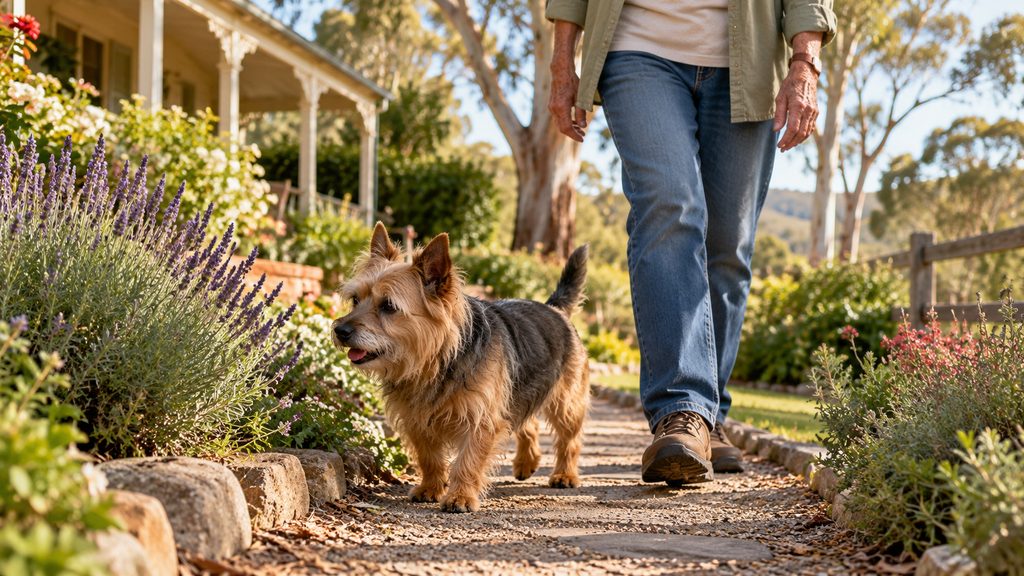
Cost of Owning an Australian Terrier
The Australian Terrier is a relatively economical breed to maintain compared with many larger dogs, but its small size should not be mistaken for inexpensive ownership. Although it generally eats modest portions, requires relatively straightforward grooming, and does not need unusually large equipment, responsible care involves financial commitments throughout its life. Veterinary treatment, preventive healthcare, training, nutrition, equipment, and unexpected emergencies can collectively represent a substantial expense. With a typical lifespan of approximately 11 to 15 years, prospective owners should consider the long-term financial responsibilities of Australian Terrier ownership rather than focusing only on the initial arrangements involved in bringing a dog home.
The first year is often more expensive than subsequent years because several essential expenses arise together. New owners need appropriate bedding, food and water bowls, a secure harness and leash, identification, suitable toys, grooming equipment, and a safe method of transporting the dog. Puppies also require veterinary examinations, scheduled vaccinations, parasite prevention, and potentially microchipping or sterilization, depending on what has already been provided. Local licensing or registration requirements may create additional costs. Families adopting an adult Australian Terrier may find that some initial medical procedures have already been completed, although the dog’s individual needs should still be reviewed carefully.
Food is one area where the Australian Terrier’s modest size provides a genuine financial advantage. Weighing approximately 15 to 20 pounds as an adult, it generally consumes considerably less food than a large or giant breed. Nevertheless, feeding costs depend on the chosen diet, the dog’s activity level, and any medical requirements. A complete and balanced commercial food is suitable for most healthy Australian Terriers, and expensive specialty products are not automatically necessary. Owners should prioritize nutritional adequacy and appropriate portions rather than assuming that higher spending always produces better health.
Veterinary care is one of the most important ongoing expenses. Even a healthy Australian Terrier requires routine examinations, vaccinations according to veterinary recommendations, parasite prevention, and appropriate dental care. These predictable services should be included in the household budget rather than treated as occasional surprises. The actual expense varies with location, veterinary practice, the dog’s age, and individual medical history. Preventive care cannot eliminate every illness, but regular examinations can help identify developing problems before they require more complicated treatment.
Breed-specific health considerations make financial planning particularly important. Australian Terriers can develop patellar luxation, Legg-Calvé-Perthes disease, diabetes mellitus, thyroid disorders, and certain eye conditions. Most individuals will not experience all of these problems, and many remain healthy throughout much of their lives. Nevertheless, an affected dog may require specialist assessment, diagnostic imaging, medication, surgery, or ongoing monitoring. Managing diabetes, for example, can involve repeated veterinary appointments and continuing treatment. Prospective owners should understand that the financial demands of caring for a dog can change considerably if a chronic condition develops.
Dental treatment deserves its own place in the budget. Like other small breeds, Australian Terriers may develop periodontal disease, and professional veterinary dental procedures can become necessary despite conscientious home care. Regular toothbrushing is inexpensive and useful, but it does not replace veterinary assessment. Owners should avoid assuming that an apparently healthy dog has no dental problems simply because it continues eating normally. Planning for occasional professional dental care helps prevent situations where treatment is postponed because the expense was unexpected.
Grooming is generally more manageable than for breeds with continuously growing or heavily feathered coats. The Australian Terrier’s harsh, weather-resistant double coat usually requires regular brushing, occasional bathing, nail care, and sensible tidying. Many owners can perform much of this work at home after learning the appropriate techniques. However, maintaining the traditional coat texture through hand-stripping may involve an experienced professional, especially for dogs participating in conformation shows. The availability and fees of specialist terrier groomers vary by location, so owners interested in professional coat maintenance should investigate local services before making a commitment.
Training costs are another consideration, particularly during puppyhood. Australian Terriers are intelligent, confident, and sometimes independent, making early socialization and consistent guidance worthwhile investments. Puppy classes or reward-based obedience sessions can help owners establish reliable routines and develop appropriate behavior around people and other dogs. Families experiencing persistent barking, resource guarding, or other behavioral difficulties may benefit from individualized professional support. Although formal training is not an endless requirement, budgeting for suitable instruction can prevent avoidable frustration and improve everyday life.
The Australian Terrier’s energetic personality also creates modest but continuing enrichment expenses. Durable toys, food puzzles, suitable chews, replacement leashes, and occasional training accessories all contribute to an engaging lifestyle. These purchases do not need to be elaborate or frequent. Simple scent games, homemade enrichment activities, and ordinary interactive play can provide considerable enjoyment without substantial spending. However, equipment should be selected for safety and replaced when damaged. A determined terrier may quickly destroy a poorly constructed toy, making durability more economical than repeatedly replacing unsuitable products.
Housing and travel arrangements can influence ownership costs as well. Australian Terriers adapt to many living environments, but secure fencing is important because of their curiosity, digging tendencies, and strong prey drive. A household may need to reinforce garden boundaries, repair gaps beneath gates, or create a safer outdoor exercise area. Owners who travel regularly should also consider boarding, pet-sitting, or other arrangements for the dog’s care. These services can become significant recurring expenses, particularly for people who are frequently away from home.
Pet insurance is worth evaluating before a serious medical problem develops. Policies differ in premiums, annual limits, deductibles, reimbursement percentages, waiting periods, and exclusions for preexisting conditions. Owners should compare the actual terms rather than selecting a policy based solely on the lowest monthly payment. Insurance may help manage some unexpected veterinary expenses, but it does not guarantee that every treatment will be covered. An alternative is to maintain a dedicated emergency savings fund, although either approach requires realistic consideration of potentially substantial veterinary bills.
Long-term costs can also increase as an Australian Terrier ages. Senior dogs may need more frequent examinations, diagnostic testing, dental treatment, medication, or adjustments to their living environment. Some continue requiring little more than ordinary preventive care, while others develop conditions that demand ongoing financial attention. Comfortable bedding, ramps, nonslip flooring, and appropriate mobility support may become useful. Families should therefore consider how the household will manage changes in the dog’s needs over many years, rather than assuming that expenses will remain constant throughout its lifetime.
Ultimately, the Australian Terrier offers several practical advantages in terms of ownership expenses. Its modest food requirements, manageable size, and relatively straightforward coat can reduce some everyday costs compared with those of larger or more grooming-intensive breeds. However, veterinary care, training, enrichment, preventive treatment, and the possibility of unexpected medical expenses remain important responsibilities. Owners who plan carefully and maintain a realistic financial safety net are better placed to provide consistent care throughout the Australian Terrier’s long and rewarding life.

Budgeting for an Australian Terrier’s Lifetime Care
The Australian Terrier’s relatively small size helps keep everyday food and equipment expenses manageable, but long-term financial planning should extend well beyond these basics. Establish a regular allowance for veterinary examinations, parasite prevention, dental care, grooming supplies, and replacement equipment. Consider professional training and occasional boarding or pet-sitting when relevant to your lifestyle. Most importantly, plan for unexpected illness or injury through suitable pet insurance, dedicated emergency savings, or a combination of both. Because Australian Terriers commonly live into their teenage years, even modest recurring expenses accumulate over time. A realistic budget helps ensure that essential care remains affordable as your dog’s needs change.
Choosing an Australian Terrier Puppy or Rescue
Choosing an Australian Terrier is an exciting prospect, but finding the right dog requires more consideration than selecting an appealing puppy photograph. This confident, affectionate, and sometimes independent little terrier can become a wonderful companion, provided its temperament and needs suit the household. Prospective owners should take time to understand the breed’s working instincts, investigate responsible breeding practices, and consider whether a puppy or an adult rescue would be the better choice. A thoughtful decision at the beginning can make an enormous difference to the relationship that develops over the following decade or more.
Australian Terriers are not among the most commonly encountered dog breeds in the United States, and responsibly bred litters may require patience to locate. The breed’s relatively limited population makes it particularly important to approach reputable Australian Terrier Breeders who understand its distinctive characteristics and inherited health concerns. An experienced breeder should prioritize sound temperament, appropriate structure, genetic diversity, and lifelong welfare rather than producing puppies simply to meet demand. Waiting for a carefully planned litter is generally preferable to making a hurried decision based on immediate availability.
The Australian Terrier Club of America is a useful starting point for researching the breed and identifying experienced breeders. Its breeder-referral resources provide information about club members and can help prospective owners establish contact with people familiar with Australian Terrier breeding and care. However, inclusion in a directory should not be treated as an automatic guarantee of quality. Owners should independently assess health-testing practices, breeding conditions, and the support offered after a puppy leaves. Breed clubs can provide useful guidance, but responsibility for evaluating an individual breeder ultimately rests with the prospective owner.
Health documentation should be a central part of that evaluation. The Australian Terrier Club of America recommends patellar examinations, specialist eye evaluations, and thyroid testing for breeding dogs. Responsible breeders should be prepared to explain these results, discuss relevant family health history, and identify any conditions that have appeared within their lines. Patellar luxation, Legg-Calvé-Perthes disease, diabetes mellitus, and certain eye disorders are among the concerns worth discussing. No screening program can guarantee that a puppy will remain completely healthy, but transparent health records demonstrate a commitment to informed breeding decisions.
Temperament deserves equal attention. Australian Terriers should be confident, alert, and affectionate without displaying excessive fearfulness or aggression toward people. A responsible breeder will consider the personalities of both parents and observe how individual puppies respond to everyday experiences. Some puppies may be particularly adventurous and energetic, while others are somewhat quieter or more thoughtful. These differences can influence household compatibility. The most outgoing puppy is not necessarily the best choice for every family, especially where owners would prefer a calmer companion or have limited experience with independent terriers.
Meeting the mother, when practical, can provide useful insight into temperament, appearance, and the environment in which the puppies are being raised. She should appear reasonably comfortable with familiar people, although normal maternal behavior must be considered. The father may live elsewhere and may not be available to meet. In that case, breeders should be willing to discuss his temperament, health records, and relevant characteristics. Owners should also ask how puppies are introduced to household sounds, gentle handling, different surfaces, and age-appropriate social experiences.
Well-raised Australian Terrier Puppies should grow up in clean, safe surroundings with appropriate opportunities for social development. Puppies benefit from positive exposure to people, ordinary household activity, and gentle handling during their early weeks. They should also have sufficient time with their mother and littermates to develop important early social skills. In the United States, puppies generally should not leave their mother before eight weeks of age, and some breeders retain them longer when appropriate. Local legal requirements may differ, but very early separation should raise concerns.
When meeting an Australian Terrier Puppy, look beyond its immediate enthusiasm. A healthy youngster should generally appear bright, responsive, and comfortable moving around its environment. Clear eyes, clean ears, an appropriate body condition, and normal movement are encouraging signs, although only a veterinary examination can properly assess health. Watch how the puppy responds to gentle interaction and unfamiliar but nonthreatening experiences. A puppy that hesitates briefly before investigating something new may be behaving normally; persistent panic, pronounced lethargy, or obvious physical discomfort deserves further investigation.
Coat color should not dominate the selection process. Australian Terriers occur in blue and tan, sandy, and red, and young puppies do not always display their mature coloring or coat texture. The characteristic harsh outer coat, neck ruff, and soft topknot develop as the dog grows. Owners should avoid placing excessive importance on a particular shade or an especially photogenic appearance. A puppy’s overall health, temperament, structure, and compatibility with the household are much more important than minor cosmetic preferences.
A conscientious breeder will usually ask prospective owners questions as well. These may concern previous dog ownership, working arrangements, children, other pets, fencing, and expectations about training. Such conversations are valuable because Australian Terriers have particular needs that may not suit every lifestyle. The breeder should explain the breed’s tendency to bark, its strong interest in small animals, and the importance of secure outdoor areas. An interest in where puppies will live and how they will be cared for is generally a positive sign rather than an unnecessary obstacle.
Before bringing a puppy home, owners should receive appropriate veterinary records, identification information, feeding guidance, and any relevant registration documentation. A written agreement should clearly explain the responsibilities of both parties and the arrangements if the owner can no longer keep the dog. Responsible breeders typically remain available to answer questions as their puppies mature and may require or offer assistance with rehoming if circumstances change. Continuing support can be particularly valuable for first-time Australian Terrier owners navigating training, grooming, and adolescent behavior.
Rescue and adoption offer another worthwhile route into Australian Terrier ownership. Adult dogs occasionally become available through breed rescue networks, general rescue organizations, or rehoming arrangements coordinated by experienced breeders. Availability may be limited, so finding a suitable dog can require patience. An adult Australian Terrier may offer the advantage of a more established temperament and clearer information about its exercise requirements, coat, and everyday behavior. Some rescue dogs are already house-trained or familiar with ordinary family routines, although these qualities should never be assumed without assessment.
When considering a rescue Australian Terrier, ask as much as possible about its previous environment, veterinary history, behavior around people and other animals, and response to being left alone. Some dogs need time to recover from major changes, while others adjust quickly to a new household. A dog that appears subdued during an initial meeting may behave differently once it feels secure. Rescue organizations and foster carers can provide valuable observations, but prospective owners should remain realistic about the possibility of unexpected challenges. Patience, predictable routines, and appropriate professional support may be needed during the adjustment period.
Compatibility with existing pets requires particular care. Australian Terriers retain strong hunting instincts, and an adult rescue with an unknown history may not be suitable for a household containing rabbits, guinea pigs, or other small animals. Relationships with cats and dogs also vary between individuals. Where possible, introductions should be carefully managed, and any behavioral information supplied by the rescue organization should guide the decision. An Australian Terrier should never be placed in a home where the safety of existing animals depends entirely on assumptions about how it might behave.
Whether choosing a puppy or adopting an adult, the most successful placements begin with realistic expectations. Australian Terriers are affectionate and entertaining companions, but they are also active, alert, and determined working terriers with an independent streak. Their needs do not disappear simply because they are small. Owners who are prepared to provide companionship, consistent guidance, appropriate exercise, and secure surroundings are more likely to enjoy everything that makes the breed special.
Ultimately, choosing an Australian Terrier should be about finding a healthy, well-matched companion rather than making the quickest possible decision. Responsible breeders and reputable rescue organizations can help prospective owners understand individual dogs and prepare for the responsibilities ahead. With careful research, patience, and a genuine appreciation of the breed’s character, bringing an Australian Terrier into the family can mark the beginning of a deeply rewarding relationship.
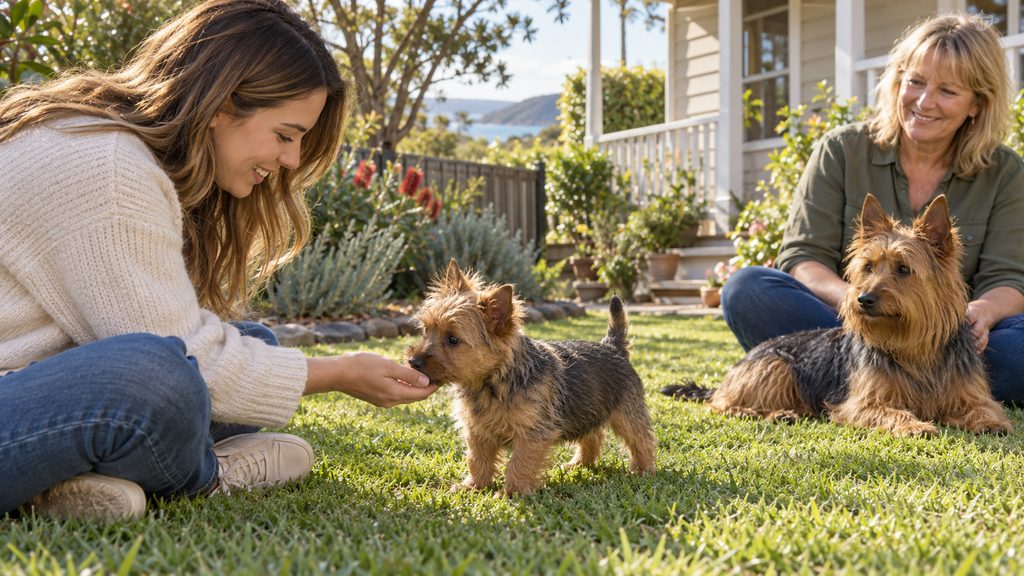
Is an Australian Terrier Right for You?
The Australian Terrier can be an exceptionally rewarding companion for the right household, but its small size and affectionate personality should not disguise the fact that it is a genuine working terrier. Confident, intelligent, alert, and frequently entertaining, this breed brings considerable character into everyday life. It enjoys companionship, purposeful activity, and opportunities to investigate its surroundings. However, its independence, strong hunting instincts, and sometimes enthusiastic barking mean that it will not suit every owner. Deciding whether an Australian Terrier is right for you involves considering both the qualities you find appealing and the responsibilities that accompany them.
One of the Australian Terrier’s greatest strengths is its adaptability. Its compact proportions make it physically suitable for houses, townhouses, and many apartments, provided its needs are understood. Unlike a large working breed requiring extensive space and demanding exercise, the Australian Terrier can enjoy a satisfying lifestyle with regular walks, play, mental stimulation, and opportunities to participate in household activities. A large garden is helpful but not essential. What matters more is having owners who recognize that a small dog can still need substantial attention, training, and engagement.
The breed is particularly appealing to people who enjoy an interactive companion. Australian Terriers generally like being involved in daily routines and often develop strong attachments to their families. They may follow their owners around the house, investigate gardening activities, eagerly anticipate walks, or settle nearby when the household becomes quiet. This combination of enthusiasm and affection can make them delightful companions for individuals, couples, and families who spend meaningful time with their dogs. Owners seeking a companion with personality rather than a particularly quiet or undemanding pet may find the Australian Terrier especially enjoyable.
However, prospective owners should be comfortable with a degree of independence. Australian Terriers were developed to hunt vermin and make decisions without waiting for continuous human direction. That heritage remains evident in their determination, curiosity, and occasional reluctance to abandon something interesting. They are intelligent and capable learners, but they may not provide the immediate, consistent obedience associated with some breeds developed to work in constant partnership with a handler. Owners who appreciate terrier character and enjoy positive, patient training are generally better suited to this independent little dog than those expecting effortless compliance.
Barking deserves honest consideration, particularly in apartments and closely spaced neighborhoods. Australian Terriers were historically valued as watchdogs, and many remain quick to announce visitors, unfamiliar noises, or movement outside the home. Although consistent training and thoughtful management can reduce unnecessary barking, owners should not expect to eliminate the breed’s natural alertness completely. A household seeking an exceptionally quiet companion may find this characteristic frustrating. Conversely, people who appreciate an attentive dog and are willing to teach appropriate responses may regard its watchful nature as part of its appeal.
Outdoor security is another important factor. Australian Terriers have strong hunting instincts and may pursue small animals with impressive determination. A secure garden, reliable fencing, and careful leash management are therefore important responsibilities. Their enthusiasm for digging can create additional challenges around poorly protected boundaries. Owners living in homes with open gates, unreliable fencing, or unrestricted access to roads should consider whether they can provide an appropriately safe environment. A securely enclosed exercise area allows the dog to enjoy its natural curiosity without unnecessary risk.
Families with children may find the Australian Terrier an affectionate and lively addition to the household. Its sturdy construction and playful personality can suit children who understand how to interact respectfully with dogs. Nevertheless, supervision remains essential, particularly around younger children who may struggle to recognize canine boundaries. Australian Terriers should have somewhere peaceful to rest and should never be expected to tolerate grabbing, rough handling, or constant interruption. Families willing to teach appropriate interaction and establish clear household routines are more likely to enjoy a positive relationship.
Existing pets can influence the decision considerably. Some Australian Terriers live comfortably with familiar dogs and cats, especially when introduced carefully and supported by appropriate management. Others are more selective about canine companionship or become strongly motivated to pursue smaller animals. Homes containing rabbits, guinea pigs, pet rodents, or free-roaming birds require particular caution because these animals resemble the prey the breed was developed to hunt. Prospective owners should assess the compatibility of individual animals rather than assuming that affection toward people will automatically translate into gentleness toward other pets.
First-time dog owners can succeed with an Australian Terrier, but they should be prepared to learn about terrier behavior and invest in early training. This is not necessarily a difficult breed to own, but it is one that benefits from clear expectations, consistency, and a sense of humor. Reward-based puppy classes, appropriate socialization, and guidance from experienced breed owners can provide a valuable foundation. People who enjoy learning alongside their dogs may find the Australian Terrier’s intelligence and determination particularly rewarding. Those seeking a companion requiring very little training or management may prefer a different temperament.
Grooming is relatively manageable, making the breed attractive to people who do not want extensive coat maintenance. Its harsh, weather-resistant double coat generally requires regular brushing, occasional bathing, and appropriate attention to its natural texture. Specialist hand-stripping may be desirable for some dogs, but ordinary family companions do not usually require elaborate daily grooming. Shedding is typically modest, although the breed is not hypoallergenic. Owners should still be comfortable with routine coat care, nail trimming, dental hygiene, and the other practical responsibilities associated with maintaining a healthy dog.
Time alone is another consideration. Australian Terriers are affectionate companions that usually prefer being included in family life. Although many can learn to remain comfortable during ordinary absences, regularly spending long days alone without sufficient interaction or enrichment may lead to boredom, barking, or unwanted behavior. A household with predictable opportunities for companionship, exercise, and mental stimulation is generally a better match than one where the dog would spend most of its life isolated. Owners who work outside the home should consider how the dog’s needs will be met throughout the day.
Long-term commitment also matters. With a typical lifespan of approximately 11 to 15 years, bringing home an Australian Terrier means accepting responsibility through puppyhood, adolescence, adulthood, and potentially an extended senior period. Veterinary expenses, changes in household circumstances, travel arrangements, and age-related health needs should all be considered. Responsible ownership includes being prepared for circumstances that may be less convenient than expected. A dog that remains affectionate and engaging for many years also deserves consistent care when illness or aging changes its abilities.
Ultimately, the Australian Terrier is best suited to someone who appreciates a small dog with genuine working instincts, a lively mind, and a strong desire for companionship. It offers affection, adaptability, intelligence, and considerable entertainment, but it also requires patience, secure surroundings, regular activity, and realistic expectations about barking and prey drive. For owners willing to embrace those qualities rather than suppress them, the Australian Terrier can become a remarkably loyal, entertaining, and deeply cherished family companion.
Before Choosing an Australian Terrier
Consider whether your household can accommodate a confident, independent terrier that enjoys investigating its surroundings and may bark at unfamiliar activity. Daily walks, mental stimulation, positive training, and regular companionship are important, even though the breed is small. A securely enclosed garden or reliable leash routine is essential because Australian Terriers can be determined chasers and diggers. Think carefully about compatibility with existing pets, particularly small animals, and ensure children understand respectful handling. Finally, consider the financial and practical responsibilities of caring for a dog that may live well into its teenage years. The best match comes from realistic expectations rather than appearance alone.
Australian Terrier Final Thoughts
The Australian Terrier is a remarkable example of how much personality, courage, and character can be found in a small dog. Developed from hardworking British terriers and shaped by the demanding conditions of nineteenth-century Australia, this distinctive breed has retained the determination, intelligence, and independence that made its ancestors such valuable companions. Today, those same qualities are expressed in a lively family dog that approaches everyday life with enthusiasm, curiosity, and an unmistakably confident attitude.
What makes the Australian Terrier particularly appealing is its combination of genuine working instincts and affectionate companionship. It is courageous without needing to be confrontational, independent without being emotionally distant, and energetic without requiring the demanding exercise schedules of many larger working breeds. Australian Terriers generally enjoy being involved in family routines, accompanying their owners on walks, investigating their surroundings, and settling nearby when the day’s activities are finished. Their cheerful personalities and strong attachments to people help explain why enthusiasts remain so devoted to the breed.
However, the Australian Terrier is not simply a convenient small dog. Its natural alertness can produce enthusiastic barking, its hunting heritage creates a strong interest in smaller animals, and its independent judgment occasionally challenges inexperienced owners. These characteristics are fundamental parts of the breed’s identity rather than faults that can be completely trained away. Successful ownership depends on understanding those instincts, providing appropriate outlets, and establishing consistent expectations. A secure environment, positive training, regular activity, and meaningful companionship are essential foundations for a happy Australian Terrier.
The breed also offers practical advantages. Its compact size allows it to adapt to many living arrangements, while its sturdy construction and relatively manageable coat make everyday care straightforward for committed owners. Australian Terriers generally enjoy good longevity, often sharing family life for 11 to 15 years or longer. As with every pedigree breed, responsible breeding, appropriate health screening, preventive veterinary care, and attention to changing needs throughout life remain important.
Perhaps the Australian Terrier’s most endearing quality is its ability to combine a surprisingly substantial personality with a genuine desire to belong. Whether exploring a woodland trail, investigating a garden, playing with familiar family members, or relaxing beside a favorite person, it approaches life with a distinctive mixture of confidence and affection. Its rugged appearance and lively expression offer a reminder of the practical little working dog from which the modern breed developed.
For someone seeking a quiet, highly obedient companion with minimal interest in the outside world, the Australian Terrier may not be the ideal choice. But for people who appreciate intelligence, independence, loyalty, and a little terrier mischief, it can be an exceptionally satisfying breed to own.
Ultimately, the Australian Terrier is much more than a small dog with an interesting history. It is a courageous, affectionate, and engaging companion whose character has been shaped by generations of purposeful work and close human partnership. Given the right home, understanding, and care, this spirited Australian original can bring enormous enjoyment, companionship, and personality to family life for many years.
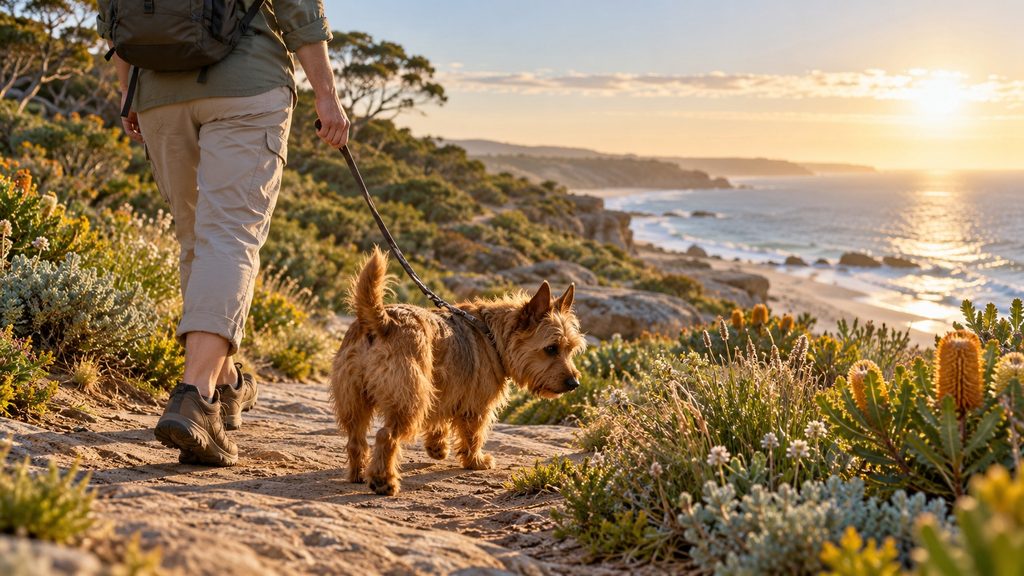
Explore More Terrier Breeds
The Australian Terrier is one of many distinctive terriers known for their courage, intelligence, and independent personalities. From energetic working terriers to affectionate family companions, this diverse breed group offers a fascinating range of sizes, coat types, and temperaments. If you enjoy the Australian Terrier’s spirited character, exploring related breeds can help you understand what makes each terrier unique. Visit our Terrier Breeds guide to discover more dogs from this remarkable group and compare their characteristics, care requirements, and suitability for different households.
Australian Terrier Breed Information
For additional information about the Australian Terrier, the American Kennel Club provides an authoritative breed profile covering its history, temperament, physical characteristics, exercise requirements, grooming, and general health. The AKC also publishes the official breed standard, helping owners understand the characteristics that distinguish this Australian working terrier. Whether you are researching the breed for the first time or exploring its heritage in greater detail, the American Kennel Club’s Australian Terrier guide is a useful companion resource to the practical information provided throughout this CanineBase breed profile.