

Borzoi
The Borzoi is one of the most elegant and recognizable dog breeds in the world, celebrated for its extraordinary height, graceful silhouette, and flowing silky coat. Originally developed in Russia to pursue wolves and other swift game, this aristocratic sighthound combines remarkable speed and athleticism with a gentle, often reserved personality. Affectionate with its family yet naturally independent, the Borzoi is a fascinating companion for owners who appreciate its quiet dignity, strong hunting instincts, and surprisingly playful nature. Behind its refined appearance lies a powerful, courageous athlete with a rich history and a distinctive character that sets it apart from other hounds.
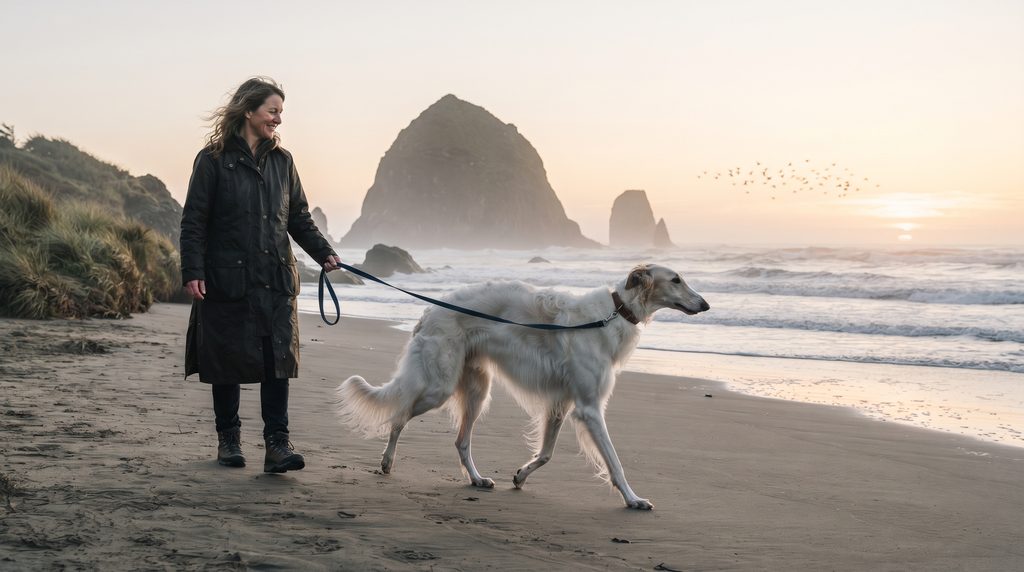
The Borzoi’s distinctive appearance reflects centuries of selective breeding for speed, endurance, and the ability to pursue fast-moving animals across open countryside. Unlike scenthounds that primarily follow scent trails, these elegant dogs use their exceptional eyesight to detect movement and pursue quarry. Their long legs, deep chests, flexible bodies, and powerful hindquarters allow them to accelerate rapidly, while their remarkable agility enables them to change direction when following moving targets.
Originally known in English as the Russian Wolfhound, the Borzoi developed a particularly strong association with Russia’s aristocratic hunting traditions. Vast estates, mounted hunters, and carefully maintained kennels formed part of a culture in which these magnificent dogs were highly prized. Although their historical role could be demanding and dangerous, modern Borzois are more commonly encountered as family companions, show dogs, and participants in organized canine sports.
The breed’s name also reflects its Russian heritage. For readers curious about Borzoi pronunciation, the name is generally pronounced “BOR-zoy” in American English, with the emphasis on the first syllable. It derives from a Russian word associated with swiftness, a particularly appropriate description of a dog developed to pursue fast-moving game. Today, the name Borzoi has largely replaced the older English designation Russian Wolfhound, although both terms remain familiar to enthusiasts.
Despite their impressive athleticism, Borzois are often surprisingly relaxed around the home. Many enjoy stretching out on comfortable furniture, observing household activities from a favorite resting place, or quietly following familiar family members between rooms. Their dignified appearance can suggest a distant or aloof personality, but owners frequently discover affectionate, sensitive dogs that enjoy companionship without constantly demanding attention.
Their temperament differs noticeably from that of many traditional working breeds. Borzois are intelligent and capable of learning, but they are not naturally inclined toward continuous obedience or repetitive exercises. Their hunting background encouraged independent decisions, particularly when pursuing quarry at considerable speed. Training therefore requires patience, consistency, and an understanding that successful cooperation depends on motivation rather than forceful control.
One of the most important considerations for prospective owners is the Borzoi’s powerful instinct to chase moving animals. A squirrel crossing a garden, a rabbit appearing unexpectedly on a walk, or a rapidly fleeing cat can trigger an immediate pursuit response. Even an affectionate, well-trained individual may become intensely focused when its hunting instincts are activated. Secure fencing and careful management around smaller animals are essential aspects of responsible ownership.
Exercise requirements are sometimes misunderstood. Although Borzois are capable of extraordinary bursts of speed, they do not necessarily require continuous strenuous activity throughout the day. Regular walks, opportunities to explore, and occasional safe running sessions in properly enclosed areas can help maintain fitness and satisfaction. Their exercise needs should reflect age, physical condition, and individual temperament, with particular care taken while puppies are still developing.
The breed’s beautiful coat is another appealing characteristic, but it comes with practical responsibilities. Borzois possess long, silky hair that may be straight, wavy, or somewhat curly, with more substantial feathering around the chest, legs, and tail. Regular brushing helps prevent tangles and removes loose hair, particularly during periods of increased shedding. Although their coats are less demanding than some heavily coated breeds, owners should not expect a completely maintenance-free grooming routine.
Size is also an important consideration. Borzois are genuinely tall dogs, with adult males standing at least 28 inches at the shoulder and females at least 26 inches. Their slender appearance can disguise considerable strength and physical substance. They need appropriately sized resting areas, sufficient room to move comfortably indoors, and safe transportation arrangements. Their elegant proportions should never be mistaken for physical fragility.
Families considering a Borzoi should appreciate the breed’s sensitive nature. Many are gentle and affectionate with familiar people but dislike rough handling, excessive noise, or unpredictable interactions. Older children who understand respectful dog behavior may develop wonderful relationships with these graceful companions. However, households with very young children should provide careful supervision and ensure the dog always has access to a quiet, undisturbed resting place.
Relationships with other animals depend heavily on individual temperament and upbringing. Some Borzois enjoy living alongside compatible dogs and may establish peaceful relationships with familiar household cats. Nevertheless, their inherited prey drive makes introductions to smaller pets particularly important. Owners should never assume that friendliness toward people or other dogs guarantees safety around rabbits, cats, or other animals likely to trigger pursuit instincts.
Health and longevity deserve thoughtful consideration before choosing the breed. Like other large, deep-chested dogs, Borzois can face certain orthopedic, cardiac, and gastrointestinal concerns, including the risk of gastric dilatation-volvulus. Responsible breeding practices, appropriate veterinary care, maintaining a healthy weight, and managing exercise sensibly can all contribute to long-term well-being. Understanding potential medical concerns helps prospective owners prepare without assuming that every Borzoi will experience them.
For owners who enjoy canine sports, the Borzoi offers opportunities to appreciate its remarkable natural abilities. Lure coursing, in particular, allows dogs to pursue an artificial lure around a controlled course, demonstrating the speed, agility, and visual concentration that distinguish traditional sighthounds. Appropriate participation should take place in safely managed environments, with activities adapted to the dog’s age, fitness, and individual capabilities.
The Borzoi is not necessarily the ideal choice for everyone. Its substantial size, independent temperament, grooming requirements, and powerful chase instincts may prove challenging for owners expecting a highly obedient or easily managed companion. However, those willing to appreciate its distinctive personality often find the breed extraordinarily rewarding. Its calm household manner, elegant movement, gentle affection, and occasional playful enthusiasm create a fascinating combination of characteristics.
Ultimately, living with a Borzoi means understanding the remarkable athlete beneath the refined exterior. This is a dog whose history, physical construction, and behavior remain closely connected to its original purpose. For families who can provide secure surroundings, suitable exercise, patient training, and affectionate companionship, the Borzoi offers a distinctive relationship built on trust, mutual understanding, and appreciation of one of the world’s most graceful dog breeds.
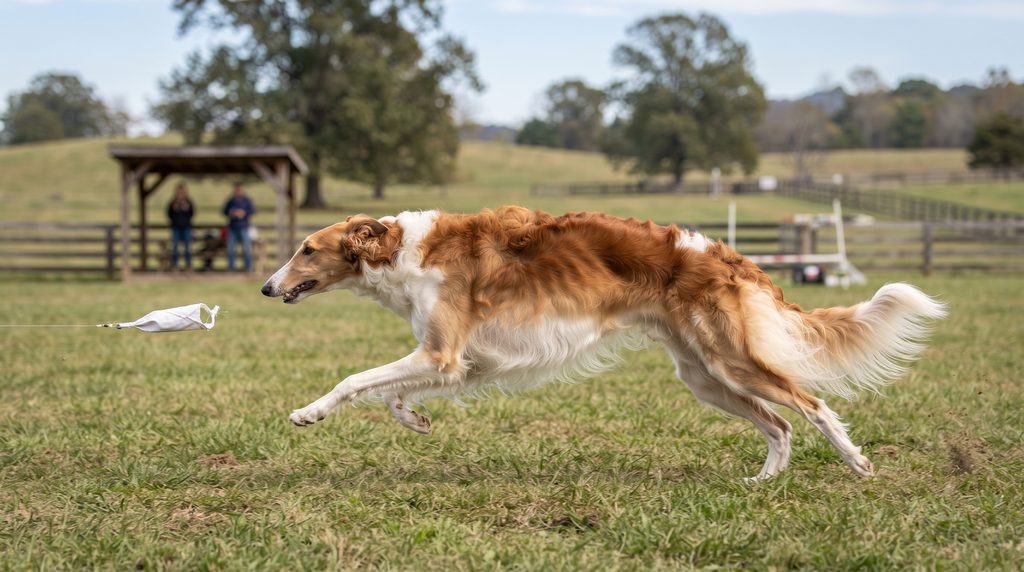
Table of Contents
Borzoi Fast Facts
Breed Group: Hound
Origin: Russia
Height: Males 28 inches and up; females 26 inches and up
Weight: Males 75–105 pounds; females 60–85 pounds
Life Expectancy: 9–14 years
Size: Large to giant
Coat: Long, silky, straight, wavy, or slightly curly; many colors and patterns
Coat Care: Regular brushing, with extra attention during shedding periods
Shedding: Moderate to heavy; seasonal increases
Exercise Needs: Moderate to high; daily walks and opportunities for secure running
Temperament: Gentle, dignified, affectionate, sensitive, independent
Primary Role: Sight-based hunting and coursing; family companion
Borzoi Star Ratings
Apartment Friendly: ★★★☆☆
Family Friendly: ★★★★☆
Good With Children: ★★★☆☆
Good With Other Dogs: ★★★★☆
First-Time Owner Friendly: ★★☆☆☆
Easy Grooming: ★★★☆☆
Affectionate: ★★★★☆
Easy to Train: ★★☆☆☆
Low Shedding: ★★☆☆☆
Adaptable: ★★★☆☆
High Exercise Needs: ★★★★☆
Tolerates Being Alone: ★★★☆☆
Borzoi History and Origins
The Borzoi has one of the most fascinating histories in the canine world, closely associated with the Russian aristocracy, elaborate hunting traditions, and centuries of selective breeding. Originally known as the Russian Wolfhound, this extraordinary sighthound was developed to pursue fast-moving game across the vast landscapes of Russia. Its exceptional speed, elegant proportions, courage, and flowing coat reflect a working heritage that existed long before the breed became internationally admired for its beauty.
Understanding Borzoi history requires looking beyond the magnificent hunting estates of imperial Russia. The breed developed from several types of coursing hounds adapted to different regions, climates, and hunting conditions. Historical accounts suggest that swift, long-legged dogs were present across parts of eastern Europe and Eurasia for centuries, with influences from eastern sighthounds and native Russian dogs contributing to their development.
The precise ancestry of the modern Borzoi cannot be traced through one simple bloodline. Regional breeders worked with dogs possessing different coat types, physical proportions, and hunting abilities. Over generations, these influences helped produce an increasingly recognizable hound combining extraordinary visual awareness, powerful acceleration, and sufficient physical resilience to work in challenging Russian weather.
The breed’s traditional Russian name, Russkaya Psovaya Borzaya, broadly identifies it as a Russian long-haired sighthound. This description captures the two characteristics that distinguish it from many other hunting dogs: its reliance on exceptional eyesight and its comparatively substantial, silky coat. The Borzoi sighthound was developed to detect and pursue moving quarry rather than methodically follow scent trails in the manner of a Bloodhound or Coonhound.
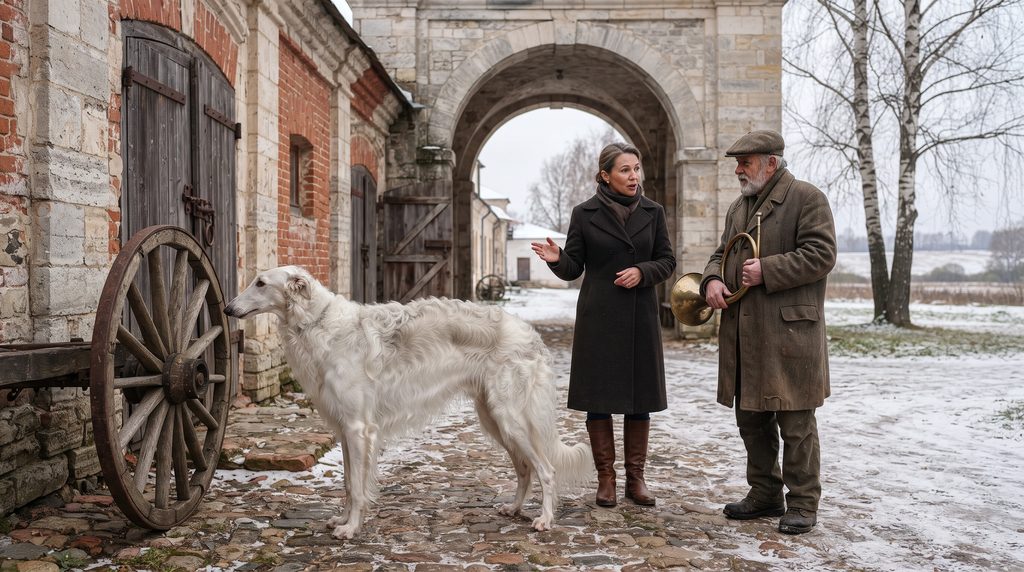
By the sixteenth and seventeenth centuries, hunting with swift hounds had become deeply embedded in Russian aristocratic life. Noble families maintained extensive kennels on country estates, selecting their dogs according to speed, courage, endurance, appearance, and performance in the field. Some establishments housed enormous numbers of animals and employed dedicated kennel managers, huntsmen, trainers, and other workers.
These hunts were elaborate social occasions as well as demanding sporting activities. Noble families invited guests to their estates, where mounted riders, hunting dogs, and numerous attendants assembled for carefully organized expeditions. A successful hunt demonstrated the wealth and standing of the host, while also providing opportunities to evaluate the working abilities of individual dogs.
Descriptions of Borzoi hunting wolves reveal how specialized this work became. In traditional wolf coursing, other hounds might first locate or flush a wolf from cover. Mounted hunters then released selected Borzois when the animal emerged into open ground. The dogs relied on extraordinary acceleration and coordinated pursuit to overtake and hold their quarry until the hunter arrived.
Such work required considerably more than speed alone. A Borzoi needed courage, agility, physical strength, and the ability to respond rapidly to unpredictable changes in direction. The breed’s deep chest, flexible body, powerful hindquarters, and long legs developed in response to these demands. Its narrow head and strong jaws also reflected the practical requirements of catching large, fast-moving animals.
Wolves were not the only quarry pursued. Borzois were also used to course hares, foxes, and other suitable game. Their hunting traditions varied according to location, available wildlife, and individual estate practices. Although wolf hunting became particularly associated with the breed’s aristocratic reputation, the Borzoi’s broader function was that of a versatile, exceptionally swift visual hunter.
During the nineteenth century, one of the most important influences on the breed’s development was the changing structure of Russian society. The emancipation of the serfs in 1861 undermined the labor system that had supported many enormous aristocratic estates. As landownership and financial arrangements changed, numerous hunting establishments became increasingly difficult to maintain, and established breeding programs were disrupted.
Nevertheless, dedicated enthusiasts continued preserving and refining the breed. One particularly influential figure was Grand Duke Nicholas Nikolaevich, whose famous Perchino estate became associated with an ambitious effort to maintain exceptional Russian coursing hounds. During the late nineteenth and early twentieth centuries, Perchino acquired an international reputation for its carefully managed breeding program and remarkable collection of Borzois.
The Grand Duke assembled dogs from different regions of Russia, seeking to preserve desirable working characteristics while improving consistency of type. The estate maintained substantial kennels, experienced staff, horses, and other hunting dogs. At its height, Perchino housed approximately 130 adult Borzois and 60 puppies, demonstrating the extraordinary scale of elite breeding establishments during this period.
Perchino also influenced the development of Borzois outside Russia. American enthusiast Joseph B. Thomas visited the estate in 1903 and acquired valuable breeding stock. His subsequent imports helped establish influential American bloodlines and contributed to the growing international appreciation of the breed. These dogs were admired not merely for their striking appearance but for the quality of their construction and distinguished ancestry.
The Borzoi had already begun attracting attention in Britain and other European countries during the nineteenth century. Russian aristocrats occasionally presented prized dogs as diplomatic or personal gifts, while imported breeding stock helped establish kennels beyond Russia’s borders. The breed’s remarkable appearance made it especially fashionable among wealthy enthusiasts, although dedicated breeders continued emphasizing soundness and functional athleticism.
In the United States, the Russian Wolfhound Club of America was established in 1903, reflecting the breed’s increasingly organized following. Early American breeders worked to develop consistent standards while maintaining valuable bloodlines imported from Russia and Europe. The breed eventually became known officially as the Borzoi rather than the Russian Wolfhound, with the American Kennel Club adopting the shorter name in 1936.
The Russian Revolution of 1917 created an especially dangerous period for the breed. Because Borzois were so strongly associated with the nobility, many aristocratic kennels were destroyed or dispersed during the political upheaval. Dogs were killed, abandoned, or transferred into different ownership arrangements as estates and breeding establishments disappeared. The extensive breeding traditions that had shaped the breed for centuries were severely disrupted.
Fortunately, Borzois had already been established in Britain, continental Europe, and North America. These overseas populations proved vital to the breed’s survival. Dedicated breeders preserved important bloodlines and continued developing the Borzoi despite the destruction of many traditional Russian kennels. Over time, dogs from established international populations also contributed to efforts to restore the breed in its homeland.
By the twentieth century, the Borzoi had developed a reputation extending well beyond hunting. Its refined appearance, graceful outline, and flowing coat made it a favorite subject for artists, photographers, and designers. The breed became particularly associated with elegant decorative imagery during the Art Deco period, when its elongated silhouette suited contemporary artistic tastes.
Although its role as a traditional wolf-hunting dog gradually diminished, the Borzoi’s athletic instincts remained remarkably intact. Modern lure coursing provides an opportunity for these dogs to demonstrate their natural ability to pursue moving targets in a controlled sporting environment. Their impressive acceleration, flexible movement, and exceptional visual concentration continue to reflect the qualities valued by Russian hunters centuries ago.
The breed’s international development has also produced some variation in appearance. Different breeding lines may emphasize slightly different combinations of substance, coat, head shape, and overall outline. However, responsible breeders continue to recognize the importance of maintaining a sound, athletic dog whose physical characteristics serve a practical purpose rather than simply producing an exaggerated appearance.
Today, the Borzoi occupies a distinctive position among recognized dog breeds. It is admired as a graceful companion, a capable canine athlete, and a living connection to Russia’s remarkable hunting traditions. While modern family life differs considerably from the aristocratic estates where the breed once flourished, its independent temperament, exceptional eyesight, and instinctive interest in moving animals remain unmistakable.
Understanding this heritage is essential for appreciating the modern Borzoi. Its gentle household demeanor does not erase the determination of a powerful hunting dog, just as its elegant coat does not make it physically delicate. The Borzoi represents centuries of adaptation, selective breeding, cultural change, and remarkable survival, preserving the extraordinary combination of beauty, speed, courage, and independence that has defined the breed for generations.
How Traditional Russian Wolf Hunts Worked
Traditional Russian wolf hunts were carefully organized events involving mounted hunters, scenthounds, and specially selected Borzois. Other hunting dogs were often used to locate and drive wolves from wooded cover, while horsemen waited in surrounding open country with their Borzois restrained on leads. Once a wolf emerged, two or three Borzois might be released together to pursue and hold it until the hunter arrived. Their remarkable acceleration, coordination, and courage were essential to this demanding work. Although modern Borzois are rarely used for such hunting, their strong chase instincts and exceptional speed remain important characteristics of the breed.
Borzoi Appearance and Size
The Borzoi is among the most visually distinctive dog breeds, combining exceptional height, flowing lines, and a beautifully proportioned athletic body. Its extraordinarily long, narrow head, deep chest, graceful topline, and silky coat create an unmistakable silhouette. Although the breed is often described as delicate or aristocratic, a correctly constructed Borzoi is a powerful, muscular sighthound developed for exceptional speed, agility, and the ability to pursue challenging quarry across open terrain.
One of the first things people notice about the Borzoi is its impressive height. According to the American Kennel Club breed standard, adult males must stand at least 28 inches at the shoulder, while females must reach at least 26 inches. These are minimum measurements rather than fixed upper limits. Many mature Borzois stand considerably taller, provided their additional height does not compromise balance, athletic ability, or structural soundness.
Typical adult males weigh approximately 75–105 pounds, while females generally weigh 60–85 pounds. These figures represent broad guidelines rather than ideal targets for every individual. A healthy Borzoi should maintain sufficient muscle to support powerful movement without carrying unnecessary body fat. Its elegant outline should never result from poor nutrition or inadequate muscle development.
The breed’s proportions differ noticeably from those of many other large dogs. A Borzoi has a relatively narrow body, substantial chest depth, long legs, and an elongated outline shaped by generations of selective breeding for speed. Its chest accommodates the heart and lungs needed for vigorous physical activity, while the muscular hindquarters provide powerful propulsion. Despite its imposing height, the dog should appear balanced and capable of effortless movement.
The back is another distinctive feature. Borzois possess a gently curved topline, which can be more pronounced in males. This natural arch should form part of a strong, flexible body rather than an exaggerated hump or structural weakness. The loin is broad, muscular, and capable of contributing to the remarkable spinal flexibility required during high-speed running.
Perhaps the breed’s most recognizable characteristic is its extraordinarily elongated head. The Borzoi nose is frequently discussed because the entire muzzle appears unusually long compared with that of most familiar dog breeds. However, the correct head is not simply an exaggerated nose attached to a narrow skull. It is a carefully balanced structure with powerful jaws, a long foreface, a slightly domed skull, and an almost imperceptible stop.
The profile may display a gentle Roman-nosed appearance, creating a subtle downward curve along the upper muzzle. The nose itself should be large and black, with sufficient nostril development for normal breathing. Although internet photographs sometimes emphasize extreme head length, responsible breeding should prioritize correct anatomy, strong jaws, and overall functional balance rather than unusual proportions selected primarily for visual novelty.
The eyes are another important component of the Borzoi’s expression. They should be dark, expressive, and appropriately positioned within the long, narrow head. Their gentle, intelligent appearance contributes to the breed’s characteristic dignity. Light-colored eyes or an excessively round, prominent appearance do not reflect the traditional ideal described in the American breed standard.
Borzoi ears are relatively small, fine, and set toward the back of the head. When the dog is relaxed, they typically lie folded backward against the neck, with the tips sometimes approaching one another behind the skull. When something captures the dog’s attention, the ears may lift or change position noticeably. This expressive movement gives the breed an interesting contrast between its calm resting appearance and alert hunting expression.
The neck is long, strong, and gracefully carried, flowing into well-developed shoulders. Its elegant appearance should not disguise substantial supporting musculature. Borzois were historically required to pursue and hold powerful game, making strength and physical stability essential characteristics. Their refined outline is therefore the result of functional athletic development rather than breeding solely for ornamental appearance.
The forelegs are long, straight, and supported by strong bone appropriate to the dog’s size. Well-angled shoulders permit the extended reach needed for efficient movement. The hindquarters are particularly powerful, with long, muscular thighs and well-developed joints. These features help the Borzoi accelerate rapidly, sustain a ground-covering stride, and change direction during pursuit.
The feet are comparatively narrow and elongated, with well-arched toes and strong pads. They should provide suitable traction without appearing excessively large or clumsy. During normal walking, a healthy Borzoi moves smoothly and economically. When trotting, its stride becomes longer and more purposeful, displaying the effortless combination of strength, coordination, and grace associated with skilled sighthounds.
The tail is long, relatively low-set, and carried in a graceful curve. It is generously furnished with silky feathering, producing an elegant outline that complements the dog’s flowing coat. When the Borzoi moves, the tail contributes to the overall impression of balance. It should not normally be curled tightly over the back like that of a spitz breed.
Another defining feature is the coat. The Borzoi possesses a long, silky coat that may lie relatively flat, form gentle waves, or develop loose curls in certain areas. The hair is generally shorter and smoother on the head, ears, and front of the legs. More abundant feathering appears around the neck, chest, hindquarters, backs of the legs, and tail.
Coat quantity varies between individuals, with some dogs displaying particularly impressive neck frills and substantial feathering. However, the coat should never become woolly or excessively coarse. Its texture is an important breed characteristic, and the overall appearance should remain natural rather than resembling a heavily sculpted show coat.
The remarkable variety of Borzoi coat colors is another reason the breed attracts attention. Under the American Kennel Club standard, any color or combination of colors is acceptable. White, cream, gold, red, black, silver, brindle, sable, and numerous combinations occur, with individual dogs displaying distinctive markings that make their appearances remarkably varied.
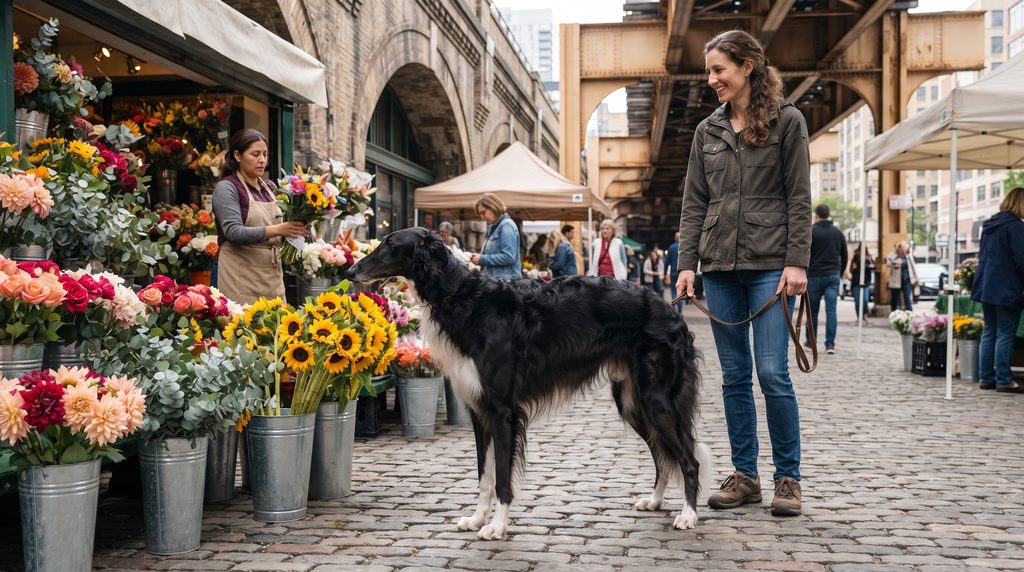
A black Borzoi dog can look particularly striking because the dark coat emphasizes the breed’s flowing outline and exceptional height. Some individuals are predominantly black, while others display white markings on the chest, legs, face, or tail. Black-and-white patterns can range from relatively small contrasting areas to extensive white backgrounds with large black patches.
A red Borzoi may display rich reddish coloring, lighter golden tones, or sable shading that darkens particular areas of the coat. Red-and-white combinations are especially distinctive, while some dogs possess dark facial masks or more complex shading. These naturally occurring variations should not be confused with artificial coat coloring or unusual breeding practices.
A brown Borzoi may refer casually to an individual with warm tan, fawn, mahogany, or brown-toned sable coloring. However, genuine chocolate or liver pigmentation is considered exceptionally uncommon and differs from ordinary brown-looking coat shades. The breed standard calls for a black nose, making correct pigmentation an important consideration when discussing unusual colors.
Brindle patterns introduce another layer of variety. These dogs display darker striping over a lighter background, sometimes accompanied by white markings or sable shading. Silver, cream, and pale gold individuals can look almost luminous in natural daylight, while heavily marked dogs create dramatic contrasts between coat colors. No particular coat color makes a Borzoi inherently more suitable as a companion or more capable as an athlete.
International breed references sometimes use different terminology to describe Borzoi coat colors and markings. However, the breed’s extraordinary variety is recognized across different countries and breeding traditions. Regardless of color, prospective owners should prioritize health, temperament, sound construction, and responsible breeding over the rarity or visual appeal of a particular shade.
Some people also encounter advertisements or photographs referring to a miniature Borzoi. There is no officially recognized miniature variety under the American Kennel Club breed standard. Smaller-than-average individuals may occur, but deliberately producing unusually tiny Borzois is not an established breed classification. The Italian Greyhound and Whippet are separate sighthound breeds rather than miniature versions of the Borzoi.
Borzoi puppies can look considerably different from mature adults. Their bodies are less developed, their coats may be shorter and softer, and their adult proportions emerge gradually. Youngsters often appear long-legged and somewhat awkward as their skeletal growth progresses. Their full coat development may continue well beyond the earliest stages of physical maturity.
Because Borzois are large, relatively slow-maturing dogs, owners should avoid encouraging excessive high-impact exercise during growth. Repetitive jumping, prolonged forced running, and demanding activities on hard surfaces can place unnecessary stress on immature joints. Appropriate nutrition, controlled activity, and regular veterinary assessments help support healthy development.
Ultimately, the Borzoi’s appearance represents an extraordinary union of elegance and function. Every important feature, from its long head and powerful hindquarters to its deep chest and flowing coat, reflects generations of development as a swift, capable hunting hound. A properly constructed Borzoi should look graceful without weakness, substantial without heaviness, and unmistakably athletic beneath its luxurious coat.
Why the Borzoi’s Long Head Is So Distinctive
The Borzoi’s exceptionally elongated head is one of the breed’s most recognizable characteristics. The skull and muzzle form an almost continuous profile, with a minimal stop and a gentle Roman-nosed curve in some individuals. Despite its refined appearance, the head must retain strong jaws and correct proportions appropriate to a powerful hunting sighthound. Photographs taken with wide-angle lenses can exaggerate muzzle length, making the nose appear even more extraordinary than it is in reality. When evaluating a Borzoi, look for balance, sound structure, and a natural expression rather than the most extreme or unusual head shape.
Borzoi Temperament and Personality
The Borzoi possesses one of the most distinctive temperaments among the recognized hound breeds, combining quiet dignity, gentle affection, remarkable independence, and extraordinary hunting instincts. Although its elegant appearance may suggest a distant or aristocratic character, the reality is considerably more interesting. These sensitive Russian sighthounds often develop deep relationships with their families while retaining an independent approach to everyday life. Understanding the Borzoi personality is essential for appreciating the breed and establishing a successful relationship.
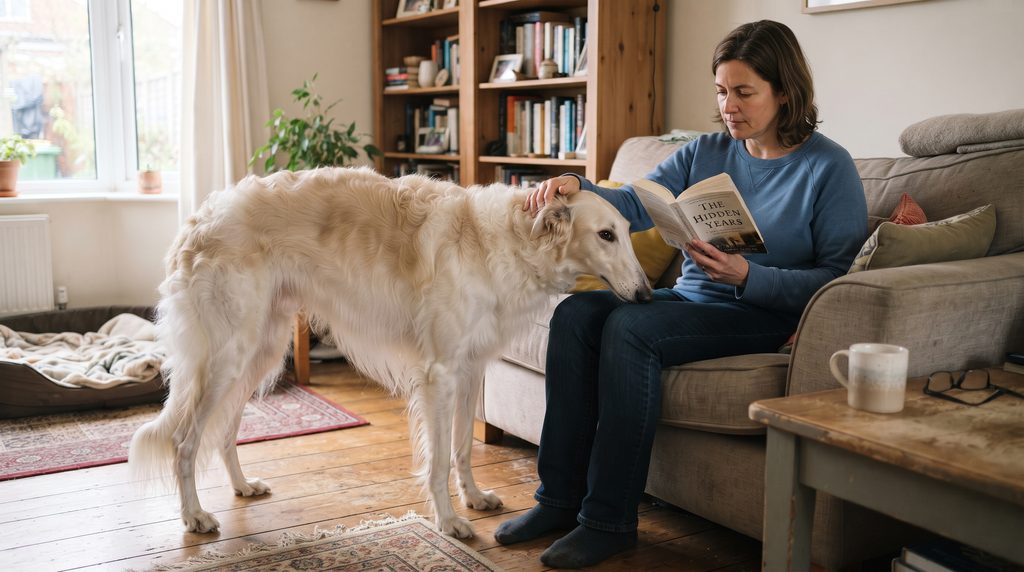
One of the Borzoi’s most appealing characteristics is its calm household demeanor. Despite being capable of remarkable speed and athletic performance, a mature Borzoi often enjoys spending substantial periods relaxing. Many are content to stretch out on comfortable furniture, observe household activities from a favorite resting place, or sleep peacefully after appropriate exercise. This relaxed behavior can surprise people who assume that such an impressive athlete must be constantly energetic.
However, the Borzoi’s quiet indoor nature should never be confused with a lack of enthusiasm. Outdoors, its demeanor can change dramatically when something interesting captures its attention. A previously relaxed dog may suddenly become intensely focused on movement in the distance, demonstrating the visual awareness and rapid reactions developed through centuries of selective breeding. This contrast between peaceful companionship and explosive athletic ability is fundamental to the breed’s character.
Affection is another important part of Borzoi temperament, although it is often expressed differently from that of more demonstrative companion breeds. Many Borzois prefer quiet closeness rather than constant physical attention. They may rest beside their owners, gently lean against familiar people, or follow family members between rooms without demanding interaction. These understated expressions of attachment can become particularly meaningful to owners who appreciate a calm, respectful relationship.
Some individuals are considerably more openly affectionate, enjoying prolonged cuddles or enthusiastically greeting family members after an absence. Others maintain a greater sense of personal space while remaining deeply attached to their households. Neither approach necessarily indicates a stronger or weaker bond. Individual temperament, upbringing, genetics, and previous experiences all influence how a Borzoi expresses affection.
Around unfamiliar people, Borzois are frequently reserved. They may prefer to observe newcomers before deciding whether to interact, and some show little interest in being approached by strangers. This reserve is a recognized breed characteristic rather than evidence of poor socialization. A confident Borzoi should remain composed and capable of handling ordinary social situations without displaying inappropriate fear or aggression.
Owners should avoid forcing interactions with unfamiliar people. A visitor who immediately reaches over the dog’s head or attempts an enthusiastic embrace may create unnecessary discomfort. Allowing the Borzoi to approach voluntarily, investigate at its own pace, and withdraw whenever necessary encourages more relaxed experiences. Respecting personal space is particularly important for a breed that often communicates preferences through subtle changes in body language.
Sensitivity is another defining characteristic. Many Borzois respond strongly to changes in tone of voice, household tension, or rough physical handling. Harsh corrections and confrontational training techniques can undermine trust and create anxiety rather than improve cooperation. These dogs generally respond more positively to patient guidance, predictable routines, and rewards that make desired behavior worthwhile.
Their intelligence is sometimes underestimated because they do not always behave like breeds developed for close cooperation with human handlers. Borzois were bred to make rapid decisions while pursuing quarry, often without continuous direction from a hunter. This independent thinking remains evident in everyday life. A Borzoi may understand an instruction perfectly but choose to investigate something more interesting instead.
Such behavior is frequently described as stubbornness, although that description oversimplifies the breed’s motivation. Borzois are capable learners, particularly when training is varied, rewarding, and relevant to their interests. Repetitive exercises may quickly lose their appeal, while short sessions incorporating movement, food rewards, and appropriate exploration can encourage much better engagement.
The breed’s strong visual hunting instincts are particularly important when understanding its behavior. Unlike scenthounds that concentrate primarily on tracking odors, Borzois are exceptionally sensitive to movement. A rapidly running rabbit, squirrel, or unfamiliar cat may trigger an immediate chase response. This reaction can occur with remarkable speed, leaving little opportunity for an owner to intervene once pursuit has begun.
Importantly, a strong prey drive does not make a Borzoi naturally aggressive toward people. The desire to chase moving animals is a specialized hunting behavior rather than an indication of hostility. Nevertheless, it creates practical responsibilities. Secure fencing, appropriate leash management, and careful supervision around smaller animals are essential, even when a dog is otherwise gentle and well behaved.
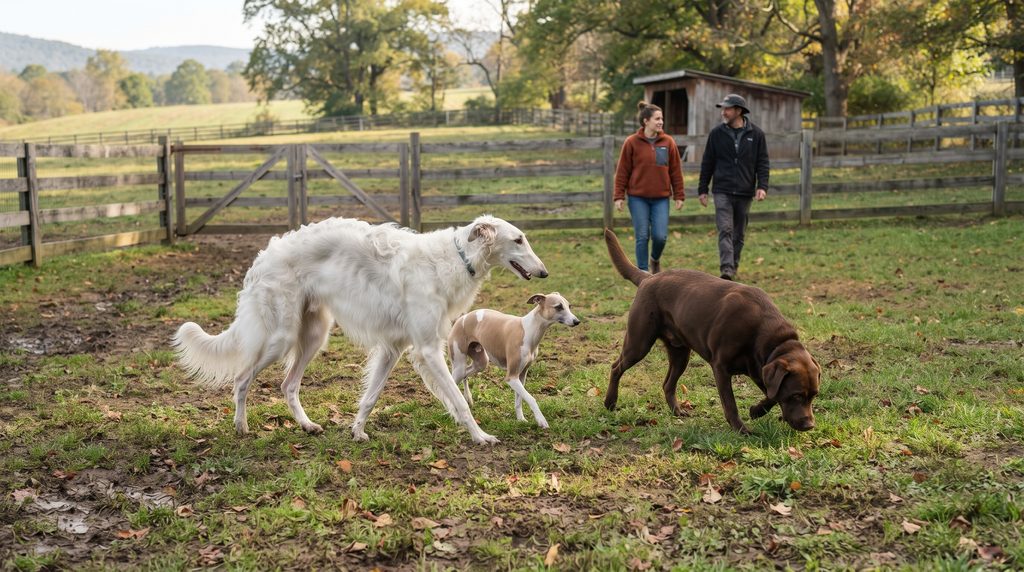
Borzoi behavior around other dogs is often relatively peaceful, particularly when individuals have experienced appropriate socialization. Many enjoy the companionship of compatible dogs and may form close bonds with another Borzoi or similarly sized sighthound. Their style of play can involve sudden bursts of speed, enthusiastic chasing, and rapid changes in direction, followed by lengthy periods of relaxation.
However, not every dog appreciates this energetic play style. Smaller or less confident companions may become overwhelmed by a Borzoi’s impressive speed and physical size. Owners should supervise introductions and ensure that play remains balanced, with both dogs willingly participating. Interactions involving significant size differences require particular care because accidental collisions can cause injuries.
Family life can be especially rewarding when household members understand the breed’s preferences. Many Borzois are affectionate and patient with familiar children, particularly those who behave calmly and respect the dog’s boundaries. However, they are generally less suited to roughhousing, climbing, pulling, or unpredictable physical handling. Their substantial height also means that excited movement can unintentionally knock over a small child.
A peaceful household environment often suits the breed particularly well. Borzois generally appreciate comfortable resting places, predictable routines, and opportunities to withdraw from excessive activity. They may find constant noise, chaotic gatherings, or repeated interruptions stressful. Providing a quiet sleeping area allows the dog to relax without being disturbed by visitors, children, or other household animals.
The Borzoi is also relatively quiet compared with many traditional hunting breeds. Excessive barking is not generally a defining characteristic, and some individuals rarely vocalize indoors. They may bark when excited, startled, or alerted to something unfamiliar, but they do not typically possess the persistent baying associated with many scent-tracking hounds. This quieter nature can make them appealing companions for households that prefer a peaceful atmosphere.
Nevertheless, a quiet dog is not necessarily one that enjoys prolonged isolation. Borzois frequently form strong attachments to familiar people and may become unsettled when left alone without appropriate preparation. Some tolerate regular absences comfortably, while others struggle with separation-related distress. Gradually teaching independence, providing suitable enrichment, and maintaining a predictable routine can help prevent difficulties.
Puppyhood and adolescence can reveal a more exuberant side of the breed. Young Borzois may be playful, curious, physically awkward, and surprisingly mischievous. Their rapidly developing bodies can make ordinary household activities more challenging, particularly when they become excited. Gentle training, suitable socialization, and clear boundaries are important during this period.
As Borzois mature, many become noticeably more settled. Their enthusiasm for running and chasing remains, but they often develop the composed, dignified behavior for which the breed is admired. However, individual personalities vary considerably, and owners should not expect every adolescent to become calm at exactly the same age.
The breed’s emotional intelligence is often apparent in its awareness of familiar routines and subtle household changes. Many Borzois quickly recognize when their owners are preparing for a walk, when visitors are expected, or when the family is settling for the evening. They may respond to gentle encouragement and familiar gestures more readily than to repeated verbal commands delivered with increasing frustration.
Their independent temperament also means that successful ownership requires realistic expectations about obedience. A Borzoi may perform beautifully in a familiar training environment yet become almost impossible to distract when moving wildlife appears. Owners should distinguish between behaviors that can be improved through training and instinctive responses that require lifelong environmental management.
For people who appreciate an affectionate but comparatively undemanding companion, these characteristics can be extremely appealing. A Borzoi often offers companionship without constant attention-seeking, enjoys physical affection without necessarily demanding it, and brings a gentle presence to everyday family life. Its occasional moments of exuberant playfulness provide a delightful contrast to its generally composed demeanor.
Ultimately, the Borzoi’s temperament reflects its extraordinary history as an independent hunting sighthound. Its sensitivity, dignity, affection, and intelligence are inseparable from the instincts that once made it a formidable coursing dog. Owners who respect its independence, provide gentle training, maintain secure surroundings, and appreciate its quieter expressions of affection are most likely to enjoy the remarkable companionship this elegant breed can offer.
Understanding a Borzoi’s Quiet Communication
Borzois often communicate through subtle body language rather than persistent barking or demanding attention. A relaxed dog may lean gently against its owner, rest nearby, or approach quietly for affection. Discomfort can be equally understated, appearing as turning away, avoiding eye contact, moving to another room, or becoming unusually still. Owners should respect these signals rather than insisting on physical interaction. The breed’s reserved nature should not be confused with fearfulness, and confidence should never be measured by enthusiasm for strangers. Allowing a Borzoi to make comfortable social choices helps develop trust and supports its naturally gentle, dignified temperament.
Living With a Borzoi
Living with a Borzoi is a distinctive experience that combines the quiet companionship of a gentle household dog with the responsibility of managing a remarkably powerful sighthound. Although its extraordinary height, flowing coat, and aristocratic appearance may suggest a demanding lifestyle, the Borzoi is often surprisingly relaxed at home. Many are content to spend hours resting near their families, provided they receive suitable exercise, attention, and opportunities to express their natural instincts.
One of the breed’s greatest advantages is its generally calm indoor behavior. Mature Borzois often settle comfortably after a satisfying walk or an opportunity to run safely. They are not usually dogs that demand constant entertainment or follow every household movement with relentless enthusiasm. Instead, many prefer a comfortable resting place where they can observe family life without being disturbed unnecessarily.
However, their relaxed nature should not obscure the practical implications of their size. Borzois are exceptionally tall, with long legs, deep chests, and bodies that occupy considerably more space than their relatively slender appearance might suggest. A dog stretching across a hallway or lying beside a sofa can create an unexpected obstacle in a busy household. Owners should provide sufficient room for comfortable movement, particularly around narrow corridors, furniture, and doorways.
Comfortable bedding is particularly important. Borzois have relatively lean bodies, prominent joints, and limited natural padding over some bony areas. Many appreciate generously sized, supportive beds that allow them to stretch out completely. A bed intended for an ordinary medium-sized dog will rarely be adequate. Positioning resting areas away from frequent foot traffic helps the dog relax without being repeatedly disturbed.
Their love of comfortable furniture is well known among enthusiasts. Some Borzois quickly discover the appeal of sofas and upholstered chairs, particularly when these provide warmth and a view of household activities. Owners who prefer their dogs to remain off furniture should establish consistent expectations from puppyhood and provide equally inviting alternatives. Rules are easier to maintain when everyone in the household follows the same approach.
A securely fenced outdoor area is highly desirable, although an enormous property is not essential. Borzois can adapt to different living arrangements when their physical and emotional needs are properly met. The critical consideration is safety. Their exceptional eyesight and powerful instinct to pursue moving animals can cause a sudden departure when wildlife appears, making unrestricted access to roads or neighboring properties dangerous.
Fencing should be sufficiently high, sturdy, and free from gaps. Owners must also consider gates, access points, and areas where a determined dog might squeeze through or jump over a barrier. A Borzoi’s ability to accelerate rapidly means that even a brief lapse in supervision can have serious consequences. Secure outdoor arrangements should be established before bringing the dog home rather than treated as an eventual improvement.
Daily exercise forms another important part of successful household management. Although Borzois are often quiet indoors, they still need regular walking and opportunities for appropriate physical activity. Many particularly enjoy running freely within a large, securely enclosed area. Their athleticism should be respected, and owners should not assume that calm behavior throughout the day means the dog has received sufficient exercise.
A Borzoi’s exercise routine differs from that of many traditional working breeds. These dogs were developed for remarkable bursts of speed rather than constant close-range activity with a handler. A satisfying routine may combine comfortable daily walks, gentle exploration, occasional controlled play, and opportunities for safe running. Activity should always reflect the dog’s age, physical condition, and individual preferences.
Leash management deserves special attention. A Borzoi may walk elegantly and calmly for much of an outing, then react almost instantly when a rabbit, squirrel, or other small animal moves nearby. Its substantial strength and rapid acceleration can surprise an unprepared handler. A secure, properly fitted collar or harness, dependable leash, and attentive handling are therefore essential.
Despite their generally dignified appearance, Borzois can have unexpectedly playful moments. Some enjoy carrying soft toys, initiating brief games, or performing enthusiastic bursts of activity around the garden. Others develop amusing household habits, such as arranging their bedding, investigating laundry, or occupying the most comfortable available furniture. Their personalities often reveal considerably more humor than their reserved appearance initially suggests.
Household cleanliness is another practical consideration. Borzois are often naturally tidy dogs, but their long coats can collect leaves, grass seeds, dust, and damp debris during outdoor activities. Feathering around the legs, chest, and tail may require attention after muddy walks. Keeping towels near entrances and inspecting the coat before the dog settles indoors can prevent unnecessary mess.
Shedding also needs to be accepted as part of everyday life. Borzois possess silky coats that release hair throughout the year, with some individuals experiencing more substantial seasonal shedding. Loose hair may collect on furniture, bedding, and clothing. Regular brushing and practical household cleaning generally keep the situation manageable, but people expecting a virtually hair-free home may be disappointed.
Temperature management matters because the breed’s elegant coat does not make it equally comfortable in every climate. Borzois often cope reasonably well with cool conditions, but their large bodies and athletic nature can make overheating a concern during hot weather. Owners should provide shade, good ventilation, fresh drinking water, and opportunities to rest in cooler indoor areas.
During summer, walks and running sessions are best arranged for cooler periods. Hot pavement can also cause discomfort or paw injuries. Owners should watch for excessive panting, weakness, or unusual reluctance to continue activity. Particularly warm or humid conditions may require substantial reductions in exercise intensity.
Feeding arrangements should account for the Borzoi’s height and deep chest. Meals should be nutritionally balanced, appropriately portioned, and provided according to a consistent routine. Owners should be aware that deep-chested dogs can develop gastric dilatation-volvulus, a potentially life-threatening emergency. Their veterinarian can advise on individual risk, sensible feeding practices, and whether preventive gastropexy deserves consideration.
Some Borzois are naturally enthusiastic about food, while others display comparatively restrained appetites. Individual preferences vary, and owners should avoid encouraging excessive weight gain simply because the dog appears slender. A healthy Borzoi should retain sufficient muscle and normal body condition without becoming overweight. Sudden appetite changes, digestive problems, or unexplained weight loss require veterinary attention.
Living with a Borzoi also involves respecting its sensitive temperament. Many respond poorly to shouting, physical confrontation, or unpredictable household tension. Calm communication, consistent expectations, and reward-based training are generally more productive. These dogs often notice subtle changes in their environment and may become unsettled when repeatedly exposed to uncomfortable situations.
Visitors should be introduced thoughtfully. Some Borzois readily greet unfamiliar people, while others prefer to observe quietly before approaching. Owners should not force enthusiastic interaction or allow visitors to overwhelm a reserved dog. Providing a comfortable place to withdraw helps preserve confidence and allows social encounters to develop naturally.
Time alone should also be managed carefully. Although Borzois are often independent, many enjoy being near familiar people and can become distressed when isolated for extended periods. Puppies and recently adopted adults particularly benefit from gradual independence training. Short, predictable absences, comfortable resting spaces, and appropriate enrichment help establish confidence.
Owners who work outside the home should consider their daily schedules realistically. A mature, well-adjusted Borzoi may tolerate a reasonable period alone, but expecting any dog to remain isolated throughout exceptionally long working days is undesirable. Reliable family assistance, suitable dog walkers, or other arrangements may be necessary when regular absences are unavoidable.
Puppyhood introduces additional challenges. Young Borzois grow rapidly and may temporarily appear awkward as their legs, bodies, and coordination develop. Their increasing size can make jumping, chewing, and exuberant play more disruptive than similar behavior in smaller breeds. Puppy-proofing the home, protecting developing joints, and establishing gentle household routines are important from the beginning.
Their long-term physical comfort should influence household design as well. Nonslip rugs can improve traction on polished floors, particularly for young dogs and older individuals experiencing joint stiffness. Secure stairways, accessible resting areas, and sufficient room to turn comfortably help accommodate the breed’s unusual proportions.
Another important consideration is transportation. A Borzoi may be too tall to travel comfortably in a vehicle that accommodates smaller dogs without difficulty. Owners should choose a suitable restraint or crate and ensure the dog can sit, stand, or lie in a safe position. Repeatedly jumping into high vehicles may also become uncomfortable as the dog ages, making stable ramps or steps useful.
Ultimately, living successfully with a Borzoi involves understanding the contrast between its peaceful domestic habits and extraordinary outdoor abilities. Its quiet affection, cleanliness, elegance, and relaxed companionship can make it a wonderful house dog, but secure boundaries, appropriate exercise, patient training, and practical accommodation are essential. For owners willing to respect its sensitivity, independence, and remarkable speed, the Borzoi offers a deeply rewarding presence in everyday family life.

Borzoi and Children
The Borzoi can be a gentle, affectionate, and rewarding companion for families with children, particularly when youngsters understand how to interact respectfully with dogs. Its calm household demeanor, sensitive nature, and generally peaceful disposition can make it a lovely addition to a considerate family environment. However, the breed’s exceptional height, considerable physical strength, and dislike of rough handling mean that successful relationships require appropriate supervision and realistic expectations.
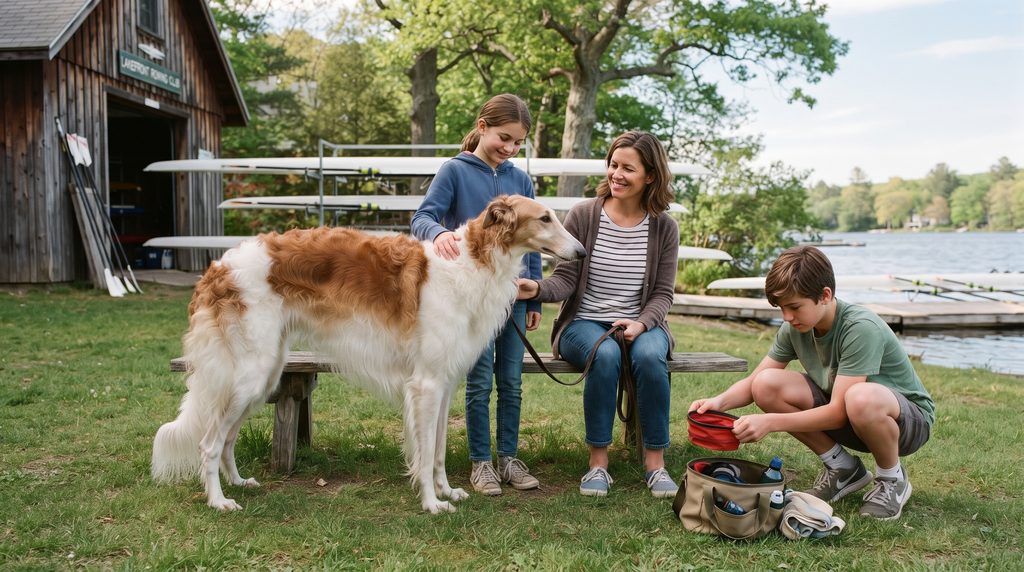
Many Borzois develop close bonds with children they know well, especially when raised alongside them in a stable household. They may enjoy relaxing nearby, accompanying family walks, or quietly observing children engaged in everyday activities. Their affection is often understated rather than exuberant, and they do not necessarily seek constant physical attention. This quieter companionship can be especially appealing to families who appreciate a gentle, dignified dog.
Nevertheless, Borzois are not generally considered ideal companions for households expecting a dog to tolerate energetic roughhousing. Their sensitive temperament means they may become uncomfortable with unpredictable handling, loud shouting, or repeated interruptions. Children who pull ears, grab tails, climb onto dogs, or attempt tight embraces can create stress even when their intentions are affectionate.
The Borzoi Club of America emphasizes that Borzois raised with children can become good companions, but they should not be expected to tolerate rough treatment. This distinction is especially important for prospective owners. A dog’s gentle personality does not mean it will enjoy every form of attention, and responsible adults must establish boundaries that protect both the dog and the children.
Size is another major consideration. Adult male Borzois commonly weigh between 75 and 105 pounds, while females typically weigh between 60 and 85 pounds. Their exceptional height and long legs can make them appear even larger than their weight suggests. Although many move gracefully around the home, an excited Borzoi could unintentionally knock over a toddler while turning, playing, or greeting family members.
Babies and very young children require particularly careful management. No dog, regardless of breed or previous behavior, should be left unsupervised with an infant or toddler. Adults must remain close enough to recognize discomfort and intervene immediately. Baby gates, separate resting areas, and appropriately managed household routines allow families to maintain safe boundaries without requiring the dog to participate in every activity.
Older children are often better suited to the Borzoi’s temperament because they can understand instructions about gentle handling and personal space. School-age youngsters can learn to approach calmly, avoid sudden movements, and allow the dog to initiate interaction. Sitting quietly while the Borzoi approaches voluntarily is generally preferable to following the dog around the house in search of attention.
Learning to recognize canine body language is especially valuable. A Borzoi that turns its head away, repeatedly licks its lips, becomes unusually still, or moves toward another room may be communicating discomfort. These signals can be subtle, particularly in a breed that often expresses itself quietly. Children should learn that moving away means the dog wants space, not that it needs to be followed or persuaded to return.
Resting areas deserve particular respect. Borzois frequently enjoy long periods of undisturbed relaxation, often choosing comfortable beds or quiet corners near family activity. Children should never climb onto a sleeping dog, pull it from its bed, or disturb it while resting. Providing an accessible retreat where the Borzoi can relax without interruption helps prevent unnecessary stress and encourages a more peaceful household.
Food-related interactions also require sensible boundaries. Although Borzois are not necessarily highly food-motivated, any dog may become uncomfortable when interrupted during meals or while enjoying a valuable chew. Children should not remove food bowls, approach a dog while it is eating, or attempt to test whether it will surrender a possession. Adults should manage feeding routines and teach appropriate trading or release behaviors through reward-based training.
The breed’s remarkable hunting instincts introduce another important consideration. Borzois were developed to detect and pursue rapidly moving animals, and their visual sensitivity remains exceptionally strong. Running children do not automatically trigger predatory behavior, but fast movement, shrieking, and exciting chase games can encourage some dogs to become overstimulated. Families should discourage games in which the dog pursues children around the garden.
Instead, supervised activities should emphasize calm cooperation. Older children may enjoy helping with simple reward-based training exercises, preparing appropriate enrichment toys, or participating in relaxed family walks. A Borzoi may learn to respond to familiar cues, settle on a designated bed, or investigate a gently presented toy. Activities should remain brief, positive, and suited to the dog’s temperament rather than involving demanding physical play.
Children should not be responsible for walking a full-grown Borzoi without capable adult control. Even a normally relaxed dog can accelerate suddenly when wildlife appears, generating considerable force through the leash. Its long legs, powerful muscles, and rapid reactions make it difficult for a smaller handler to manage safely. Adults should retain responsibility for leash control, particularly near traffic, other animals, and unfamiliar environments.
Introducing a Borzoi puppy into a family can create wonderful opportunities for developing trust, but puppyhood also brings challenges. Young Borzois are playful, curious, and sometimes physically awkward as their long legs and growing bodies develop. They may jump, investigate clothing, or become overexcited during interaction. Gentle training and consistent supervision help establish appropriate manners before the puppy reaches its substantial adult size.
Children should also understand that puppies require considerable sleep. A young Borzoi that becomes overtired may behave more impulsively, mouth clothing, or struggle to settle. Providing predictable rest periods and a quiet space away from household activity supports healthy development. Children can participate in training and socialization, but adults must ensure that interactions remain positive and manageable.
Families adopting an adult Borzoi should consider its previous experiences with children. A dog raised in a calm adult household may initially find young children unfamiliar or overwhelming. This does not necessarily mean it cannot adapt, but introductions should be gradual and closely supervised. Rescue organizations and breeders rehoming adults may be able to provide valuable information about the dog’s established preferences and behavior.
Busy household gatherings can present additional challenges. Children’s birthday parties, sleepovers, and visits from unfamiliar youngsters often involve noise, excitement, running, and unpredictable movement. A Borzoi that is comfortable with its own family may not enjoy a crowded gathering. Providing a separate quiet room with comfortable bedding and water can be more considerate than expecting the dog to tolerate prolonged activity.
The relationship between children and Borzois often becomes particularly rewarding when youngsters learn to appreciate the breed’s individuality. Rather than expecting constant entertainment, children can enjoy the dog’s calm presence, graceful movement, and occasional playful enthusiasm. These experiences can encourage patience, empathy, and an understanding that affection involves respecting another living creature’s preferences.
Parents should remain responsible for the dog’s daily care, training, and welfare. Children may assist with supervised brushing, preparing food, or simple training exercises, but they should not be expected to manage difficult behavior or provide the animal’s essential care independently. A Borzoi is a long-term family responsibility, and adult commitment is necessary regardless of how enthusiastic children may initially be.
Ultimately, the Borzoi can be a wonderful companion for families whose children are calm, considerate, and able to respect its sensitive nature. Its affectionate personality and peaceful household habits offer opportunities for meaningful relationships, but these qualities must be supported by supervision, appropriate boundaries, and thoughtful training. For families willing to provide that understanding, the Borzoi’s gentle dignity and quiet devotion can become a memorable part of growing up together.
Teaching Children to Respect a Borzoi’s Personal Space
Borzois often appreciate gentle attention but may become uncomfortable when children approach too enthusiastically. Teach youngsters to invite interaction rather than following or restraining the dog. Gentle stroking along the shoulder or body is preferable to hugging, pulling the ears, or leaning over the dog’s head. Children should never disturb a Borzoi while it is sleeping, eating, or enjoying a chew. Watch for avoidance, stiffness, or attempts to move away, and calmly end the interaction when these occur. Always provide a quiet resting place where children cannot disturb the dog. Active adult supervision remains essential, particularly around babies and toddlers.
Borzoi With Other Dogs and Pets
The Borzoi is generally a peaceful, sociable sighthound that can enjoy living alongside other dogs, particularly those with compatible temperaments and activity levels. Its traditional hunting background involved working with other Borzois, and many modern representatives of the breed appreciate canine companionship. However, their generally gentle behavior around dogs should not be confused with universal compatibility with smaller animals. The Borzoi’s powerful visual hunting instincts make careful introductions and responsible supervision particularly important.
Many Borzois develop strong relationships with other dogs in their household. They may enjoy resting together, participating in supervised outdoor activities, or engaging in short bursts of energetic play. Companionship can be especially rewarding when the dogs share similar communication styles and respect each other’s boundaries. Nevertheless, individual personalities vary, and not every Borzoi will automatically welcome a new canine companion.
The breed’s working history helps explain its potential for cooperative behavior. Traditional Russian hunters frequently used Borzois in pairs or small groups, requiring them to remain aware of one another while pursuing moving quarry. This background encouraged dogs capable of working alongside other hounds without unnecessary conflict. Modern Borzois retain aspects of that social heritage, although domestic compatibility still depends heavily on upbringing and experience.
Other sighthounds can make particularly suitable companions. Borzois may enjoy interacting with Whippets, Greyhounds, Salukis, or other Borzois because they often share similar movement patterns and interests. Their play frequently involves rapid running, changes of direction, and brief periods of pursuit. However, shared ancestry does not guarantee compatibility, and introductions should always consider the individual dogs rather than relying solely on breed.
Play between Borzois can be surprisingly energetic. A dog that spends much of the afternoon resting quietly may suddenly accelerate across a securely enclosed field with extraordinary speed. Such activity is normal, but owners should ensure both dogs remain comfortable and willing participants. Excessive pursuit, repeated attempts to escape interaction, or escalating physical contact indicate that play should be interrupted.
The Borzoi’s substantial size creates additional considerations around smaller dogs. Even a friendly individual can accidentally injure a small companion during enthusiastic movement. A Borzoi weighing 90 pounds may unintentionally collide with a dog weighing only 10 pounds, particularly during fast chasing games. Supervised introductions and careful management of high-speed activities help prevent accidents.
Owners should also recognize that rapidly moving small dogs may occasionally trigger pursuit behavior. Most Borzois can distinguish familiar canine companions from ordinary quarry, but responses differ between individuals. A small dog that suddenly runs, squeals, or behaves erratically may attract intense attention. Any tendency toward fixation, stalking, or uncontrolled chasing requires immediate management rather than assuming the interaction is harmless play.
Early socialization plays an important role in developing appropriate behavior around other dogs. Borzoi puppies benefit from positive experiences with calm, well-mannered dogs of different sizes and personalities. These encounters should be supervised and carefully matched to the puppy’s confidence. The goal is to develop relaxed social skills, not to expose a young Borzoi to overwhelming groups of unfamiliar animals.
Adult Borzois introduced to new dogs should initially meet in a neutral, controlled environment. Parallel walking at a comfortable distance can allow both animals to become familiar without the pressure of immediate face-to-face contact. As their body language remains relaxed, they may gradually be permitted closer interaction. Short, positive introductions are generally preferable to prolonged encounters that create unnecessary stress.
Living in a multi-dog household also requires sensible arrangements. Each dog should have its own comfortable resting area, particularly because Borzois often appreciate uninterrupted relaxation. Feeding separately can reduce competition, while valuable chews and favorite toys should be managed according to the dogs’ individual behavior. A peaceful relationship develops more readily when animals do not feel pressured to compete for space or resources.
Relationships with cats are considerably more complicated. Some Borzois live successfully alongside familiar household cats, especially when raised with them from puppyhood. They may learn to regard a particular cat as part of the family and show little interest in pursuing it indoors. However, this familiarity does not eliminate the breed’s natural instinct to chase moving animals.
An important distinction exists between a familiar indoor cat and an unfamiliar cat encountered outdoors. A Borzoi that peacefully shares a sofa with the family cat may respond very differently when that same animal suddenly races across the garden. The Borzoi Club of America specifically cautions that running cats can activate pursuit instincts even in dogs accustomed to living with them.
This response reflects the breed’s history as a visual hunter. Borzois are exceptionally sensitive to movement and can accelerate with remarkable speed. Once pursuit begins, an individual may become intensely focused and difficult to interrupt. For this reason, owners should never rely exclusively on obedience training to protect smaller animals when strong hunting instincts are involved.
Introducing a Borzoi to a resident cat should begin with secure physical separation. A sturdy barrier or closed door allows the animals to become familiar with one another’s presence without direct contact. The cat must have access to elevated resting places and escape routes, while the Borzoi can be rewarded for remaining calm and voluntarily disengaging.
Closer interaction should occur only when both animals consistently appear comfortable, with the dog appropriately restrained and the cat free to withdraw. Owners should watch for prolonged staring, rigid posture, stalking, sudden lunging, or an inability to respond to familiar cues. These behaviors suggest that further separation and professional guidance may be necessary.
Some Borzois may never be suitable for close contact with cats. This is particularly important when considering an adult rescue dog whose previous experiences are unknown. Even a dog that appears gentle during an initial meeting may respond differently when a cat runs. In some households, permanent separation is the safest and most responsible arrangement.
Rabbits, guinea pigs, hamsters, and other small mammals present even greater concerns. Their size and rapid movements can closely resemble the quarry Borzois were developed to pursue. Owners should not expect training or early familiarity to guarantee safe interaction. Secure enclosures, separate rooms, and prevention of unsupervised contact are essential.
Pet birds also require careful protection. Although a Borzoi may show little interest in a securely housed bird, sudden fluttering or unexpected movement could activate its visual hunting response. Birds should remain in appropriate enclosures within areas inaccessible to the dog unless strict physical separation is maintained.
Outdoor wildlife provides another reason for careful supervision. Squirrels, rabbits, foxes, and other animals may attract immediate attention during walks or garden activities. A securely fenced property and dependable leash management are essential because even a well-trained Borzoi may respond instinctively when a moving animal crosses its field of vision.
Owners should remember that prey drive and aggression are not interchangeable. A Borzoi may be affectionate with people, relaxed around dogs, and entirely comfortable in familiar surroundings while retaining an intense instinct to pursue small animals. Understanding this distinction prevents unrealistic expectations and encourages appropriate management rather than punishment for natural hunting behavior.
Professional assistance can be valuable when a Borzoi displays persistent fixation on another household animal, intense chasing behavior, resource guarding, or signs of social distress. A qualified reward-based trainer or veterinary behaviorist can assess the situation and help establish a realistic safety plan. However, training cannot guarantee that every Borzoi will become trustworthy around vulnerable pets.
Ultimately, the Borzoi can be a wonderful companion in a multi-dog household and may coexist peacefully with certain familiar pets. Its generally gentle temperament and history of cooperative hunting can support positive canine relationships, but its powerful prey drive must always be respected. Successful ownership depends on thoughtful introductions, secure environments, individual assessment, and the understanding that peaceful domestic behavior does not erase centuries of specialized hunting instinct.
Why a Borzoi May Accept One Cat but Chase Another
Some Borzois develop peaceful relationships with familiar household cats, particularly when introduced carefully during puppyhood. However, this does not mean they regard every cat as a companion. Sighthounds respond strongly to movement, and an unfamiliar cat running across a garden may trigger an immediate pursuit response. Even a resident cat can become vulnerable if it suddenly flees outdoors. Owners should never assume that successful indoor coexistence guarantees safety in other environments. Provide secure physical separation whenever necessary, ensure cats have escape routes, and prevent unsupervised interactions when there is any uncertainty about the dog’s behavior. Careful management is more dependable than relying on training alone.
Borzoi Exercise and Activity Needs
The Borzoi is an extraordinary athlete whose elegant appearance conceals remarkable speed, power, and agility. Originally developed to pursue wolves, hares, and other fast-moving animals across the Russian countryside, this tall sighthound retains a strong desire to run and respond to movement. However, its exercise requirements differ from those of many other athletic breeds. Rather than needing continuous intense activity, most Borzois benefit from a balanced routine combining regular walks, opportunities for safe running, mental stimulation, and plenty of comfortable rest.
One of the breed’s most appealing characteristics is its ability to relax indoors after satisfying exercise. Many mature Borzois happily spend considerable periods sleeping or resting near their families. This comparatively quiet domestic behavior sometimes creates the impression that they require little activity. In reality, appropriate exercise is essential for maintaining muscle condition, cardiovascular fitness, joint mobility, and emotional well-being.
For a healthy adult Borzoi, approximately an hour of daily activity provides a reasonable starting point, although individual requirements vary. This might involve two substantial walks, opportunities to investigate interesting surroundings, and additional gentle play. Younger, more energetic individuals may appreciate longer outings, while older dogs or those with medical conditions may need shorter sessions. Exercise should always be adjusted according to the dog’s fitness, age, and response to activity.
Walking is a practical foundation for everyday exercise. Borzois often enjoy exploring quiet streets, countryside paths, parks, and other environments where they can observe their surroundings. Their long-legged stride makes them comfortable companions for owners who appreciate extended walks at a steady pace. However, physical endurance should be developed gradually, especially when introducing a previously sedentary dog to longer distances.
Although Borzois primarily hunt through vision rather than scent, they still enjoy sniffing and exploring during walks. Allowing opportunities to investigate interesting areas can make ordinary outings more satisfying. Owners should balance movement with occasional pauses, recognizing that an enjoyable walk does not need to resemble a continuous exercise session.
The opportunity to run is especially important because it allows Borzois to express the athletic abilities for which they were developed. Their powerful hindquarters, flexible spines, and exceptionally long legs enable impressive acceleration and a remarkable galloping stride. Watching a healthy Borzoi move freely across a suitable field reveals the functional purpose behind its distinctive construction.
However, free running should take place only within a genuinely secure enclosure. Borzois are visual hunters, and sudden movement from a rabbit, squirrel, or other animal can trigger an immediate pursuit response. Once focused on moving quarry, a Borzoi may accelerate so rapidly that even a familiar recall command becomes ineffective. Busy roads, livestock, unfamiliar terrain, and neighboring properties create serious risks when dogs are allowed to run without adequate containment.
A large, securely fenced exercise field is particularly valuable for owners who cannot provide sufficient running space at home. The enclosure should have sturdy fencing, secure gates, and no openings through which a determined dog could escape. Its surface should be reasonably even and free from hidden obstacles. Dangerous holes, sharp objects, discarded equipment, and slippery areas should be removed before allowing vigorous activity.
Borzoi running sessions do not necessarily need to be lengthy. Some dogs enjoy several exhilarating sprints followed by a period of relaxed exploration or rest. Their exercise needs are not best measured by how long they can be encouraged to run continuously. Owners should observe whether the dog remains comfortable, coordinated, and enthusiastic rather than repeatedly pushing it toward exhaustion.
Lure coursing is one of the most suitable organized sports for the breed. This activity uses an artificial lure moving along a controlled course to simulate the pursuit of fast-moving quarry. It allows Borzois to demonstrate their remarkable eyesight, acceleration, agility, and instinctive hunting behavior without pursuing live animals.
The Borzoi Club of America actively supports lure coursing as a way to preserve and appreciate the breed’s natural abilities. Dogs participating in these activities should be appropriately conditioned, physically mature enough for the demands involved, and introduced gradually. Experienced clubs can provide guidance on safe participation, suitable equipment, and preparation for organized events.
Fast CAT and other straight-line sprint activities may also appeal to some Borzois. These events emphasize speed over a measured distance, providing another opportunity to demonstrate their athletic ability. However, owners should not assume that every dog enjoys organized competition. Some individuals prefer informal running opportunities or quieter activities that offer similar physical benefits without a busy sporting environment.
Beyond coursing, Borzois may enjoy selected canine sports such as rally, agility, and obedience. Their independent temperament can make training different from that of breeds developed for constant handler cooperation, but many respond well to enjoyable, reward-based activities. Exercises should be chosen according to the dog’s physical structure, motivation, and comfort rather than expecting enthusiasm for every available sport.
Mental stimulation is also important, although it need not involve exhausting physical challenges. Interactive food puzzles, simple search games, short training sessions, and opportunities to explore unfamiliar environments can provide meaningful engagement. Borzois often appreciate activities that encourage independent problem-solving rather than endless repetition of commands.
Puppies require a particularly thoughtful approach to exercise. Young Borzois grow rapidly, and their developing bones, joints, and muscles should not be subjected to excessive repetitive strain. Forced distance running, demanding hikes, repeated high jumps, and intense sporting activities are inappropriate for immature dogs. Instead, puppies benefit from frequent short outings, gentle play, positive socialization, and opportunities to move naturally at their own pace.
As puppies mature, exercise can gradually become more structured. Adolescent Borzois often display increasing physical confidence and enthusiasm, sometimes accompanied by surprising bursts of speed. However, their bodies may continue developing well beyond their first birthday. Owners interested in demanding activities should consult their veterinarian and experienced breed or sporting professionals about appropriate conditioning and maturity.
Warm weather presents another important consideration. Although the Borzoi originated in a climate associated with cold winters, its coat and large body do not protect it from overheating. Exercise during hot or humid conditions should be reduced or scheduled for cooler periods. Fresh drinking water, shade, and opportunities to recover in a comfortable environment are essential.
Owners should recognize signs that exercise is becoming excessive. Unusual slowing, persistent heavy panting, weakness, reluctance to continue, or changes in coordination require immediate attention. Heat-related illness can develop rapidly and demands urgent veterinary care when serious symptoms appear. Even physically fit dogs have limits, particularly during demanding activity in unsuitable weather.
Cold weather is generally more comfortable for many Borzois, although individual tolerance varies. Their silky coats offer some protection, but prolonged exposure to freezing temperatures, wet conditions, or strong winds can still cause discomfort. Owners should monitor their dog’s behavior and avoid assuming that Russian ancestry guarantees unlimited cold-weather tolerance.
Care is also necessary around feeding times. Because Borzois are large, deep-chested dogs, they can be susceptible to gastric dilatation-volvulus, commonly called bloat. Avoiding strenuous exercise immediately before and after substantial meals is a sensible precaution, although no exercise or feeding routine can guarantee prevention. Owners should discuss individual risk factors with their veterinarian.
As Borzois enter their senior years, exercise should focus increasingly on preserving mobility and comfort. Older dogs may still enjoy relaxed walks and opportunities to explore familiar surroundings, even when their enthusiasm for fast running begins to diminish. Shorter outings on suitable surfaces can help maintain muscle strength without placing unnecessary strain on aging joints.
A senior Borzoi that becomes stiff, reluctant to rise, or unwilling to participate in previously enjoyed activities should receive veterinary assessment. Arthritis, injury, and other medical conditions can affect comfort, and appropriate treatment may allow the dog to remain active for considerably longer. Reduced mobility should not automatically be dismissed as an unavoidable part of aging.
Owners should also remember that exercise and behavioral management are closely connected. A Borzoi that receives insufficient activity may become restless, bored, or more inclined to investigate household objects. However, attempting to solve every behavioral problem through increasingly intense exercise is not necessarily appropriate. Mental stimulation, predictable routines, companionship, training, and sufficient rest are equally important.
Ultimately, meeting a Borzoi’s exercise needs involves appreciating the extraordinary athlete beneath its calm, elegant exterior. These dogs do not generally require nonstop activity, but they need meaningful opportunities to walk, explore, and occasionally demonstrate their remarkable speed in secure surroundings. With appropriate conditioning, sensible safety precautions, and activities suited to their age and temperament, Borzois can remain physically healthy, mentally satisfied, and wonderfully relaxed companions at home.

Finding Safe Places for a Borzoi to Run
Borzois benefit from opportunities to run freely, but their exceptional speed and strong visual hunting instincts make secure containment essential. Look for private dog exercise fields, well-maintained enclosed training grounds, or reputable sighthound clubs offering supervised activities. Fencing should be sufficiently high, gates securely fastened, and running surfaces free from holes, debris, and slippery patches. Avoid unrestricted running near roads, livestock, or wildlife, even if your Borzoi usually responds well to recall. A few enjoyable sprints in a safe environment can provide valuable exercise without requiring prolonged high-intensity activity. Always allow appropriate warm-up, recovery, and access to drinking water.
Training a Borzoi
Training a Borzoi requires patience, consistency, and an understanding of the independent hunting instincts that distinguish this elegant Russian sighthound. Although Borzois are intelligent and capable of learning a wide range of behaviors, they were not developed for constant obedience to human commands. Their ancestors needed to make rapid decisions while pursuing moving quarry, often at considerable distances from their handlers. Successful training therefore depends on encouraging cooperation rather than demanding unquestioning compliance.
One of the most important principles is recognizing that independence does not indicate a lack of intelligence. A Borzoi may learn a new behavior quickly but show little enthusiasm for repeating it unnecessarily. Some become distracted when training sessions are prolonged or predictable. Owners often achieve better results by keeping lessons brief, varied, and rewarding, with opportunities for the dog to succeed before its interest begins to fade.
Positive reinforcement is particularly well suited to the breed’s sensitive temperament. Small food rewards, gentle praise, enjoyable toys, and permission to engage in appropriate activities can encourage desirable behavior. Many Borzois respond poorly to shouting, physical corrections, or confrontational handling. These methods may undermine confidence and damage the relationship between dog and owner without improving reliability.
Training should begin when a puppy first arrives home. Early lessons can introduce name recognition, coming when called, following a hand target, settling on a mat, and accepting gentle handling. Sessions lasting only a few minutes are usually sufficient for young puppies. Frequent, enjoyable experiences establish positive expectations and help the puppy associate learning with cooperation rather than pressure.
Socialization is equally important. Borzoi puppies should gradually experience different people, environments, surfaces, sounds, and appropriately matched dogs. These introductions should remain comfortable and positive, allowing the puppy to observe unfamiliar situations without becoming overwhelmed. Because some adult Borzois are naturally reserved around strangers, the objective is relaxed confidence rather than indiscriminate enthusiasm for everyone they encounter.
Recall deserves particular attention because the Borzoi’s exceptional eyesight and powerful chase instinct can override familiar instructions. Begin training indoors, where distractions are minimal. Reward the puppy immediately for approaching when called, then gradually increase the distance. Once responses become consistent, practice in a securely enclosed garden or training area before introducing more challenging distractions.
A long training line attached to a properly fitted harness can provide additional security during controlled outdoor practice. It allows the dog some freedom to move while preventing an uncontrolled departure. Owners should avoid sudden jerks or allowing the line to become entangled around people, obstacles, or the dog’s legs. Training should progress gradually, with generous rewards for successful responses.
Even a well-trained Borzoi should not be expected to demonstrate completely dependable recall around moving wildlife. A rabbit crossing an open field can trigger an immediate pursuit response, and the dog’s extraordinary acceleration may make intervention impossible. Securely fenced areas and appropriate leash management remain essential throughout life. Training improves cooperation, but it cannot guarantee that inherited hunting instincts will disappear.
Loose-leash walking is another important skill. Borzois are generally graceful movers, but their substantial size and physical power can create difficulties if they suddenly pull toward something interesting. Rewarding the dog for remaining near its owner, maintaining a relaxed leash, and responding to changes of direction helps establish comfortable walking habits.
Equipment must fit the breed’s unusual anatomy. Borzois have relatively narrow heads compared with their necks, so an ordinary flat collar may slip off when a dog backs away. A correctly fitted martingale collar or suitable escape-resistant harness may provide additional security. Equipment should be selected and adjusted carefully to avoid discomfort, and owners should never rely on restrictive devices as a substitute for training.
Teaching a reliable waiting response is particularly valuable. A Borzoi that pauses calmly before passing through an open doorway, leaving a vehicle, or entering a garden is easier to manage safely. Begin with brief pauses in quiet environments and reward the dog before gradually introducing more exciting situations. These practical skills help prevent accidental escapes when a sudden movement attracts attention.
Impulse-control exercises can also strengthen everyday cooperation. Owners might reward a Borzoi for looking away from a mildly interesting object, waiting calmly while a gate opens, or responding to a familiar cue before investigating something new. The difficulty should increase gradually. Attempting to demand attention when the dog is already intensely focused on a running animal is unlikely to produce reliable learning.
House training usually progresses well when routines are predictable. Puppies should receive frequent opportunities to eliminate outdoors, particularly after sleeping, eating, and playing. Successful behavior should receive immediate positive reinforcement. Accidents are best addressed through supervision, suitable cleaning, and more consistent opportunities rather than punishment, which can create confusion or anxiety.
Crate training can be useful when introduced gradually and positively. A sufficiently large crate offers a comfortable resting place during travel, recovery, or periods when supervision is temporarily unavailable. Because Borzois are exceptionally tall, owners must choose equipment that accommodates their full height and body length. The dog should be able to stand, turn around, and lie comfortably without being cramped.
Teaching a Borzoi to settle calmly is just as valuable as teaching movement-based exercises. Rewarding the dog for relaxing on a designated bed or mat helps establish predictable household routines. This skill can be particularly useful when visitors arrive, meals are being prepared, or family activities become busy. A comfortable resting place should remain a positive environment rather than somewhere the dog is sent as punishment.
Adolescence often presents additional challenges. As young Borzois become physically stronger and more confident, their interest in movement and the surrounding environment may intensify. Previously reliable responses can become less consistent, especially in unfamiliar places. Owners should temporarily simplify exercises when necessary and continue reinforcing successful behavior rather than interpreting normal developmental changes as deliberate disobedience.
Training must also respect the breed’s physical development. Young Borzois experience substantial growth, and demanding jumps, repetitive high-impact exercises, and strenuous sporting activities should be postponed until the dog is sufficiently mature. Foundation skills such as balance, body awareness, calm handling, and responding to cues can be developed without placing excessive stress on growing joints.
Organized training classes can provide valuable opportunities for learning. Reward-based puppy classes, family manners programs, rally, and appropriately managed obedience activities allow Borzois to practice responding around distractions. However, owners should choose instructors who understand independent sighthounds and adapt exercises to individual motivation rather than expecting every dog to work continuously throughout a lengthy class.
Some Borzois particularly enjoy activities involving movement. Carefully structured games, short retrieves, or appropriate toy-based rewards can make training more engaging. However, owners should distinguish controlled play from unrestricted chasing, especially around smaller dogs or vulnerable animals. Activities that encourage the dog’s natural athleticism should always take place in suitable, secure surroundings.
Consistency between household members is essential. Everyone should use the same basic cues and reward desirable behavior in a similar way. A Borzoi can become confused when one person encourages a behavior that another discourages. Establishing clear, realistic expectations helps the dog understand everyday routines and reduces unnecessary frustration.
Ultimately, training a Borzoi is about building communication, trust, and reliable household manners while respecting the breed’s independent nature. These dogs can become responsive, cooperative companions when teaching remains enjoyable and expectations are realistic. Their extraordinary speed and powerful hunting instincts will always require sensible management, but patience, positive reinforcement, and consistent practice can create a deeply rewarding partnership with this graceful and intelligent sighthound.
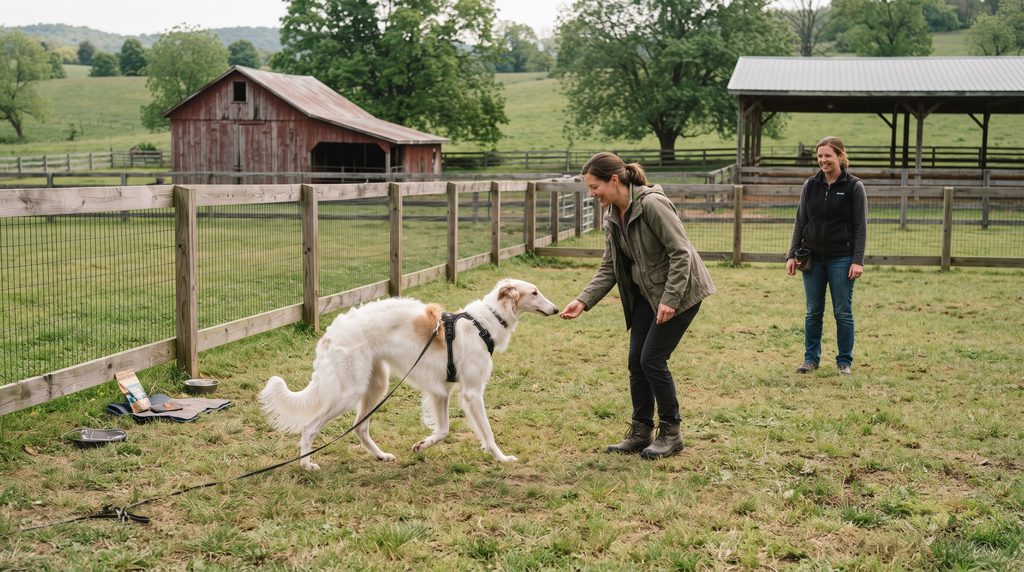
Borzoi Grooming and Coat Care
The Borzoi’s magnificent silky coat is one of its most recognizable features, contributing enormously to the breed’s elegant appearance. Although its flowing hair may suggest complicated grooming requirements, coat maintenance is generally manageable with the right equipment and a consistent routine. Unlike breeds requiring elaborate clipping or specialist styling, Borzois retain their natural beauty through regular brushing, careful detangling, occasional bathing, and attention to everyday hygiene.
The breed possesses a distinctive coat that differs considerably from the heavy, continuously growing hair of some companion breeds. Borzoi hair may be relatively straight, gently wavy, or somewhat curly, with a silky texture that should never feel excessively coarse or woolly. The coat lies closer to the body in certain areas, while longer feathering creates the flowing outline associated with the breed.
Hair distribution also varies naturally across the body. The head, ears, and front of the legs generally carry shorter, smoother hair. Longer furnishings appear around the neck, chest, thighs, backs of the legs, and tail. Some Borzois develop particularly impressive neck frills and substantial feathering, while others have a lighter, less abundant coat. These differences influence how frequently individual dogs require grooming.
For most Borzois, brushing two or three times a week provides a practical foundation for maintaining coat condition. Dogs with especially abundant feathering may benefit from more frequent attention, particularly after outdoor adventures. Short, regular sessions are generally preferable to allowing tangles to accumulate and then attempting to remove them during a lengthy, uncomfortable grooming session.
A good-quality pin brush is especially useful for maintaining the breed’s silky coat. Its widely spaced pins can move through longer hair without unnecessarily damaging the natural texture. A gentle slicker brush may help remove loose hair and minor tangles, while a stainless-steel comb allows owners to check whether the coat has been thoroughly detangled.
Brushing technique matters as much as equipment. Work through the coat gently, following the natural direction of hair growth. Lift sections of longer feathering when necessary so that the brush reaches beyond the outer surface. Simply smoothing the visible hair may leave hidden tangles developing closer to the skin, particularly around areas where the coat is thicker.
Several locations deserve particular attention. The feathering behind the ears, beneath the chest, around the armpits, along the hindquarters, and beneath the tail can become tangled through ordinary movement. Areas beneath collars or harness straps may also develop friction-related knots. Checking these locations regularly helps prevent small tangles from becoming uncomfortable mats.
When encountering a knot, avoid pulling forcefully with a brush. Instead, gently separate the hair with your fingers, supporting the surrounding coat to prevent unnecessary tension on the skin. A suitable dog-safe detangling product may help with stubborn areas. Work gradually from the outer ends of the hair toward the base, using a comb only when the tangle has loosened.
Severely matted hair may require professional assistance. Attempting to cut close to the skin with ordinary scissors can cause serious injury, particularly when a tight mat conceals the underlying tissue. A qualified groomer can assess whether the hair can be safely detangled or whether limited clipping is necessary for the dog’s comfort.
Bathing is another important aspect of coat maintenance, although healthy Borzois do not require an excessively rigid washing schedule. Many remain relatively clean between baths, especially when regularly brushed and kept in comfortable living conditions. Bathing becomes appropriate when the coat accumulates significant dirt, develops an unpleasant smell, or requires cleaning after particularly muddy adventures.
Use a mild shampoo formulated specifically for dogs, preferably one suitable for longer coats. Thoroughly wet the hair before applying shampoo, then work the product gently through the coat without creating unnecessary tangles. Harsh scrubbing can cause long strands to become knotted, particularly around the chest and hindquarters.
Rinsing deserves particular care because shampoo residue can cause skin irritation and leave the coat looking dull. Continue rinsing until the water runs clear and no product remains beneath the longer feathering. A suitable canine conditioner may help maintain smoothness and reduce tangling, particularly in dogs with dry or easily knotted hair.
Drying a Borzoi requires more preparation than drying a short-coated dog. Begin by gently pressing absorbent towels against the coat rather than rubbing vigorously. A dryer designed for dogs can be useful when operated at an appropriate temperature and airflow setting. Introduce drying equipment gradually, especially with puppies or dogs sensitive to unfamiliar sounds.
The dense hair around the chest, thighs, and underside should be dried thoroughly before the dog settles for an extended period. Leaving these areas persistently damp may contribute to irritation, particularly where moisture becomes trapped against the skin. Gentle brushing during or after drying helps prevent tangles and restores the coat’s natural flowing appearance.
Routine clipping is generally unnecessary for a typical pet Borzoi. The breed’s elegant appearance comes from its natural coat rather than from elaborate sculpting. Owners should avoid shaving the body simply for convenience or because they assume it will make the dog more comfortable during summer. Removing substantial amounts of coat can alter its protective function and is not an effective substitute for appropriate temperature management.
Limited trimming may occasionally be helpful around the feet or sanitary areas when excessive hair interferes with cleanliness or comfort. Any trimming should remain conservative and preserve the breed’s natural appearance. Owners uncertain about appropriate techniques should seek advice from a groomer experienced with long-coated sighthounds.
Foot care is particularly important because Borzois are athletic dogs with long legs and relatively narrow feet. Their feathering can collect grass seeds, small twigs, burrs, and other debris during walks through woodland or fields. Checking between the toes and around the paw pads after outdoor activity helps identify potential problems before they cause discomfort.
Nail maintenance also deserves consistent attention. Long nails can interfere with normal foot placement and may affect comfort during walking or running. Although exercise on firm surfaces may provide some natural wear, many Borzois still require regular trimming. Owners should check nail length every few weeks and use appropriate clippers or a grinder according to their dog’s tolerance.
The Borzoi’s small, folded ears generally require less complicated maintenance than those of breeds with heavy, pendulous ears. Nevertheless, regular inspection remains important. Look for unusual redness, discharge, unpleasant odors, or signs of discomfort. Healthy ears do not necessarily need frequent cleaning, and unsuitable products or excessive cleaning can cause irritation.
Dental hygiene should form part of the same routine. Daily toothbrushing with a dog-specific toothbrush and toothpaste helps reduce plaque accumulation and supports periodontal health. Regular veterinary dental assessments remain important because even a dog with an attractive coat may develop dental problems that are not immediately visible.
Grooming also provides valuable opportunities to assess the dog’s overall condition. Running your hands gently over the body can reveal unexpected lumps, skin irritation, tender areas, or changes in muscle condition. Borzois have relatively lean bodies, so owners should become familiar with their dog’s normal physical structure without assuming every prominent bone indicates a health problem.
Puppies should become accustomed to grooming from an early age. Short sessions involving gentle brushing, paw handling, ear inspection, and rewards help build confidence. Because Borzoi puppies rapidly develop into exceptionally tall adults, teaching comfortable cooperation while they are small makes later grooming considerably easier.
Senior Borzois may require adjustments to their grooming routines. Dogs experiencing arthritis or other mobility problems may find prolonged standing uncomfortable. Shorter sessions, nonslip surfaces, supportive handling, and opportunities to rest help maintain comfort. Owners should avoid forcing an older dog into awkward positions simply to complete grooming quickly.
Ultimately, Borzoi grooming is less complicated than its beautiful coat might initially suggest, but consistency remains essential. Regular brushing, gentle detangling, sensible bathing, nail care, dental hygiene, and routine skin inspections help maintain both appearance and comfort. With appropriate attention, the Borzoi’s flowing coat can remain healthy, attractive, and naturally elegant throughout its life.
Preventing Tangles in Borzoi Feathering
The Borzoi’s longest feathering is particularly vulnerable to tangling where hair rubs against itself, collars, or harness straps. Pay special attention behind the ears, beneath the chest, around the armpits, along the hindquarters, and underneath the tail. Gently lift sections of hair and use a pin brush or wide-toothed comb to check for hidden knots. If a tangle develops, separate it carefully with your fingers rather than pulling forcefully. Regular inspections after woodland walks are especially useful because burrs, grass seeds, and small twigs can become caught in the silky hair. Keeping these areas comfortable helps prevent painful matting.

Borzoi Shedding
The Borzoi’s beautiful, flowing coat is one of its most distinctive characteristics, but that elegance comes with an inevitable reality: loose hair around the home. Although its silky coat is generally easier to maintain than the heavy coats of some other long-haired breeds, the Borzoi sheds throughout the year and can experience substantial seasonal coat loss. Prospective owners should be comfortable with regular brushing, routine household cleaning, and the occasional dramatic increase in loose hair.
For anyone wondering do Borzoi shed, the answer is definitely yes. The breed is not a low-shedding dog, although the amount of hair released varies considerably between individuals. Many Borzois shed moderately during ordinary periods, with more noticeable shedding occurring when the coat changes seasonally. Understanding these patterns helps owners distinguish normal coat turnover from unusual hair loss that may require veterinary attention.
The Borzoi possesses a distinctive double coat, consisting of longer protective outer hairs and a softer undercoat that varies in density. Its coat developed partly to provide protection against the challenging climate associated with its Russian origins. The silky outer hair creates the breed’s elegant appearance, while the undercoat contributes insulation when environmental conditions require it.
Coat density is not identical in every Borzoi. Some individuals have substantial undercoats and abundant furnishings, while others carry lighter coats that appear comparatively sleek. Climate, genetics, age, sex, and hormonal status all influence coat development and shedding. A Borzoi living in a cooler environment may develop a different seasonal coat from one living primarily in a warm, climate-controlled home.
The most noticeable shedding often occurs during seasonal coat changes. According to the American Kennel Club, Borzois typically experience a heavier shedding period lasting several weeks, often around once a year. During this time, substantial quantities of loose undercoat may become trapped among the longer hairs before being removed through brushing or falling naturally.
The Borzoi Club of America also describes differences associated with sex and reproductive hormones. Intact females may shed heavily following a heat cycle, while males and spayed females commonly experience more predictable annual coat changes. Individual patterns are not identical, however, and owners should become familiar with what is normal for their particular dog.
These seasonal changes can be surprising to inexperienced owners. A Borzoi with an impressive, full coat may temporarily appear considerably less heavily furnished after shedding. The neck frill, feathering, and overall coat volume can become noticeably reduced, particularly when substantial undercoat is lost. This does not necessarily indicate illness when the dog remains otherwise healthy and the skin appears normal.
During heavy shedding periods, more frequent brushing becomes especially useful. The American Kennel Club recommends brushing every day or two to remove loose hair and dirt, with additional attention when shedding increases. A suitable pin brush, gentle slicker brush, and stainless-steel comb can help maintain coat condition without unnecessarily damaging the silky outer hair.
The objective is to remove hair that has already loosened, rather than aggressively stripping the coat. Excessive pressure, repeated use of harsh deshedding blades, or forceful pulling can irritate the skin and damage healthy hair. Borzois generally respond better to patient, comfortable grooming sessions that preserve the natural texture of their coats.
Owners should pay particular attention to areas where loose undercoat can become trapped beneath longer feathering. The chest, neck, thighs, and hindquarters may hold more loose hair than the smoother areas of the body. Gently separating the coat and brushing through manageable sections helps prevent accumulating hair from forming tangles.
Because Borzois have relatively long, silky hair, their shedding behaves differently from that of short-coated breeds. Loose strands often collect visibly along furniture edges, bedding, rugs, and clothing. Some hairs may remain temporarily attached to the coat rather than falling immediately, making the dog appear less actively shedding until a brushing session releases a surprising amount.
The breed’s coat colors also influence how noticeable loose hair appears indoors. A predominantly white Borzoi may leave pale hairs clearly visible on dark upholstery, while a black or richly colored dog can leave obvious strands on light-colored fabrics. Multicolored individuals may contribute a mixture of hair that becomes noticeable across several household surfaces.
Practical household management can make shedding considerably less troublesome. Washable dog blankets, removable furniture covers, and regularly cleaned bedding are especially helpful. A vacuum cleaner suitable for pet hair, lint rollers, and reusable upholstery brushes can keep loose strands from accumulating throughout the home.
Owners who allow their Borzoi to share sofas or beds may find washable throws particularly useful. These provide a convenient surface that can be removed for laundering without requiring the entire piece of furniture to be cleaned. Placing a comfortable dog bed near family activity can also encourage the dog to use a designated resting area.
Regular grooming outdoors can reduce the amount of loose hair entering the house, provided the environment is secure and weather conditions are comfortable. A sheltered patio or enclosed garden is often suitable. Because Borzois are powerful visual hunters, owners should never allow grooming equipment or household activity to distract them from maintaining secure gates and fencing.
Bathing may temporarily help remove loose coat, particularly during seasonal shedding. A gentle dog-specific shampoo and thorough rinsing can clean away accumulated dirt and loosen hairs ready to fall. However, excessive bathing is unnecessary and may dry the skin. A suitable bathing schedule should reflect the dog’s actual condition rather than an attempt to eliminate shedding completely.
Drying is particularly important after bathing because longer coat areas can retain moisture. Gentle towel drying followed by appropriate brushing or careful use of a dog-safe dryer may help remove additional loose hair. Owners should avoid excessively hot airflow, which can irritate the skin or cause discomfort.
Another frequently asked question is are Borzoi hypoallergenic. They are not. Borzois produce allergens found in dander, saliva, and other bodily secretions, just as other dogs do. Their long coat and regular shedding can distribute allergen-carrying material throughout the home, making them unsuitable for anyone expecting a reliably allergy-friendly breed.
It is important to recognize that dog allergies are not caused by coat length alone. Allergic reactions are primarily associated with proteins produced by the animal, rather than simply the presence of visible hair. Consequently, even breeds that shed relatively little may provoke allergic reactions, and no dog can be guaranteed completely hypoallergenic.
Families with known dog allergies should seek appropriate medical advice before bringing home a Borzoi. Spending time around adult dogs may provide useful insight into individual reactions, although a short visit cannot guarantee tolerance during long-term ownership. Regular cleaning and suitable household management may help reduce allergen exposure, but they do not eliminate the underlying source.
Normal shedding should also be distinguished from abnormal hair loss. Healthy coat turnover generally involves loose hair being released without significant skin irritation or unexplained bald patches. Sudden thinning, persistent scratching, redness, sores, or unusual changes in coat texture deserve veterinary assessment.
Several medical conditions can affect coat health, including allergies, skin infections, parasites, and certain hormonal disorders. Thyroid dysfunction, for example, can sometimes contribute to coat changes and hair loss. However, owners should not assume that every unusual shedding pattern indicates a specific disease. Veterinary examination is necessary to establish the cause.
Nutrition also influences coat condition. A complete and balanced diet provides the protein, fatty acids, vitamins, and minerals required for healthy hair growth and skin maintenance. Poor nutrition may contribute to a dull coat or abnormal hair loss, but even excellent feeding cannot prevent the natural shedding cycle.
As Borzois age, coat texture and density may change gradually. Some older dogs develop thinner furnishings or experience alterations in hair growth. Senior dogs with arthritis may also find lengthy grooming sessions uncomfortable, making shorter, gentler brushing sessions more appropriate.
Ultimately, Borzoi shedding is a manageable but unavoidable part of living with this magnificent breed. Regular brushing, attention during heavier seasonal coat changes, practical household cleaning, and an understanding of normal coat variation help keep loose hair under control. For owners who appreciate the Borzoi’s gentle temperament, extraordinary elegance, and affectionate companionship, a little additional vacuuming is usually a reasonable trade-off for sharing life with such a remarkable dog.
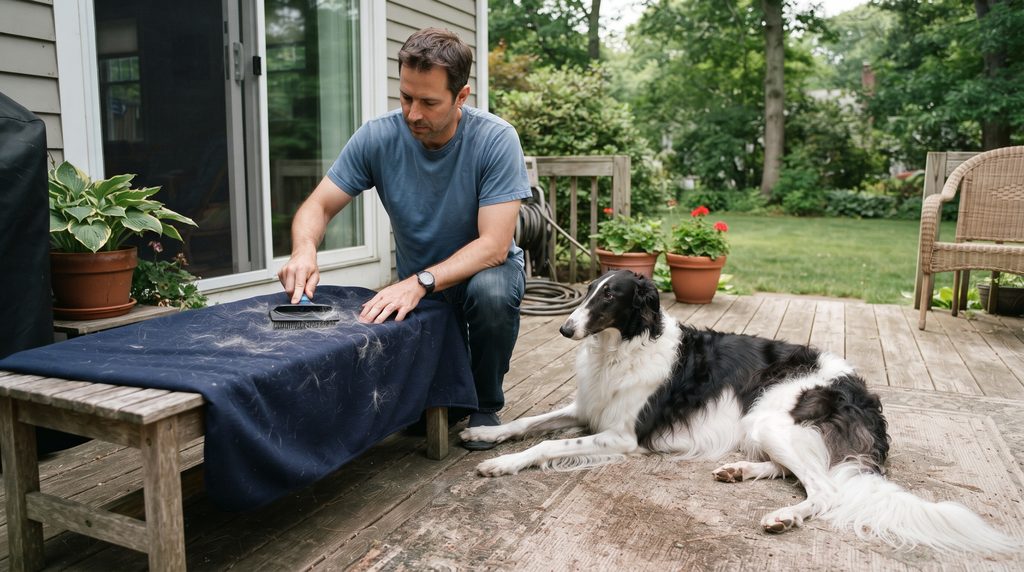
Why Borzois Sometimes Lose So Much Coat at Once
A Borzoi’s seasonal coat change can produce considerably more loose hair than its normal daily shedding. The soft undercoat may loosen over several weeks, temporarily reducing the volume of the neck frill and feathering. Intact females can experience particularly noticeable shedding following a heat cycle, while males and spayed females commonly follow more seasonal patterns. During these periods, gentle daily brushing can help remove loose hair before it collects on furniture and clothing. Avoid harsh deshedding tools or aggressive brushing, which may damage the coat. If hair loss produces bald patches, inflamed skin, or persistent itching, arrange a veterinary examination.
Borzoi Feeding and Nutrition
Feeding a Borzoi properly involves understanding the nutritional requirements of an exceptionally tall, athletic sighthound with a surprisingly moderate appetite. Although mature Borzois can reach impressive heights and weights, they do not necessarily consume as much food as their size might suggest. Their lean construction, individual activity levels, and relatively relaxed household habits mean that successful feeding depends on balanced nutrition, appropriate portions, and careful attention to body condition rather than simply providing large quantities of food.
The Borzoi Club of America notes that mature Borzois are often comparatively modest eaters for their size. However, individual requirements vary considerably. A young adult participating regularly in lure coursing may need substantially more energy than an older companion enjoying relaxed daily walks. Age, reproductive status, climate, metabolism, and overall health also influence the amount of food required.
A complete and balanced commercial dog food is a practical choice for most owners. Look for a product formulated for the dog’s current life stage and supported by recognized nutritional standards, such as those established by the Association of American Feed Control Officials. Foods designed for adult maintenance should provide the nutrients required to support normal muscle function, healthy skin, coat condition, and general well-being.
The most expensive food is not necessarily the most appropriate. Ingredient marketing, unusual protein sources, and attractive packaging do not automatically indicate superior nutritional quality. A manufacturer’s nutritional expertise, quality-control procedures, feeding trials, and ability to provide reliable information about its products are more meaningful considerations. Owners should consult their veterinarian when comparing diets, particularly if their Borzoi has specific health concerns.
Protein plays an important role in maintaining the breed’s lean muscle mass. Borzois possess powerful hindquarters, substantial supporting musculature, and exceptional athletic ability despite their elegant appearance. An appropriate diet must provide sufficient high-quality protein to support normal tissue maintenance and recovery from physical activity. However, unnecessarily high protein levels are not automatically beneficial, and nutritional balance remains more important than emphasizing one ingredient.
Dietary fat supplies concentrated energy and contributes essential fatty acids that support normal skin and coat health. The Borzoi’s flowing silky coat benefits from adequate nutrition, but owners should avoid adding oils or supplements indiscriminately. Excessive dietary fat increases calorie intake and may contribute to digestive problems. A complete, appropriately formulated food generally provides the nutrients required without routine supplementation.
Carbohydrates can also form a useful part of a balanced diet, providing digestible energy and dietary fiber. There is no general requirement for healthy Borzois to avoid grains. Grain-free feeding should not be assumed superior simply because the breed is a sighthound. Dietary restrictions are best introduced when supported by an individual medical need rather than marketing claims.
Feeding requirements are particularly important during puppyhood. Borzoi puppies grow rapidly, developing exceptionally long limbs and substantial skeletal structures over an extended period. Their nutritional needs differ from those of mature adults, making a properly formulated large-breed growth diet particularly valuable. Controlled growth helps support normal bone and joint development while reducing the risks associated with excessive calorie intake.
Puppies should not be encouraged to grow as quickly as possible. Overfeeding during skeletal development can contribute to excessive weight gain and place additional stress on immature joints. Calcium and phosphorus levels must also remain appropriately balanced. Adding calcium supplements to a complete puppy diet without veterinary direction can disrupt that balance and potentially interfere with normal skeletal development.
Young puppies generally benefit from several smaller meals throughout the day. Three or four daily meals may be appropriate during early growth, with feeding frequency gradually reduced as the puppy matures. Adult Borzois commonly do well with two measured meals daily, although some individuals benefit from three smaller portions. Consistent mealtimes also make appetite changes easier to recognize.
Because Borzois are large, deep-chested dogs, feeding routines should take account of gastric dilatation-volvulus, commonly called GDV or bloat. This life-threatening condition occurs when the stomach becomes distended and may rotate, compromising blood circulation and requiring immediate veterinary treatment. Large body size, deep chest conformation, rapid eating, and feeding one substantial meal daily are among the factors associated with increased risk.
Dividing the daily food allowance into two or more smaller meals is generally preferable to providing one large meal. Dogs that eat excessively quickly may benefit from an appropriately designed slow-feeder bowl or other controlled feeding methods. Meals should take place in a calm environment, particularly in multi-dog households where competition can encourage hurried eating.
Raised feeding bowls are sometimes promoted as a way to make eating easier for tall breeds. However, research has associated elevated feeding with an increased risk of GDV in some large and giant breeds. For most healthy Borzois, feeding from a bowl placed directly on the floor is a sensible approach unless a veterinarian recommends otherwise for a specific medical reason.
Strenuous exercise should also be avoided immediately before and after substantial meals. Although the relationship between activity and GDV is complex, allowing the dog time to settle around feeding is a reasonable precaution. Owners should not regard any particular feeding schedule as a guarantee against bloat. Veterinary advice about individual risk, including the possible benefits of preventive gastropexy, remains important.
Recognizing the warning signs of GDV can save a dog’s life. Repeated unsuccessful attempts to vomit, abdominal swelling, excessive salivation, restlessness, weakness, or sudden collapse require immediate emergency veterinary attention. Not every affected dog develops an obviously swollen abdomen, so owners should never wait for every symptom to appear before seeking help.
Maintaining a healthy body condition is equally important. Borzois naturally possess a lean silhouette, and their narrow waist and relatively prominent anatomical features can look unusual to people accustomed to heavier breeds. However, genuine thinness should not be confused with healthy athletic construction. A properly conditioned dog should possess adequate muscle, a defined waist, and ribs that can be felt without excessive pressure.
Regular body-condition assessments are more useful than relying on the number displayed by a scale alone. Two Borzois of similar height may have different appropriate weights because of differences in bone structure, muscle development, sex, and maturity. Veterinarians can help owners identify a suitable body condition and adjust feeding amounts as the dog develops.
Treats should be included within the daily calorie allowance. Small food rewards can be particularly valuable when training an independent Borzoi, but frequent rewards can gradually contribute to unwanted weight gain. Using small portions of the dog’s regular food for training is one practical way to maintain nutritional consistency while encouraging cooperation.
Fresh drinking water must remain available throughout the day. Borzois need appropriate hydration following exercise, during warm weather, and whenever consuming dry food. Water should never be routinely withheld in an attempt to prevent bloat. However, dogs that habitually gulp excessive quantities immediately after vigorous activity may benefit from veterinary guidance on safer drinking routines.
Some Borzois develop selective eating habits. A dog may show little enthusiasm for a particular food or occasionally eat less when circumstances change. However, persistent refusal, repeated vomiting, diarrhea, or unexplained weight loss should never be dismissed as ordinary breed behavior. Sudden appetite changes warrant veterinary advice, particularly when accompanied by lethargy or abdominal discomfort.
Dietary changes are best introduced gradually, generally over approximately seven to ten days. Mixing increasing amounts of the new food with decreasing amounts of the previous diet allows the digestive system time to adjust. Dogs with sensitive digestion or established medical conditions may require a more individualized transition.
Home-prepared diets are possible, but they must be nutritionally complete and balanced. Recipes based primarily on meat, rice, or vegetables may lack essential nutrients despite appearing wholesome. Owners considering home cooking should consult a board-certified veterinary nutritionist to develop a suitable formulation. Raw diets introduce additional concerns involving bacterial contamination and nutritional imbalance and are not necessary for maintaining good health.
As Borzois age, their calorie requirements may change. Some senior dogs become less active and require smaller portions, while others experience muscle loss or medical conditions affecting appetite. Senior nutrition should be tailored to body condition, activity, and veterinary findings rather than assuming that every older dog requires a substantially reduced diet.
Ultimately, feeding a Borzoi successfully means supporting its athletic body without encouraging unnecessary weight gain or excessively rapid growth. A complete, balanced diet, measured portions, sensible feeding routines, constant access to fresh water, and awareness of GDV risk provide a strong foundation. With individualized veterinary guidance and regular monitoring, appropriate nutrition can help preserve the Borzoi’s strength, elegant condition, and overall health throughout its life.
Feeding Practices That May Help Reduce Bloat Risk
Because Borzois are large, deep-chested dogs, owners should take sensible precautions against gastric dilatation-volvulus. Divide the daily food allowance into at least two smaller meals rather than offering one substantial feeding. Encourage slower eating when necessary, maintain a calm feeding environment, and avoid strenuous activity immediately around mealtimes. Food bowls should generally remain at floor level unless a veterinarian recommends otherwise. Fresh water must always be available. These measures cannot eliminate the risk of GDV, so recognizing emergency symptoms remains essential. Repeated unproductive retching, abdominal discomfort, restlessness, weakness, or collapse require immediate veterinary treatment.
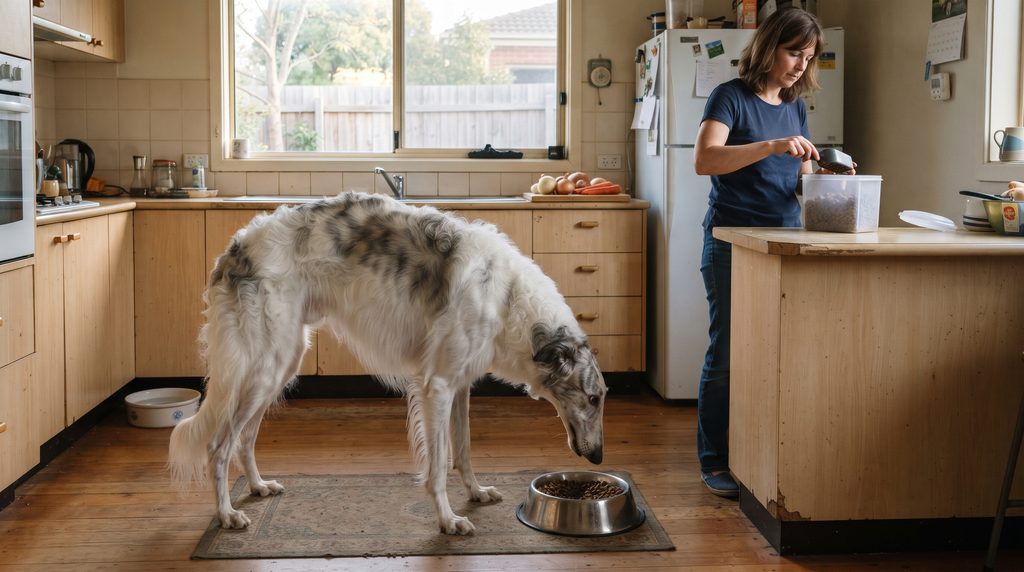
Borzoi Health and Common Health Problems
The Borzoi is generally considered a relatively healthy breed, particularly when compared with some other dogs of similar size. Its athletic construction, naturally lean body, and comparatively moderate exercise requirements can support good physical condition throughout adulthood. However, Borzois are susceptible to several important medical conditions, including some associated with their large size and deep chest. Understanding Borzoi health issues helps owners recognize warning signs, make informed veterinary decisions, and provide appropriate preventive care.
The Borzoi Club of America identifies several health concerns deserving particular attention, including gastric dilatation-volvulus, certain cancers, cardiac disease, and less common respiratory disorders. The breed also has inherited conditions for which responsible breeders can arrange screening. Not every Borzoi will develop these problems, and their presence within the breed does not mean that an individual dog is destined to become seriously ill.
One of the most important emergencies owners should understand is gastric dilatation-volvulus, commonly called GDV or bloat. Borzois have deep, relatively narrow chests, a physical characteristic associated with increased susceptibility. GDV occurs when the stomach becomes distended and twists, trapping gas and compromising normal circulation. The condition can progress rapidly, causing severe pain, shock, and potentially death without urgent veterinary intervention.
Warning signs include repeated unsuccessful attempts to vomit, excessive drooling, restlessness, abdominal discomfort, rapid breathing, weakness, or collapse. A noticeably swollen abdomen may develop, but it is not present or obvious in every case. Suspected GDV requires immediate emergency treatment rather than observation at home. Owners should identify the nearest suitable emergency veterinary hospital before an urgent situation arises.
Although no feeding routine can completely prevent GDV, several precautions may help reduce risk. Dividing food into smaller meals, discouraging rapid eating, and avoiding strenuous activity immediately around substantial meals are reasonable measures. Owners should also discuss preventive gastropexy with their veterinarian. This procedure surgically attaches the stomach to the abdominal wall, substantially reducing the likelihood of twisting, although ordinary stomach distension can still occur.
Cancer is another important health consideration. The Borzoi Club of America’s health statement specifically identifies osteosarcoma and hemangiosarcoma as concerns. These conditions are not unique to Borzois, but their potential severity makes awareness particularly valuable. Regular veterinary examinations, attention to unexplained symptoms, and prompt investigation of unusual changes can support earlier diagnosis.
Osteosarcoma is an aggressive form of bone cancer seen in several large and giant breeds. It commonly affects the limbs and may initially cause persistent lameness, swelling, or pain. Owners sometimes mistake early symptoms for a minor sporting injury, especially when an athletic dog becomes reluctant to run or favorably bears weight on another leg. Persistent or worsening lameness should always receive veterinary assessment.
Osteosarcoma is an aggressive form of bone cancer seen in several large and giant breeds. It commonly affects the limbs and may initially cause persistent lameness, swelling, or pain. Owners sometimes mistake early symptoms for a minor sporting injury, especially when an athletic dog becomes reluctant to run or begins favoring one leg. Persistent or worsening lameness should always receive veterinary assessment.
Heart disease also deserves attention in Borzois. Cardiomyopathy and other cardiac abnormalities can interfere with the heart’s ability to function normally. Some affected dogs initially appear healthy, making routine examinations and appropriate screening important. Possible warning signs include reduced exercise tolerance, unusual fatigue, coughing, fainting, or changes in breathing, although these symptoms can also arise from unrelated conditions.
A veterinarian may recommend additional cardiac testing when a murmur, irregular rhythm, or concerning symptom is identified. An echocardiogram provides information about heart structure and function, while an electrocardiogram or ambulatory heart monitor can help investigate rhythm abnormalities. The Borzoi Club of America recommends an echocardiogram performed by a board-certified veterinary cardiologist for breeding dogs.
Eye health is another area of concern. Progressive retinal atrophy and other inherited or acquired eye disorders have been reported within the breed. Some retinal conditions gradually impair vision, potentially affecting a dog’s confidence in unfamiliar environments or ability to navigate in reduced light. Cloudiness, persistent redness, unusual discharge, or apparent vision changes should prompt veterinary examination.
Because Borzois rely heavily on eyesight, maintaining visual health has particular practical importance. Their extraordinary ability to detect movement is central to their behavior and athletic activities. Regular veterinary checks and specialist ophthalmological examinations when indicated can help identify abnormalities that might otherwise remain unnoticed until symptoms become more apparent.
Thyroid disease is also relevant to breed health. Hypothyroidism occurs when the thyroid gland produces insufficient hormones, potentially contributing to lethargy, weight gain, skin changes, coat thinning, and reduced activity. These symptoms can develop gradually and may resemble ordinary aging. Blood testing and veterinary interpretation are necessary for diagnosis, as no individual symptom is specific to thyroid dysfunction.
Degenerative myelopathy is another condition recognized in Borzoi health screening recommendations. This progressive neurological disease affects the spinal cord and can lead to increasing weakness and loss of coordination in the hind limbs. Signs generally develop in later adulthood, although many dogs with mobility difficulties have other, potentially treatable conditions. Genetic testing provides information about inherited risk but does not establish that a particular dog currently has the disease.
Joint and skeletal disorders can occur, although significant hip dysplasia is generally considered less common in Borzois than in several other large breeds. Hip dysplasia, elbow abnormalities, and osteochondritis dissecans have nevertheless been reported. Persistent stiffness, reluctance to exercise, difficulty rising, or altered movement should receive veterinary attention rather than being attributed automatically to the dog’s size or temperament.
The breed’s exceptional athleticism introduces additional considerations. Sudden acceleration, rapid turns, and high-speed running can contribute to muscle strains, ligament injuries, and accidental trauma. Appropriate conditioning, safe running surfaces, and avoidance of excessive exercise during growth help reduce preventable injuries. Owners should also inspect paws and legs after demanding activity, particularly when running on unfamiliar ground.
Two less common but significant respiratory conditions identified by the Borzoi Club of America are chylothorax and lung lobe torsion. Chylothorax involves the accumulation of lymphatic fluid within the chest cavity, restricting normal lung expansion. Lung lobe torsion occurs when part of a lung twists, potentially disrupting normal circulation and airflow. Both conditions can cause serious breathing difficulties requiring urgent veterinary investigation.
Owners should seek prompt attention for persistent unexplained coughing, increasing respiratory effort, reduced stamina, or unusual breathing patterns. Sudden severe breathing difficulty, blue-tinged gums, or collapse constitutes an emergency. These symptoms do not establish a specific diagnosis, but they indicate that waiting for a routine appointment may be dangerous.
Geriatric-onset laryngeal paralysis polyneuropathy, commonly abbreviated GOLPP, is another concern mentioned in the breed club’s health statement. This condition may affect older dogs, causing changes in voice, noisy breathing, exercise intolerance, and progressive neurological weakness. Veterinary evaluation is important because similar symptoms can result from other disorders, and treatment decisions depend on the individual dog’s condition.
Anesthetic management deserves particular consideration. Like other sighthounds, Borzois have relatively low body fat and physiological characteristics that can influence their response to certain medications. Some older anesthetic drugs are particularly unsuitable for these dogs. Modern veterinary anesthesia can be performed safely with appropriate protocols, but owners should ensure that their veterinary team understands the breed’s characteristics before any procedure.
Preventive healthcare remains the foundation of long-term well-being. Routine veterinary examinations, appropriate vaccination, parasite prevention, dental care, and consistent weight monitoring are all important. Owners should also become familiar with their dog’s normal appetite, energy level, breathing, movement, and behavior, making subtle changes easier to recognize.
For a breed with such a distinctive body shape, maintaining appropriate weight is especially valuable. Excess body fat places additional stress on joints, reduces athletic efficiency, and may complicate existing medical conditions. Conversely, a Borzoi that becomes unusually thin or loses muscle unexpectedly may require investigation. A healthy adult should remain lean but sufficiently muscular to support normal movement.
Ultimately, good Borzoi health depends on informed breeding, thoughtful preventive care, and early recognition of potential problems. Serious conditions such as GDV, cancer, and respiratory emergencies deserve particular awareness, but they should not overshadow the fact that many Borzois enjoy healthy, active lives. By maintaining a close relationship with a veterinarian familiar with large sighthounds, owners can give their dogs the best opportunity for lasting comfort and well-being.
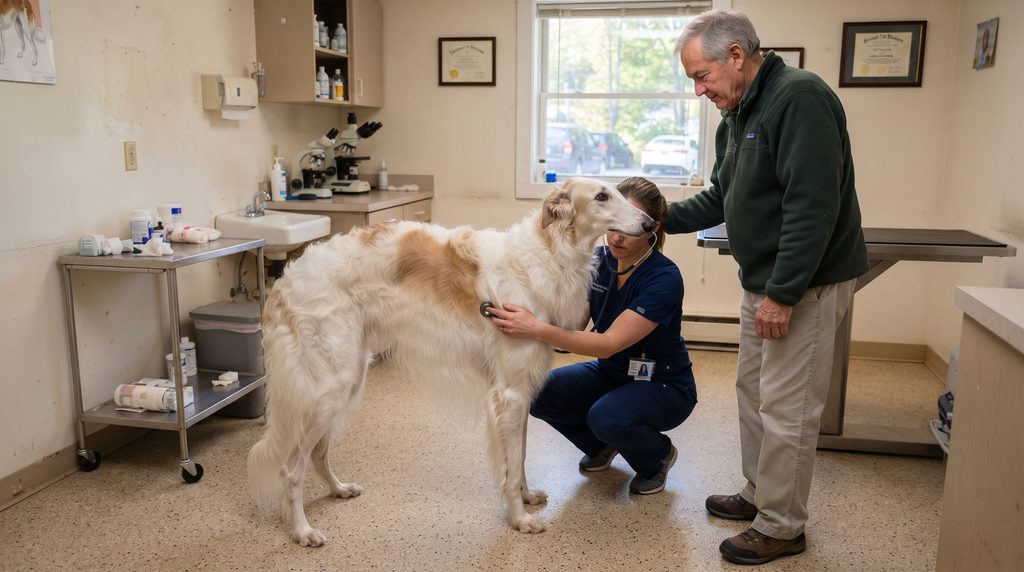
Borzoi Health Screening and Inherited Conditions
Health screening is one of the clearest differences between simply producing puppies and breeding Borzois responsibly. The breed is often described as relatively healthy overall, but that should never be taken to mean that inherited disease is irrelevant or that thoughtful screening is unnecessary. In Borzois, responsible breeders use a combination of formal testing, pedigree knowledge, veterinary oversight, and long-term awareness of what appears in their lines. For puppy buyers, understanding that process is one of the most important parts of choosing a sound, well-bred dog.
The American Kennel Club and the Borzoi Club of America both identify four recommended health tests from the national breed club. These are a cardiac exam, an ophthalmologist evaluation, a thyroid evaluation, and a degenerative myelopathy DNA test using the SOD1A variant. Those recommendations form the current basis for CHIC participation in the breed. In practical terms, they offer a useful screening framework for breeders and a sensible checklist for puppy buyers who want to ask informed questions.
It is worth understanding what a CHIC number actually means. CHIC stands for the Canine Health Information Center, which works through OFA to track breed-specific screening. A Borzoi can receive a CHIC number when the required tests have been completed and the results have been made public. However, a CHIC number does not automatically mean that every result was normal. It confirms that the required screening was performed and disclosed. That distinction matters because transparency is just as important as the existence of a certificate.
The cardiac component is especially important in Borzois. The Borzoi Club of America recommends an echocardiogram performed by a board-certified veterinary cardiologist for breeding dogs. This is more informative than a simple casual listen to the chest during a routine examination. An echocardiogram allows the specialist to assess heart structure and function in a much more detailed way. Since Borzois can be affected by forms of heart disease, this recommendation gives breeders a meaningful tool for reducing avoidable risk.
Eye screening is another essential part of responsible health testing. The recommended exam is a CAER examination carried out by a board-certified veterinary ophthalmologist. Eye testing helps detect inherited or clinically important abnormalities that may not be obvious in everyday life, especially in the early stages. Because Borzois rely so heavily on sight, maintaining healthy visual function has both welfare and practical significance. A dog may appear normal in the home while still carrying or developing issues that deserve formal specialist evaluation.
Thyroid evaluation is also included in the current recommended panel. Thyroid disease can affect metabolism, energy, coat quality, and general well-being. Although it may not always produce dramatic symptoms at the beginning, it can become an important health issue within breeding decisions. Responsible breeders should be able to explain when thyroid testing was done, what laboratory was used, and whether the result was considered normal under the relevant screening system.
The fourth recommended test is DNA screening for degenerative myelopathy, commonly called DM. This disease affects the spinal cord and can contribute to progressive weakness and coordination loss later in life. The test identifies whether a dog is genetically clear, a carrier, or at-risk for the common mutation being screened. For breeders, this information is particularly useful when planning matings because it helps avoid producing high-risk combinations. For owners, it is important to remember that a DNA result is a breeding and risk-management tool, not a guarantee about how a specific dog will age.
Formal screening, though, is only part of the picture. Some significant Borzoi health concerns do not currently have straightforward screening tests. The Borzoi Club of America identifies cancer, especially osteosarcoma and hemangiosarcoma, along with gastric dilatation-volvulus, chylothorax, lung lobe torsion, and geriatric-onset laryngeal paralysis polyneuropathy as health areas of concern. These are clinically important problems, but most are not conditions a breeder can simply clear through one routine certification. That is why pedigree knowledge and honesty about line history remain so important.
A thoughtful breeder should be able to discuss more than just paperwork. Ask whether parents, grandparents, siblings, and older relatives remained active and healthy into later life. Ask whether there is any family history of sudden collapse, significant heart disease, breathing disorders, thyroid problems, vision issues, osteosarcoma, hemangiosarcoma, or repeated bloat. No line is likely to be completely perfect, and a breeder who claims there are absolutely no health concerns anywhere in the pedigree may deserve more caution than one who answers frankly and specifically.
This is also the point at which puppy buyers should separate marketing language from meaningful evidence. Phrases such as “health tested,” “clear lines,” or “vet checked” sound reassuring, but they can mean very different things. A routine veterinary visit before sale is useful, but it is not the same as a board-certified eye exam, a specialist echocardiogram, OFA-recognized thyroid testing, or documented DNA screening. Responsible breeders should be willing to show proof of the actual tests performed and explain what those results do, and do not, prove.
Inherited conditions are not always expressed in a simple yes-or-no way. Some have genetic tests; others are influenced by multiple factors or appear later in life. This means that responsible breeding involves both testing and judgment. A breeder may use a dog that is a carrier for a manageable recessive condition if it is paired appropriately with a genetically clear mate and if the rest of the dog’s qualities justify its use. What matters is not simplistic perfection, but informed, transparent decision-making that prioritizes the long-term welfare of the breed.
For puppy buyers, the most helpful approach is to ask practical, specific questions. Were both parents tested for DM? When was the most recent eye exam done, and by whom? Was the cardiac screening a formal echocardiogram with a board-certified cardiologist? Has thyroid testing been completed and documented? Are the results publicly available through OFA or otherwise available for review? What significant health issues, if any, have appeared in close relatives? How long have dogs in the line typically lived, and what have they died from?
Health screening also matters in rescue, although the situation is naturally different. Adult rescue Borzois may arrive with incomplete pedigrees or without formal documentation of specialist testing. In those cases, adopters should think less in terms of breeding suitability and more in terms of present management. A rescue organization should disclose known medical issues honestly, arrange basic veterinary care, and explain what is known about the dog’s mobility, eyesight, heart status, and general condition. If the dog’s background is unclear, regular veterinary monitoring becomes especially important.
Owners should also remember that screening does not replace everyday care. A Borzoi with excellent breeder documentation still needs a lean body condition, appropriate nutrition, safe exercise, regular veterinary visits, and prompt attention to changes in movement, breathing, appetite, or behavior. Good genes support good health, but they do not eliminate the influence of management and environment across the dog’s lifetime.
It is also sensible to view inherited risk with perspective rather than anxiety. The existence of recommended health tests does not mean the Borzoi is an unhealthy breed. It means the breed community has identified areas where screening and transparency can genuinely help. That is a positive sign. It shows a willingness to gather evidence, inform puppy buyers, and improve breeding choices rather than relying on appearance alone.
Ultimately, Borzoi health screening is about responsibility and openness. The most responsible breeders complete the recommended cardiac, eye, thyroid, and DM testing, make results available, and remain honest about health patterns in their lines. The most informed puppy buyers look beyond beautiful photographs and elegant pedigrees to ask careful questions about health evidence. That combination of testing, transparency, and long-term awareness gives Borzoi puppies the strongest possible foundation for healthy lives.
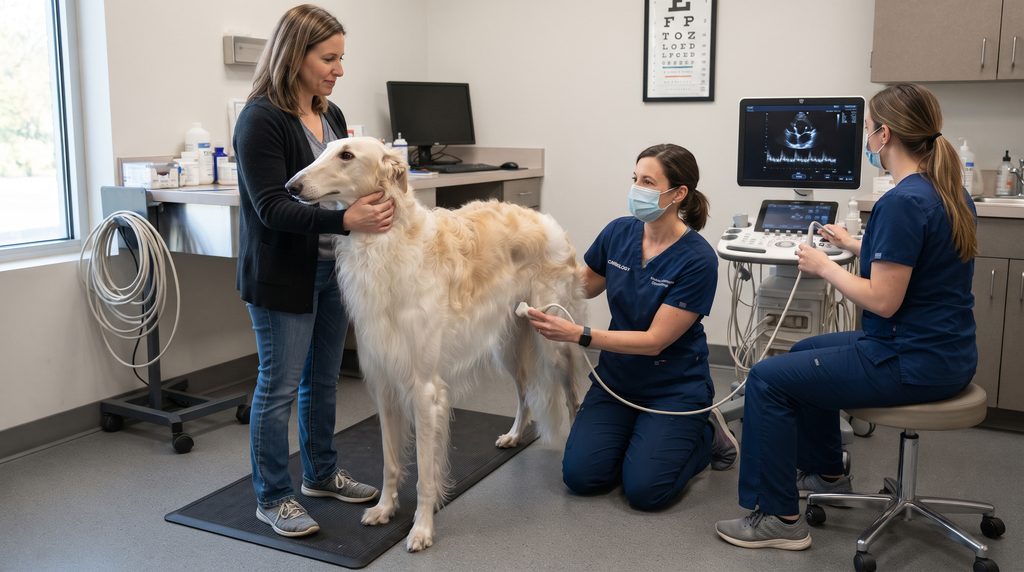
What to Ask a Borzoi Breeder About Health Testing
Ask whether both parents have completed the Borzoi Club of America’s recommended screenings: a cardiac echocardiogram, a CAER eye exam, thyroid testing, and degenerative myelopathy DNA testing. Request copies of the results or confirmation that they are publicly recorded through OFA. Then go a step further and ask about the health history of close relatives, including any known cancer, bloat, breathing problems, or age-related neurological disease. Good breeders usually welcome detailed health questions and can explain their breeding decisions clearly. Vague reassurances are less valuable than specific, documented answers.
Borzoi Lifespan and Aging
The Borzoi is a remarkably elegant and athletic dog that can remain a gentle, affectionate companion well into its senior years. Although its exceptional height places it among the larger dog breeds, many Borzois enjoy satisfying lives with relatively few major health problems. Understanding their expected longevity, recognizing the early signs of aging, and making thoughtful adjustments to everyday care can help owners preserve their comfort, mobility, and quality of life.
The typical Borzoi lifespan is approximately 9–14 years, according to the American Kennel Club. Dogs Victoria provides a narrower average estimate of 10–12 years. These ranges are useful guides rather than predictions for individual dogs. Some Borzois experience serious illness at younger ages, while others remain active and comfortable beyond their twelfth birthday.
Several factors influence longevity, including inherited health, nutrition, body condition, exercise, preventive veterinary care, and environmental safety. Responsible breeding and appropriate health screening can reduce certain inherited risks, although no breeder can guarantee a particular lifespan. For owners, maintaining healthy routines and responding promptly to medical concerns are among the most practical ways to support long-term well-being.
Because Borzois are large dogs, they generally enter their senior years earlier than many small breeds. Around seven or eight years of age is a reasonable time to begin discussing a more structured senior-care plan with a veterinarian. However, aging is highly individual. A healthy eight-year-old Borzoi may remain enthusiastic about running, while another dog of the same age may already need adjustments because of arthritis or another medical condition.
The earliest signs of aging are often subtle. A Borzoi may take slightly longer to rise after sleeping, move more cautiously on slippery flooring, or show less enthusiasm for vigorous activity. Some become more interested in relaxed walks than fast running sessions. These changes can develop gradually, making them easy to overlook when the dog remains calm and affectionate at home.
Owners should avoid assuming that stiffness or reduced mobility is simply an unavoidable consequence of getting older. Arthritis, muscle injuries, spinal problems, and other conditions may cause discomfort that can be managed with appropriate treatment. A veterinarian can assess changes in movement and recommend suitable pain relief, rehabilitation, exercise adjustments, or additional investigations.
Maintaining muscle condition becomes increasingly important during the senior years. The Borzoi’s naturally lean build can make gradual muscle loss difficult to recognize, particularly beneath its flowing coat. Owners should regularly assess body condition and pay attention to changes around the hindquarters, shoulders, and back. Unexplained loss of muscle or body weight deserves veterinary attention.
Regular exercise remains valuable, but the emphasis should gradually shift toward comfort and consistency. Senior Borzois often benefit from shorter, more frequent walks rather than occasional strenuous outings. Gentle movement helps maintain joint mobility, muscle strength, and mental engagement. Owners should allow older dogs to choose a comfortable pace and include opportunities to investigate their surroundings.
Some older Borzois continue to enjoy occasional running, particularly when they have remained physically active throughout adulthood. However, high-speed pursuits and sudden changes of direction place considerable demands on muscles and joints. Activities should reflect the dog’s current condition rather than its athletic achievements when younger. Safe footing, gradual warm-ups, and appropriate recovery become increasingly important.
Household adjustments can make an enormous difference to an aging Borzoi. Its long legs, deep chest, and relatively lean body mean that comfortable resting surfaces are particularly valuable. A generously sized orthopedic bed can reduce pressure on prominent joints, while nonslip rugs improve traction on polished floors. Raised thresholds, steep steps, and slippery outdoor surfaces may require modification.
Vehicle access also deserves consideration. A senior Borzoi may struggle to jump into a vehicle it previously entered without difficulty. A stable, appropriately sized ramp can reduce unnecessary strain, provided the dog is introduced to it patiently. Owners should also ensure that travel restraints accommodate the dog’s substantial height and allow comfortable positioning.
Nutrition may need adjustment as activity levels change. Some older Borzois require fewer calories to maintain a healthy weight, while others need additional nutritional support because of muscle loss or medical conditions. A complete, balanced diet appropriate to the individual’s health remains essential. Owners should avoid drastically reducing food simply because a dog has become less active.
Veterinary monitoring becomes especially valuable during this stage of life. Many veterinarians recommend senior wellness examinations approximately every six months, depending on the dog’s health. These appointments may include physical examinations, body-condition assessments, dental checks, and blood or urine testing when appropriate. Regular monitoring can reveal changes that are not immediately obvious in everyday behavior.
Cardiac health deserves continuing attention. Borzois can develop heart disease, and some affected dogs initially show few noticeable symptoms. Unexplained fatigue, reduced exercise tolerance, coughing, fainting, or changes in breathing should be investigated. A veterinarian may recommend specialist cardiac assessment when clinical findings or the dog’s history justify additional testing.
Cancer is another consideration as Borzois age. Osteosarcoma and hemangiosarcoma are recognized concerns within the breed. Persistent lameness, unusual swelling, unexplained weight loss, or sudden weakness should never be dismissed without assessment. These symptoms can have several possible causes, but prompt veterinary investigation may improve opportunities for diagnosis and treatment.
Older Borzois can also develop neurological or respiratory problems. The Borzoi Club of America identifies geriatric-onset laryngeal paralysis polyneuropathy among the breed’s health concerns. Affected dogs may develop noisy breathing, changes in vocalization, weakness, or difficulty coordinating movement. Symptoms require veterinary evaluation because other potentially serious conditions can produce similar signs.
Vision and hearing may gradually decline with age. An older Borzoi that hesitates in unfamiliar places, becomes startled when approached, or seems less responsive to familiar sounds may be experiencing sensory changes. Because the breed relies heavily on visual awareness, loss of sight can be particularly noticeable. Predictable furniture arrangements, gentle communication, and appropriate veterinary assessment can help maintain confidence.
Changes in sleep and behavior deserve equal attention. Some senior dogs become more restless at night, appear confused in familiar surroundings, or develop unusual anxiety. Others become less tolerant of disruption and seek quieter resting areas. These changes may reflect pain, sensory decline, cognitive dysfunction, or another medical problem rather than simply a change in personality.
Grooming routines should also adapt to physical comfort. An older Borzoi experiencing joint stiffness may find prolonged standing uncomfortable. Shorter brushing sessions, supportive nonslip surfaces, and gentle handling are preferable to forcing the dog into difficult positions. Regular nail care remains especially important because overgrown nails can further interfere with normal movement.
Dental health should never be overlooked during the senior years. Periodontal disease can cause significant discomfort, and some dogs continue eating despite painful dental problems. Routine oral examinations and appropriate dental treatment can improve comfort and general well-being. Owners should discuss anesthetic considerations with a veterinarian experienced in managing older sighthounds.
Emotional well-being remains just as important as physical health. Many senior Borzois become increasingly attached to familiar routines and quiet companionship. They may enjoy spending time near their owners, exploring favorite walking routes, or resting in comfortable places where they can observe family activity. Maintaining predictable daily experiences can provide reassurance as physical abilities gradually change.
One of the most meaningful aspects of caring for an aging Borzoi is learning to evaluate quality of life. Appetite, mobility, comfort, interest in familiar activities, social interaction, and the balance between good and difficult days all provide useful information. Keeping a simple record of these observations can help owners and veterinarians recognize gradual changes and make compassionate decisions when treatment needs become more complex.
Ultimately, the Borzoi’s senior years can be deeply rewarding. Its quiet dignity, affectionate nature, and preference for peaceful companionship often become especially apparent with age. While owners cannot prevent every illness or control exactly how long their dog will live, attentive veterinary care, thoughtful household adjustments, suitable activity, and genuine companionship can make those later years comfortable and fulfilling.
When Should a Borzoi Begin Senior Health Checks?
Around seven or eight years of age, consider discussing a more structured senior-care plan with your veterinarian. A healthy Borzoi may remain athletic well beyond this stage, but earlier monitoring can help identify subtle changes in mobility, muscle condition, heart function, and general health. Many veterinarians recommend examinations approximately every six months for older dogs, with blood or urine testing when appropriate. Watch for difficulty rising, persistent lameness, unexplained weight loss, noisy breathing, changes in appetite, or unusual nighttime behavior. These signs should not automatically be attributed to aging. Early assessment can often improve comfort and preserve independence.

Cost of Owning a Borzoi
Owning a Borzoi is a rewarding experience, but its exceptional size, specialized needs, and potential veterinary expenses make careful financial planning essential. Although this elegant Russian sighthound is generally less demanding than its aristocratic appearance might suggest, providing appropriate food, preventive healthcare, secure accommodation, and everyday equipment involves a substantial long-term commitment. Prospective owners should consider both predictable expenses and the possibility of unexpected medical treatment before welcoming a Borzoi into their household.
In the United States, a reasonable planning allowance for routine Borzoi ownership is approximately $2,000–$4,000 annually, although actual expenses can fall outside this range. This is an illustrative budget rather than a published breed-specific average. Costs vary considerably according to location, veterinary fees, insurance arrangements, diet, and individual health. Boarding, professional grooming, specialized training, and significant medical treatment can increase expenditure substantially.
General dog ownership research supports the importance of planning beyond basic food expenses. Synchrony’s 2025 Pet Lifetime of Care Study estimated annual dog-care expenses of approximately $1,591–$2,770 across dogs generally. Borzoi owners may need to budget toward the higher end or beyond these figures because of the breed’s size, equipment requirements, and potential veterinary needs.
The initial expense of acquiring a Borzoi varies according to whether the dog comes from a responsible breeder or an established rescue organization. A well-run breeding program involves health screening, reproductive veterinary care, appropriate puppy nutrition, early socialization, and careful assessment of prospective homes. Owners should value evidence of responsible breeding practices and transparent health information rather than choosing a source based primarily on the lowest initial expense.
Rescue adoption can provide an alternative route into Borzoi ownership. Adoption contributions often help organizations cover veterinary examinations, vaccinations, microchipping, and other essential care. However, an adopted adult may have additional medical, behavioral, or equipment requirements that should be considered. A lower initial outlay does not necessarily mean that the dog’s ongoing care will be less expensive.
Preparing the home creates another category of one-time expenses. Borzois require generously sized beds, suitable feeding equipment, secure collars or harnesses, strong leashes, grooming tools, and appropriate travel restraints. Because their bodies are exceptionally tall and elongated, standard products intended for average-sized dogs may not fit comfortably or safely.
A supportive bed is particularly important. Borzois have relatively lean bodies and may experience discomfort when resting repeatedly on hard surfaces. Large orthopedic beds can be worthwhile investments, particularly as dogs mature. Durable, washable covers make cleaning easier and may extend the useful life of the bedding.
Walking equipment also deserves attention. The Borzoi’s narrow head and long neck can make some ordinary collars unsuitable, particularly if the dog backs away unexpectedly. Properly fitted martingale collars or secure harnesses may provide additional safety. Owners should prioritize appropriate sizing, reliable construction, and comfort over decorative accessories.
One of the largest potential initial expenses is secure fencing. Borzois were developed to pursue fast-moving animals and can accelerate with extraordinary speed. A suitable enclosure needs sturdy construction, secure gates, and sufficient height to discourage escape. Owners without an adequately fenced property may need to arrange access to private exercise fields or other safe running facilities.
Food is a substantial recurring expense. Although many mature Borzois have moderate appetites relative to their height, they still require complete and balanced nutrition appropriate to a large, athletic dog. Depending on the food selected and individual consumption, an illustrative allowance of approximately $600–$1,200 annually may be reasonable, with premium diets or specialized veterinary foods potentially costing more.
Feeding requirements also change throughout life. Growing puppies need carefully balanced nutrition that supports controlled skeletal development, while active adults may require additional energy. Senior dogs sometimes benefit from dietary adjustments related to mobility, weight management, or medical conditions. Owners should choose food according to nutritional suitability rather than assuming that expensive ingredients or fashionable diets automatically provide better care.
Routine veterinary expenses deserve a dedicated place in the household budget. Annual examinations, vaccinations, parasite prevention, dental assessments, and any recommended diagnostic testing help maintain health throughout adulthood. Veterinary fees vary significantly across the United States, so obtaining estimates from a local clinic provides a more reliable planning figure than relying on national averages alone.
Preventive treatments also contribute to recurring costs. Flea, tick, heartworm, and intestinal parasite protection may be necessary according to local disease risks and veterinary recommendations. Because medication quantities are frequently determined by body weight, maintaining protection for a large Borzoi can cost more than treating a smaller companion breed.
Emergency veterinary care represents one of the most important financial considerations. Borzois are susceptible to gastric dilatation-volvulus, a potentially life-threatening condition requiring immediate treatment. Emergency stabilization, surgery, hospitalization, and postoperative care can create bills totaling several thousand dollars or more, depending on the circumstances and facility.
Other serious health concerns, including certain cancers, cardiac disorders, and orthopedic injuries, can also involve substantial diagnostic and treatment expenses. Specialist consultations, imaging, surgery, and ongoing medication may be necessary. Owners should recognize that even a carefully bred, healthy Borzoi can develop unexpected medical problems during its lifetime.
Pet insurance is one way to manage some of this uncertainty. Policies vary in their premiums, deductibles, reimbursement percentages, annual limits, exclusions, and treatment coverage. Insurance may be particularly valuable for a breed with potential exposure to expensive emergency conditions, although individual circumstances determine whether a particular policy offers suitable value.
Owners considering insurance should investigate coverage for hereditary conditions, cancer treatment, emergency surgery, diagnostic imaging, and specialist referrals. Preexisting-condition exclusions are especially important when insuring an older dog or one with an established medical history. Insurance does not eliminate veterinary expenses, and owners may still need money available to pay bills before reimbursement.
An alternative approach is maintaining a dedicated veterinary emergency fund. This gives owners direct control over savings, but building sufficient reserves takes time. A relatively small savings balance may not cover a serious emergency. Some households combine insurance with separate savings for deductibles, routine care, and expenses excluded from their policies.
Grooming expenses are comparatively manageable because Borzois generally do not require elaborate professional haircuts. Their silky coats can usually be maintained with regular home brushing, occasional bathing, nail trimming, and attention to tangled feathering. A good pin brush, stainless-steel comb, suitable shampoo, and nail-care equipment are useful initial purchases.
Professional grooming remains an option for owners who prefer assistance with bathing, drying, nail care, or coat maintenance. A Borzoi’s size and long feathering may increase appointment costs, particularly where groomers charge according to coat condition and time required. Regular home maintenance can reduce unnecessary professional grooming expenses.
Training and socialization are additional considerations. Borzois benefit from reward-based puppy classes, recall practice, and patient instruction in everyday manners. Professional support can be valuable when addressing leash handling, independence training, or difficulties involving other animals. Owners interested in lure coursing may also choose to pay for club memberships, event entries, or access to suitable practice facilities.
Travel arrangements can become surprisingly expensive. A Borzoi may require a larger vehicle restraint or travel crate than other breeds, while boarding facilities sometimes apply additional charges for large dogs. Owners planning regular vacations should investigate suitable accommodation or reliable pet-care arrangements before committing to the breed.
Cost-conscious owners can often reduce everyday expenditure without compromising welfare. Buying durable equipment, maintaining the coat at home, comparing appropriate food options, and using reputable secondhand pet accessories can all help. However, used items should be thoroughly inspected for cleanliness, structural damage, and safety. Collars, harnesses, travel restraints, and other critical equipment must fit correctly and remain dependable.
Ultimately, the financial responsibility of Borzoi ownership extends far beyond bringing home a beautiful puppy or adopting an adult. Food, veterinary care, grooming, equipment, secure exercise opportunities, and emergency preparedness all contribute to the long-term commitment. Owners who establish a realistic budget and maintain suitable financial reserves are better equipped to provide the stability, comfort, and care this remarkable sighthound deserves throughout its life.
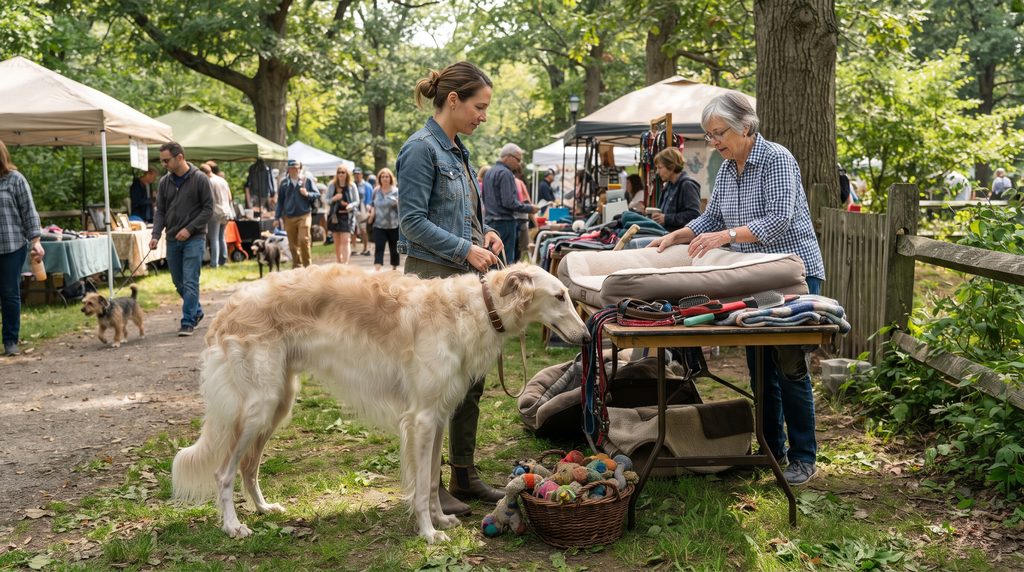
Budgeting for the Expenses Unique to a Borzoi
A Borzoi’s unusual height and athletic instincts can create expenses that are easy to overlook. Standard dog beds, harnesses, vehicle restraints, and travel crates may be too small, making properly sized equipment essential. Secure fencing or access to a private exercise field should also be included in your planning. Although routine coat maintenance is relatively straightforward, veterinary emergencies can be expensive, particularly if the dog develops gastric dilatation-volvulus or requires specialist treatment. Consider pet insurance, a dedicated emergency fund, or a combination of both. Buying suitable secondhand accessories can reduce initial expenses, but safety-critical equipment should always be carefully inspected before use.
Choosing a Borzoi Puppy or Rescue
Choosing a Borzoi is an important decision that deserves considerably more thought than simply finding a beautiful dog. This elegant Russian sighthound combines a gentle, affectionate temperament with exceptional size, independent thinking, and powerful hunting instincts. Whether you are considering a puppy from a responsible breeder or an adult through rescue, the goal should be to find a healthy, well-adjusted companion whose needs and personality genuinely suit your household.
A Borzoi puppy can be an appealing choice for owners who want to guide their dog’s development from an early age. Raising a puppy offers opportunities to establish household routines, introduce positive social experiences, and develop a trusting relationship. However, prospective owners must also prepare for rapid growth, considerable physical strength, occasional adolescent mischief, and the challenges of managing an increasingly athletic young sighthound.
Finding a responsible breeder is particularly important because early temperament, inherited health, and appropriate socialization can influence the dog’s development throughout life. A thoughtful search for a Borzoi puppy breeder should begin with recognized breed organizations, established sighthound communities, and referrals from people familiar with responsible breeding practices. The Borzoi Club of America provides breeder information and encourages prospective owners to investigate breeding programs carefully rather than making impulsive decisions.
Although there are many Borzoi breeders, standards of care and breeding practices can differ considerably. Responsible breeders understand the breed’s history, temperament, structure, and health concerns. They plan litters carefully, maintain appropriate conditions for their dogs, and take a genuine interest in the suitability of prospective homes. Their responsibilities extend beyond producing attractive puppies to supporting their health and welfare throughout life.
One of the clearest characteristics of reputable Borzoi breeders is their willingness to answer detailed questions and provide meaningful evidence of health testing. They should be comfortable discussing both the strengths and limitations of their breeding lines. No breeding program can guarantee perfect health, but transparency about inherited risk, longevity, temperament, and previous medical problems demonstrates a responsible approach.
The Borzoi Club of America currently recommends four health screenings for breeding dogs: a cardiac echocardiogram performed by a board-certified veterinary cardiologist, an eye examination by a board-certified ophthalmologist, thyroid testing through an approved laboratory, and DNA testing for degenerative myelopathy using the SOD1A variant. Prospective owners should request documentation rather than accepting vague assurances that the parents have been health checked.
Results may be available through the Orthopedic Foundation for Animals and its Canine Health Information Center program. A CHIC number indicates that the breed-specific screening requirements have been completed and the results disclosed, but it does not necessarily mean every test was normal. Reviewing the actual findings provides a clearer understanding of the breeding dogs’ health status.
Family history deserves equal attention. Ask about the health and longevity of parents, grandparents, siblings, and older relatives. Borzois can be affected by gastric dilatation-volvulus, certain cancers, cardiac disorders, and other serious conditions that cannot always be predicted through routine screening. An experienced breeder should be willing to discuss known problems in the pedigree without suggesting that any line is completely free from inherited risk.
Whenever possible, arrange to meet the breeder and observe the dogs in their normal environment. Healthy adult Borzois should appear appropriately conditioned, comfortable with familiar people, and capable of moving naturally. Their surroundings should be clean, secure, and suitable for large sighthounds. Meeting the puppy’s mother can provide valuable insight into temperament, although the father may live elsewhere.
The puppies themselves should appear curious, alert, and physically comfortable. Their eyes should be clear, their coats reasonably clean, and their movement appropriate for their age. Some may approach visitors enthusiastically, while others prefer to observe initially. A quieter puppy is not automatically unsuitable, but persistent fearfulness, unusual lethargy, or obvious signs of illness deserve careful attention.
Early socialization is especially important for a breed that can become reserved around unfamiliar people. Puppies should experience gentle handling, ordinary household sounds, suitable surfaces, and positive interactions with different people. Carefully managed exposure helps develop confidence without overwhelming sensitive youngsters. Responsible breeders understand that socialization involves creating good experiences rather than exposing puppies indiscriminately to stressful situations.
Matching temperament to the household is often more important than choosing a particular coat color or the largest puppy in the litter. A confident, energetic youngster may suit an experienced owner interested in canine sports, while a quieter individual may fit a relatively peaceful family environment. A knowledgeable breeder who has observed the puppies over several weeks can provide valuable guidance about their individual personalities.
The breeder should also ask prospective owners detailed questions. Expect discussions about fencing, previous dog experience, daily routines, children, other pets, and access to secure exercise areas. Borzois are exceptionally fast visual hunters, and their instinct to pursue moving animals creates genuine safety considerations. A breeder who carefully assesses the suitability of each home is demonstrating concern for the dog’s future welfare.
Warning signs include reluctance to provide health records, pressure to make an immediate commitment, unwillingness to discuss the puppy’s upbringing, or repeated excuses preventing reasonable observation of the dogs. Responsible breeders should be transparent about their arrangements, even when in-person visits require scheduling or suitable alternatives. Attractive photographs and registration paperwork alone are not evidence of ethical breeding.
Before the puppy comes home, confirm the arrangements for veterinary examination, vaccinations, parasite control, identification, and written records. The breeder should explain the puppy’s current diet, routine, social experiences, and any relevant health concerns. A clear written agreement should outline responsibilities and expectations, including what happens if the owner can no longer keep the dog.
Bringing home a Borzoi puppy also requires preparation. Secure fencing, a generously sized sleeping area, suitable walking equipment, nonslip flooring, and access to appropriate veterinary care should be arranged in advance. Because these puppies grow rapidly, owners should anticipate replacing some equipment as their bodies develop. Gentle training and controlled exercise are particularly important while their joints and skeletal structures remain immature.
Rescue adoption offers another rewarding way to welcome a Borzoi into the family. Adult dogs may enter rescue because of changes in an owner’s circumstances, financial difficulties, illness, or unsuitable previous living arrangements. Their need for a new home does not necessarily indicate behavioral problems. Many are affectionate, well-adjusted companions whose lives have simply changed through circumstances beyond their control.
Established breed rescue organizations and regional Borzoi clubs can be useful starting points. Rescue availability varies, and prospective adopters may need patience because Borzois are less common than many other breeds. A reputable organization should discuss the individual dog’s known history, medical requirements, temperament, and suitability for the prospective household.
One advantage of adopting an adult is that its mature size and many established personality traits are already apparent. A rescue organization or experienced foster carer may know whether the dog is comfortable with children, accustomed to other dogs, or able to settle when left alone. However, behavior can change after rehoming, particularly when a dog is adjusting to unfamiliar surroundings.
Compatibility with cats and smaller animals deserves special attention. Some Borzois coexist peacefully with familiar household cats, but others retain a powerful instinct to chase. A dog that appears calm indoors may react differently when an animal runs across an open garden. Adopters should take reported prey drive seriously and avoid assuming that affection toward people guarantees safety around smaller pets.
The transition into a new home should be gradual. A rescued Borzoi may benefit from predictable routines, a quiet sleeping area, short familiar walks, and opportunities to explore without pressure. Visitors and unfamiliar dogs should be introduced thoughtfully. Owners should allow the dog to establish trust rather than expecting an immediate demonstration of its full personality.
Families should also consider the long-term financial and practical commitment. Borzois require appropriate nutrition, regular veterinary care, coat maintenance, secure exercise opportunities, and equipment suited to their exceptional proportions. Potential medical emergencies, particularly bloat, should be considered when planning veterinary insurance or emergency savings.
Ultimately, choosing a Borzoi puppy or rescue should be guided by health, temperament, responsible sourcing, and realistic compatibility rather than appearance alone. Both paths can lead to an exceptionally rewarding relationship. Owners who investigate carefully, ask informed questions, and prepare for the breed’s distinctive requirements give their Borzoi the strongest possible foundation for a secure, comfortable, and fulfilling life.
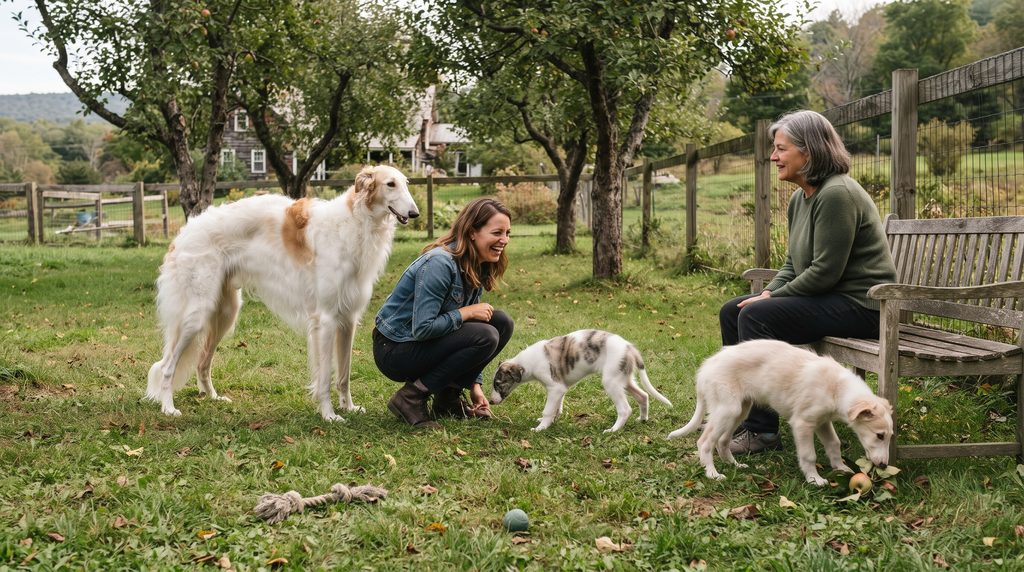
Is a Borzoi Right for You?
The Borzoi can be an exceptionally rewarding companion for the right household, offering a remarkable combination of elegance, gentle affection, athletic ability, and quiet independence. However, its distinctive temperament and powerful hunting instincts mean that it is not necessarily suitable for everyone. Choosing this Russian sighthound requires more than an appreciation of its magnificent appearance. Prospective owners must consider their lifestyle, living arrangements, experience, and willingness to accommodate a dog whose needs differ considerably from those of many familiar companion breeds.
One of the Borzoi’s greatest attractions is its generally peaceful household demeanor. Mature individuals often enjoy relaxing near their families and can spend substantial periods resting comfortably after appropriate activity. Unlike some highly demanding working breeds, they do not typically require constant interaction or complicated daily tasks to remain content. This makes them particularly appealing to people who appreciate quiet companionship rather than an endlessly energetic dog.
Nevertheless, a calm Borzoi should never be mistaken for a dog that requires little care. Its extraordinary athletic ability and strong visual hunting instincts create responsibilities that cannot be overlooked. Owners must provide regular exercise, secure surroundings, appropriate mental stimulation, and safe opportunities for natural movement. The breed is best suited to people who genuinely enjoy spending time outdoors but also appreciate a relaxed atmosphere at home.
Living space is an important consideration, although a large rural property is not essential. Borzois can adapt to suburban homes and, in some circumstances, apartments, provided their needs are consistently met. Their relatively quiet indoor behavior may make apartment living more realistic than their size initially suggests. However, adequate space for comfortable movement, appropriate bedding, and dependable access to suitable exercise areas remain essential.
Their exceptional height can create practical challenges in smaller homes. A Borzoi stretching across a hallway, turning around in a narrow room, or settling beside the sofa occupies considerable space. Owners should consider whether the household layout allows the dog to move comfortably without constantly negotiating furniture and crowded walkways. Slippery floors may also require nonslip rugs, particularly as the dog ages.
Secure fencing is one of the most important requirements for responsible Borzoi ownership. These dogs were developed to pursue fast-moving quarry using exceptional eyesight and rapid acceleration. A rabbit or other small animal moving across an open area may trigger an immediate chase response. Even a well-trained Borzoi cannot be relied upon to ignore every such distraction.
For this reason, owners who expect to enjoy unrestricted off-leash walks through open countryside may find the breed frustrating. Borzois can be wonderful walking companions, but their freedom must be managed responsibly. A secure private garden, enclosed exercise field, or suitable sighthound sporting facility provides safer opportunities for vigorous activity without exposing the dog to unnecessary danger.
Daily schedules should also be considered carefully. Many Borzois enjoy the company of familiar people and develop strong attachments to their households. Although some tolerate reasonable periods alone, they are not ideal for owners who are routinely absent for exceptionally long hours without suitable arrangements. A predictable routine, opportunities for exercise, and gradual independence training help maintain emotional well-being.
The breed’s sensitive temperament is another important factor. Borzois often respond best to calm communication, gentle handling, and positive reinforcement. They can become uncomfortable in households characterized by frequent shouting, unpredictable activity, or rough treatment. Owners who value patience and respect a dog’s personal space are more likely to appreciate the breed’s quiet, understated affection.
Training expectations should remain realistic. A Borzoi can learn household manners, basic obedience, and enjoyable sporting activities, but it may not demonstrate the constant eagerness to please associated with some highly handler-focused breeds. Its independent nature reflects centuries of development as a hunting sighthound capable of making rapid decisions without continuous human direction.
People who expect immediate, consistent responses to every command may struggle with this characteristic. By contrast, owners who enjoy building cooperation through short, rewarding sessions often find Borzois intelligent and engaging companions. Successful training involves understanding what motivates the dog rather than relying on repetition or harsh correction.
Families with children should consider both temperament and physical size. Many Borzois are affectionate and gentle with familiar youngsters, particularly when children behave calmly and understand appropriate boundaries. However, their impressive height and considerable strength make close supervision necessary, especially around toddlers. The breed is generally better suited to households where children can respect a dog’s need for quiet rest and personal space.
Families seeking a dog that enthusiastically participates in constant roughhousing may prefer another breed. Borzois often enjoy companionship without wanting to be climbed on, chased around the house, or repeatedly disturbed. A peaceful relationship develops when children learn to appreciate the dog’s individuality rather than expecting unlimited tolerance.
Other household animals deserve equally careful consideration. Many Borzois live happily alongside compatible dogs, especially when introductions are managed appropriately. Some also coexist peacefully with familiar cats. However, their powerful prey drive can create serious risks for rabbits, guinea pigs, birds, and other small animals. A Borzoi that accepts a resident cat indoors may still pursue an unfamiliar cat outdoors.
Prospective owners with vulnerable small pets must be willing to establish reliable separation and supervision. Training cannot guarantee that a strong instinctive chase response will disappear. Households unable to provide appropriate physical management may find a different breed more suitable.
Grooming requirements are moderate but should not be underestimated. The Borzoi’s silky coat benefits from regular brushing, particularly around feathered areas prone to tangling. Seasonal shedding can be substantial, and loose hair may accumulate on clothing, bedding, and furniture. Owners who enjoy maintaining a beautiful natural coat may find grooming straightforward, while those seeking a virtually hair-free home are likely to be disappointed.
Financial readiness is another important part of the decision. Borzois require equipment suited to their unusual size, complete and balanced nutrition, preventive veterinary care, and suitable transport arrangements. Their deep-chested construction also creates susceptibility to gastric dilatation-volvulus, a potentially life-threatening emergency. Insurance or adequate emergency savings should be considered before acquiring the breed.
The commitment extends throughout the dog’s lifetime. Borzois commonly live approximately 9–14 years, and their needs change considerably between puppyhood, adulthood, and old age. A rapidly growing puppy requires carefully managed activity and patient socialization, while a senior dog may need supportive bedding, shorter walks, mobility assistance, and more frequent veterinary examinations.
Owners should also consider whether their future circumstances are compatible with such a large dog. Moving house, changing employment, traveling frequently, or downsizing to accommodation with limited outdoor access may create practical difficulties. These changes are not necessarily impossible to manage, but they deserve consideration before making a long-term commitment.
First-time dog owners are not automatically unsuitable for Borzois. A committed beginner who researches the breed carefully, works with a responsible breeder or rescue organization, and seeks appropriate training support may establish an excellent relationship. However, the breed’s size, independent temperament, and powerful chase instinct can make it more challenging than some forgiving companion breeds.
For experienced owners who appreciate sighthounds, the Borzoi offers distinctive rewards. Its graceful movement, quiet humor, gentle affection, and ability to settle peacefully indoors create an appealing balance. Many owners particularly value the contrast between the dog’s dignified household presence and its astonishing athletic ability in suitable outdoor environments.
The Borzoi is less appropriate for people who want a small, easily transported dog, a consistently obedient off-leash hiking companion, or an animal that can safely mingle with every smaller pet. It may also disappoint those who expect constant affection, frequent exuberant play, or a highly protective watchdog. Recognizing these limitations is part of making a responsible decision rather than a criticism of the breed.
Ultimately, the Borzoi is best suited to a patient, considerate owner who values gentle companionship, understands independent sighthounds, and can provide secure opportunities for exercise. Its magnificent appearance is only one part of its appeal. For households prepared to respect its sensitivity, accommodate its exceptional size, and manage its hunting instincts responsibly, the Borzoi can become an unforgettable and deeply cherished family companion.

The Household That Suits a Borzoi Best
The ideal Borzoi home offers a peaceful atmosphere, patient owners, comfortable indoor space, and dependable access to securely enclosed exercise areas. This breed often suits people who enjoy regular walks and appreciate affectionate companionship without constant demands for attention. Owners must be comfortable managing a powerful chase instinct, maintaining a silky coat, and providing equipment appropriate for an exceptionally tall dog. Households with respectful older children or compatible dogs can work particularly well. However, homes with vulnerable small pets, inadequate fencing, or expectations of unrestricted off-leash freedom may face significant challenges. A good match depends on lifestyle and preparation rather than property size alone.
Borzoi Final Thoughts
The Borzoi is a remarkable breed that combines centuries of hunting heritage with the gentle, dignified companionship of a modern family dog. Its extraordinary height, flowing silky coat, and graceful movement make it immediately recognizable, but its greatest appeal extends far beyond physical appearance. Beneath that elegant exterior is an intelligent, sensitive, affectionate sighthound with a distinctive personality and an enduring connection to its remarkable Russian origins.
For the right owner, living with a Borzoi can be a particularly rewarding experience. These dogs often bring a peaceful presence to the home, enjoying comfortable resting places, familiar routines, and the quiet companionship of people they trust. Their affection may be less demonstrative than that of some companion breeds, but the relationships they develop can be exceptionally meaningful.
One of the breed’s most fascinating characteristics is the contrast between its relaxed household behavior and extraordinary athletic abilities. A Borzoi may spend much of an afternoon sleeping peacefully before displaying astonishing speed and agility during an opportunity to run. This combination reflects generations of development as a visual hunter capable of explosive acceleration followed by periods of relative inactivity.
However, that heritage creates responsibilities that every prospective owner must understand. Borzois possess powerful instincts to pursue moving animals, and these responses can emerge suddenly, even in otherwise calm and obedient individuals. Secure fencing, appropriate leash management, and access to safe exercise areas are essential rather than optional conveniences.
The breed’s independence also requires a thoughtful approach to training. Borzois are intelligent dogs, but they were not developed for constant direction from human handlers. They often respond best to short, rewarding lessons, consistent expectations, and owners who understand that cooperation is more effective than confrontation.
Patience is especially important during puppyhood and adolescence. Young Borzois grow rapidly, gradually developing the long legs, deep chest, and remarkable proportions that characterize the mature breed. Their physical development requires appropriate nutrition, controlled exercise, and careful attention to joint health. Early socialization and positive experiences help establish the confidence needed for a well-adjusted adult.
Their sensitive temperament deserves equal consideration. Many Borzois appreciate peaceful environments and become uncomfortable with harsh handling, excessive noise, or repeated disruption. Owners who respect their dog’s body language and provide opportunities for undisturbed rest are more likely to develop a relaxed and trusting relationship.
Families with children can enjoy the breed’s gentle companionship when youngsters understand appropriate boundaries. Borzois often form close bonds with familiar children, but their size and preference for calm interaction make supervision essential. Their affectionate nature should never be mistaken for an unlimited tolerance of rough play.
Other household animals introduce additional considerations. Many Borzois coexist happily with compatible dogs, particularly those accustomed to similar styles of play. Relationships with cats and smaller pets require considerably more caution because the breed’s natural hunting instincts can remain powerful even when the dog behaves gently around people.
Grooming is generally manageable, although the Borzoi’s beautiful coat requires consistent attention. Regular brushing helps maintain its silky texture and prevents tangles in the longer feathering. Seasonal shedding can be substantial, and owners should be comfortable with the practical realities of maintaining a long-coated dog.
Health is another important part of responsible ownership. Although Borzois are generally regarded as a relatively healthy breed, their deep-chested construction creates susceptibility to gastric dilatation-volvulus. Certain cancers, cardiac conditions, eye disorders, and other inherited health concerns also deserve awareness. Responsible breeding, appropriate screening, regular veterinary examinations, and early attention to symptoms can help support long-term well-being.
Choosing a responsible breeder or reputable rescue organization provides an important foundation. Prospective owners should prioritize temperament, health information, transparency, and the suitability of the individual dog rather than being guided primarily by coat color or appearance. A careful match benefits both the Borzoi and its future household.
Financial preparation also matters. Large beds, properly fitted equipment, appropriate nutrition, preventive care, and potential veterinary emergencies all contribute to the cost of ownership. The commitment continues throughout the dog’s life, which commonly extends approximately 9–14 years, with individual longevity influenced by genetics, health, and everyday care.
As Borzois grow older, their quieter qualities often become especially endearing. A senior dog may no longer run with the same extraordinary enthusiasm, but it can continue enjoying gentle walks, comfortable surroundings, and time spent near familiar people. Thoughtful adjustments to exercise, bedding, and veterinary care help preserve comfort and independence during these later years.
The Borzoi will not suit every household, and recognizing that is an important part of appreciating the breed. People seeking a consistently obedient off-leash companion, an energetic rough-and-tumble playmate, or a dog requiring minimal space and financial commitment may find other breeds more appropriate.
For those who understand its needs, however, the rewards are considerable. Borzois offer a distinctive combination of elegance, quiet humor, gentle affection, and remarkable athleticism. Their independent nature encourages owners to build relationships based on trust and understanding rather than expecting constant obedience or attention.
Ultimately, choosing a Borzoi means welcoming far more than a beautiful dog into the family. It means accepting the instincts of a historic Russian hunter, appreciating the sensitivity of a gentle companion, and providing the security and care needed for both sides of its character to flourish.
In a household prepared for those responsibilities, the Borzoi can become an unforgettable companion: peaceful at home, breathtaking in motion, and deeply cherished for the unique personality that lies beneath its magnificent appearance.
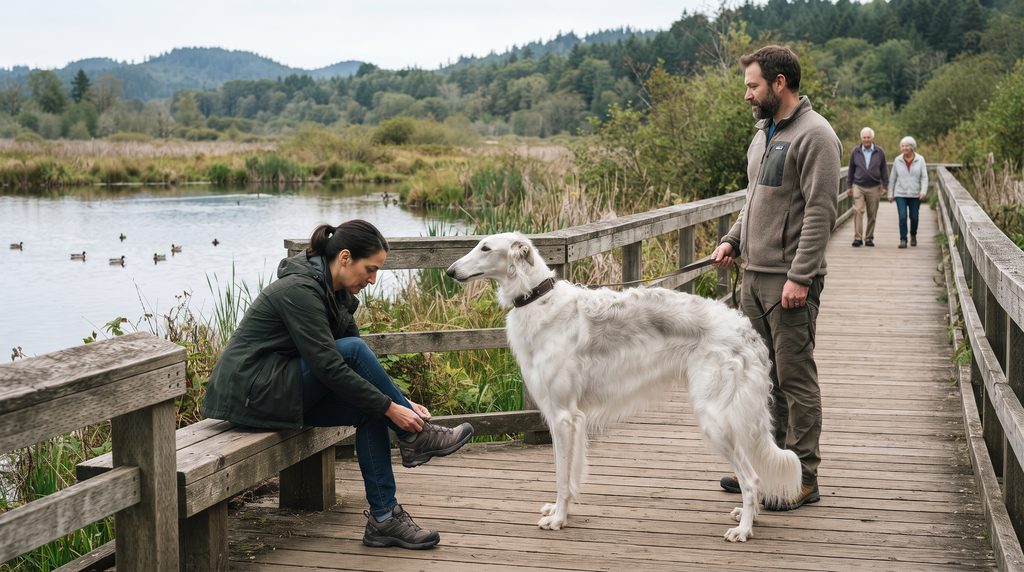
Explore More Hound Dog Breeds
Interested in discovering other dogs with remarkable hunting histories and distinctive personalities? From elegant sighthounds to determined scent trackers, the Hound Group includes breeds with widely varying temperaments, exercise requirements, and family suitability.
Visit our Hound Dogs breed guide to explore more fascinating hounds and compare their characteristics before choosing your ideal companion.
Learn More About the Borzoi
For additional information about the Borzoi’s official breed standard, recognized characteristics, history, and responsible ownership, the American Kennel Club provides authoritative guidance and resources for prospective owners and enthusiasts.
Visit the American Kennel Club’s official Borzoi breed profile to learn more about this elegant Russian sighthound and its place within the Hound Group.